Representative image. Chiring chandan, CC BY-SA 4.0, Wikimedia Commons

Why it matters
Cheques are still used for rent, EMIs and large payments, and a notice like this pushes people to rush to branches, replace post-dated cheques or destroy unused leaves for no reason. On the RBI's statement, none of that is needed. Fake notices that use the RBI's logo are also a common way to make a rumour look official.
A viral notice about an RBI cheque book rule starting on 1 January 2027, which says old cheques stop working for larger payments, is fake, the Reserve Bank of India (RBI) said on Saturday, 7 November 2026. In a post on X at about 6.50 pm IST, the central bank shared the same image with a red stamp reading “fake” across it. “RBI is not introducing any such measures with regard to the CTS cheque books,” it said, as quoted by the news agency Indo-Asian News Service (IANS).
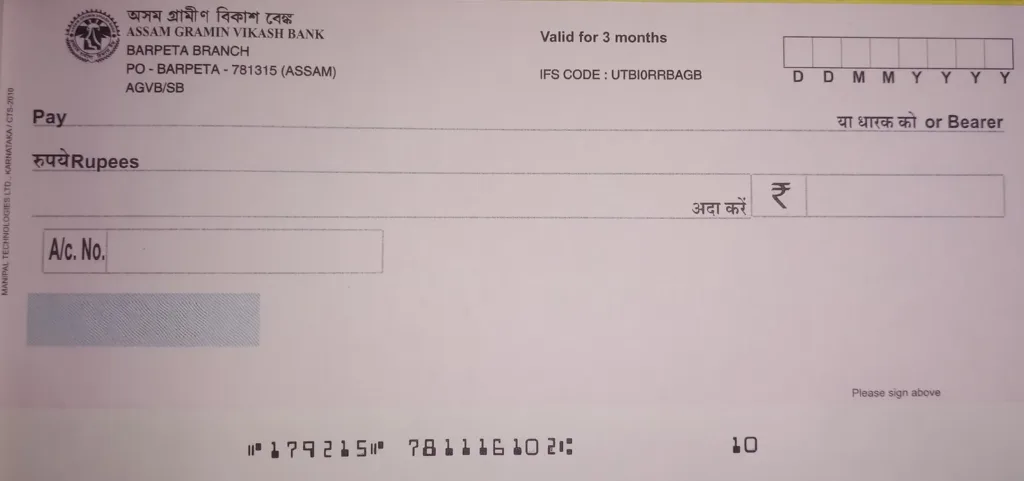
CTS is the Cheque Truncation System, the clearing system in which banks pass a scanned image of a cheque instead of the paper itself. The RBI’s post describes the cheque books now in use as standard CTS cheque books.
What the fake RBI cheque book rule notice claimed
The image is styled as an “Important Notice” and headed as a new cheque book rule from the RBI, from 1 January 2027. NewsPlainly read the copy RBI attached to its post. It told readers to “act before 31 Dec 2026” and said old cheques above ₹50,000 would not be accepted after that date.
It listed four supposed changes to every new cheque leaf: an alphanumeric number mixing letters and digits for the bank, branch and zone; a new MICR line (the machine-readable code printed along the bottom of a cheque) in letters and numbers; a hidden code visible only under ultraviolet (UV) light; and each leaf “directly linked” to an RBI system.
The notice then told people to surrender old cheque books at their branch or order new ones through a banking app or SMS, and claimed that one public sector bank had already started issuing the new books. It ended with a checklist: count your remaining leaves, apply for a new book “this week”, warn tenants, destroy old unused cheques and replace post-dated cheques given for rent or loan EMIs.
It also mixed in general cheque-writing tips, such as using only a ballpoint pen and avoiding overwriting, and a line on cheque bounce cases under Section 138 of the Negotiable Instruments Act. The RBI’s post marked the whole notice as fake; it did not comment on each line separately.
What the RBI said about the CTS cheque book claim
The central bank said it had come to its notice that a message was circulating on social media claiming that standard CTS cheque books now in use would change from 31 December 2026, and that new cheque books with updated security features would follow. It called the message factually incorrect and misleading, IANS reported.
In other words, there is no new cheque book rule for 1 January 2027 from the RBI. The RBI also asked people to rely only on information it publishes itself. Its post, with the stamped image, is on the RBI’s official X account.
It has come to the notice of the Reserve Bank of India that a message is circulating on social media claiming that the standard Cheque Truncation System (CTS) cheque books currently in use will change from December 31, 2026 and the new cheque books featuring updated security… pic.twitter.com/jT1hHAM9QA
— ReserveBankOfIndia (@RBI) November 7, 2026
The same claims had been going round for weeks before the denial. A Hindi news website published an article on 24 August 2026 presenting the alphanumeric code, UV ink and a ₹50,000 limit for old cheques after 31 December 2026 as a coming change.
Claim against the record, line by line
The table below sets the notice’s main lines against what the RBI said on 7 November and what an existing RBI cheque rule actually says.
| What the viral notice said | What the record shows |
|---|---|
| New RBI cheque book rule from 1 January 2027 | RBI: it is not introducing any such measures for CTS cheque books (7 November 2026) |
| Current cheque books change after 31 December 2026 | RBI called this factually incorrect and misleading |
| Old cheques above ₹50,000 not accepted from 1 January 2027 | Part of the notice RBI stamped fake. The real ₹50,000 rule is Positive Pay (below), which does not cancel any cheque book |
| Alphanumeric numbers, new MICR line, UV code on new leaves | Part of the same notice; RBI said no such measures are coming |
| Surrender old books and apply for new ones this week | Not needed on the RBI’s statement; it asked people to rely on its own announcements |
The ₹50,000 cheque rule that does exist
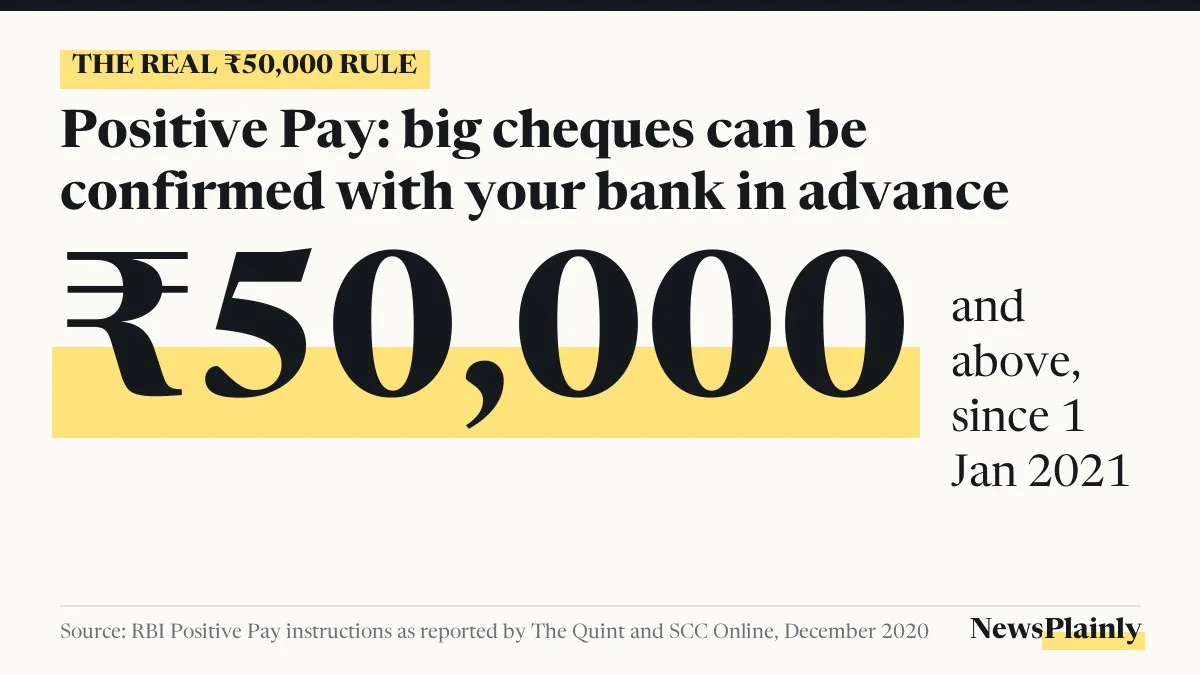
The ₹50,000 figure does appear in a real RBI rule, but that rule is about something else. Since 1 January 2021, banks have had to offer Positive Pay, a check for cheques of ₹50,000 and above.
Under Positive Pay, the person writing a large cheque sends its key details, such as the date, the payee’s name and the amount, to their bank through SMS, the mobile app, internet banking or an ATM. When the cheque is presented, the clearing system matches it against those details and flags any mismatch. The RBI’s instructions, as reported at the time, left it to account holders whether to use it, and said banks may consider making it compulsory for cheques of ₹5 lakh and above.
Positive Pay changes how a large cheque is confirmed. It does not make any CTS cheque book invalid, and it has nothing to do with a 1 January 2027 deadline. Anyone who already uses Positive Pay with their bank carries on as before.
How to check an RBI notice yourself
This notice used the RBI’s name and logo to look official. These checks can help with the next one:
- Look for the announcement in the Press Releases section of rbi.org.in, or under Notifications on the same site, where circulars to banks are posted with a date and reference number.
- Check the RBI’s own X account, @RBI, which is where it posted this denial.
- Ask your own bank through its official app, website or branch. Your bank issues your cheque book and can tell you whether anything about it has changed.
- Be wary of an image with no date, no circular number and an instruction to act “this week” or share it with everyone. This notice had all three.
For other banking dates that do come from the RBI, see NewsPlainly’s list of bank holidays in November 2026.
Frequently asked questions
Is there a new RBI cheque book rule from 1 January 2027?
No. On 7 November 2026 the RBI said it is not introducing any such measures for CTS cheque books and called the viral message factually incorrect and misleading.
Will my old cheque book stop working after 31 December 2026?
The RBI says the claim that current CTS cheque books will change from 31 December 2026 is false. It has announced no such change.
Are cheques above ₹50,000 being stopped?
No. The ₹50,000 figure belongs to Positive Pay, in force since 1 January 2021, under which you can confirm a large cheque's details with your bank in advance. It does not cancel cheque books.
Where can I check if an RBI notice is real?
Look in the Press Releases and Notifications sections of rbi.org.in, check the RBI's X account @RBI, or ask your bank through its official app or branch.