Representative image. יהב טרודלר (Yahav Trudler - Yahav Studio), CC BY-SA 3.0, Wikimedia Commons

Why it matters
Israel's next government will set its policy on Gaza and the wider region, and which parties it depends on will shape those choices. If every attempt fails, Israel's Basic Law leads to the Knesset being dissolved and another election, after five between 2019 and 2022.
Gadi Eisenkot, the former Israeli army chief who leads the Yashar party, is to be formally asked on Sunday, 8 November 2026, to form Israel’s next government. President Isaac Herzog’s office said on Saturday evening that it had told Eisenkot of the president’s “intention to task him with forming a government”, with the formal step set for a ceremony at the President’s Residence in Jerusalem. Once tasked, Gadi Eisenkot has 28 days to show he can command a majority in the 120-seat Knesset, Israel’s parliament.
The choice passes over Prime Minister Benjamin Netanyahu, whose camp still holds more seats than Eisenkot’s after the election of 27 October. Neither side has the 61 seats needed to govern alone.
Why Herzog picked Gadi Eisenkot over Netanyahu
In the 27 October vote, Netanyahu’s religious-nationalist camp won 53 seats and the broad opposition bloc led by Eisenkot won 48, according to an agency report carried by The Guardian and Germany’s public broadcaster DW. Netanyahu’s coalition lost its majority even though it remains the largest bloc.
What decided the mandate was the round of consultations, in which party leaders tell the president whom they back. Eisenkot received 67 endorsements against 46 for Netanyahu, Ynetnews reported. Both Arab-majority lists recommended Eisenkot during the week, the agency report said, while Netanyahu had ruled out working with Arab parties to reach a majority.
Gadi Eisenkot, 66, was chief of staff of the Israeli military from 2015 to 2019. His first reaction came on X: “Now is the time to form a national emergency government. I will do everything to ensure we are worthy.”
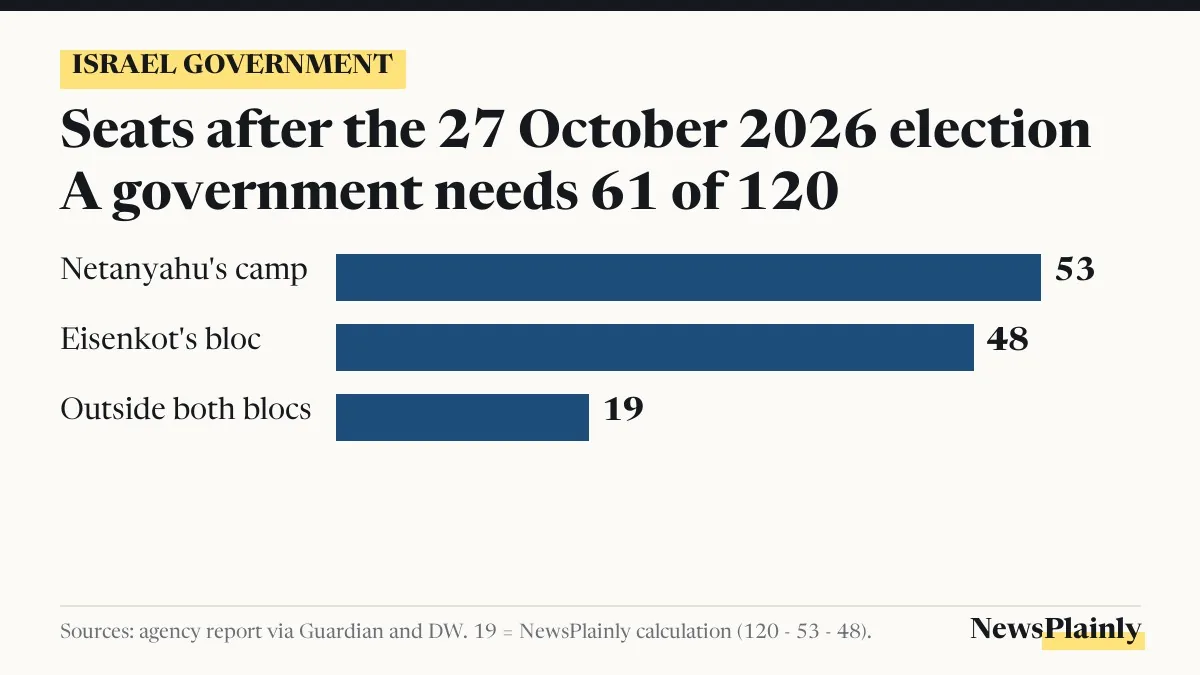
The Israel government math: 48 seats and the 13 that decide it
Endorsing a candidate is not the same as joining his government, and the numbers show why the talks will be hard. A 48-seat bloc is 13 short of a majority. Shas and United Torah Judaism (UTJ), the two Haredi, or ultra-Orthodox, parties, hold exactly 13 seats between them, Ynetnews reported, with Shas holding six. By NewsPlainly’s arithmetic that leaves UTJ with seven, and 48 plus 13 makes 61.
| Group | Seats | Position, as reported |
|---|---|---|
| Eisenkot’s opposition bloc | 48 | Wants a “national emergency government” |
| Netanyahu’s camp | 53 | Includes Shas, which endorsed Netanyahu |
| Shas and UTJ together | 13 (Shas 6, UTJ 7) | UTJ endorsed no candidate |
| Seats outside both blocs | 19 | NewsPlainly calculation: 120 minus 48 minus 53 |
| Majority needed | 61 | Half of 120, plus one |
That arithmetic is the plan of Avigdor Liberman, who leads Yisrael Beytenu and sits in the anti-Netanyahu bloc. According to Ynetnews, Liberman has said the only options are a 61-seat government with the Haredi parties or another election. He has rejected a minority government that depends on Arab parties, even if their support comes from outside the coalition, and has signalled flexibility on the law on military service for Haredi men, once a red line for him.
The obstacle is Shas. It endorsed Netanyahu, and its leader Aryeh Deri has said the party is not expected to leave the right-wing bloc at this stage, Ynetnews reported. UTJ endorsed no one and has been talking to both sides.
What Netanyahu, Liberman and Golan said
Netanyahu responded by renewing his call for a national unity government, his first such call since the election, Ynetnews reported. “There is only one choice, not national suicide, but national unity,” he said, calling for a government of “all the parties of the national camp and all the Zionist parties that want to protect our country”. Ynetnews described his message as a bid to use the divisions in the opposing bloc and to present Eisenkot’s possible reliance on Arab parties as a security threat.
Eisenkot, for his part, warned that anyone who blocks a government for personal rather than real reasons “will be remembered by history as someone who failed to rise to the occasion”. Ynetnews read the remark as aimed indirectly at Liberman.
Yair Golan, who chairs the Democrats party, said with his colleagues that they want a partnership with the Haredi community, but not at any price. “We are not looking to punish the Haredim,” their statement said, while setting conditions such as military service for Haredi men and more of them in the workforce.

Eisenkot mandate deadlines: what Israel’s Basic Law sets
The timetable comes from Basic Law: The Government, one of the laws that serve as Israel’s constitution. NewsPlainly read articles 8 to 11 of the Knesset’s English text. The calendar dates below are NewsPlainly’s calculation, counted from the formal tasking announced for 8 November.
| Step | Time allowed | Date if each step runs full |
|---|---|---|
| Eisenkot tries to form a government (art. 8) | 28 days | 6 December 2026 |
| Extensions by the president (art. 8) | 14 days in all, at most | 20 December 2026 |
| President reassigns the task or tells the Speaker no government is possible (art. 9) | 3 days | Depends on when the first attempt ends |
| A second Knesset member tries (art. 9) | 28 days, no extension | Depends on the step before |
| A majority of Knesset members can ask for a named member (art. 10) | 21 days to ask, then 14 days to form | Depends on the step before |
If every route fails, article 11 leads to the Knesset being dissolved and a new election. Israel held five elections between 2019 and 2022 because of similar deadlocks, the agency report noted. Until a new government wins a confidence vote, the outgoing one stays on in a caretaker role, The Jerusalem Post said.
What to watch in the coming weeks
Eisenkot has two difficult paths, Ynetnews wrote: a minority government with outside support, which Liberman opposes, or a 61-seat coalition with the Haredi parties, which would need concessions on military service. Netanyahu, meanwhile, is trying to draw the same parties back to his side.
The first deadline in the Gadi Eisenkot mandate for world news readers to mark is 6 December 2026, when Eisenkot’s 28 days run out unless Herzog extends them. Whether Shas or UTJ will join either side was not settled in the reports read for this article.
Frequently asked questions
How long does Gadi Eisenkot have to form a government?
28 days from the formal tasking, under article 8 of Basic Law: The Government. The president can add extensions of up to 14 days in all. Counted from 8 November, that is 6 December, or 20 December with the full extension.
Why did Herzog not choose Netanyahu?
Eisenkot received 67 endorsements in the consultations against 46 for Netanyahu, Ynetnews reported, although Netanyahu's camp won more seats (53 to 48).
What happens if Eisenkot fails?
The president has 3 days to give the task to another Knesset member or tell the Speaker no government is possible. If later steps also fail, the Knesset is dissolved and a new election is held.