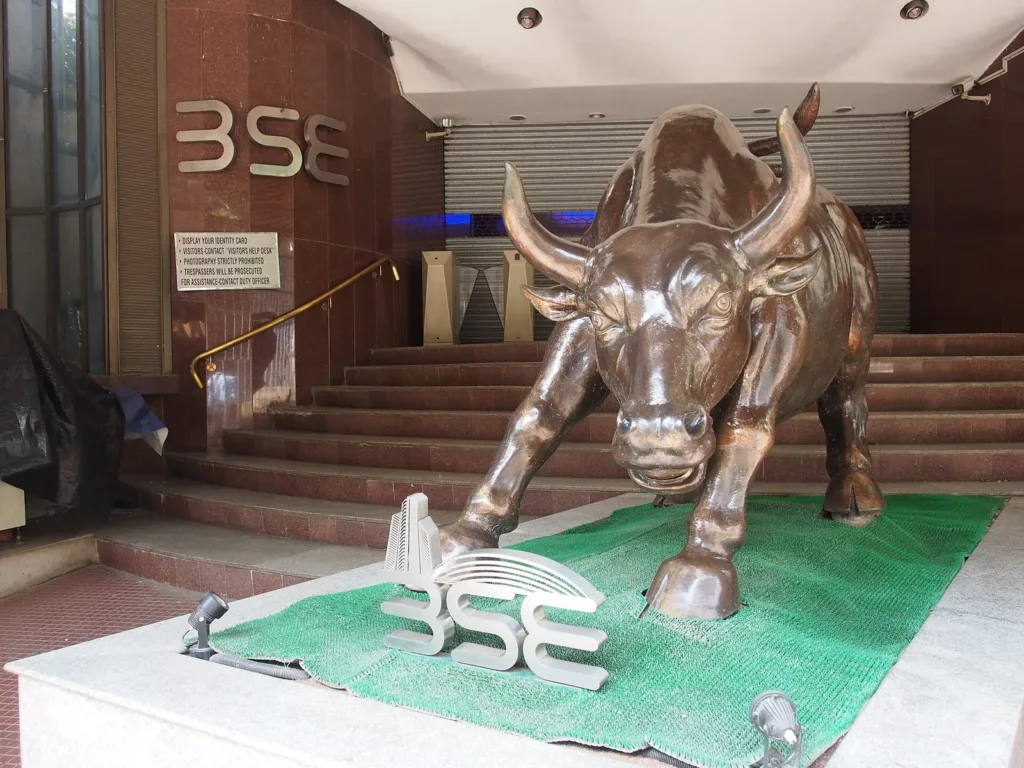
BSE bull statue, file photo uploaded to Commons on 29 October 2018; capture date unverified. Representative image. Pradeep717, CC BY-SA 4.0, Wikimedia Commons

Why it matters
Readers following opening headlines need the final figures to understand the result. Daily change uses the previous close, while an opening-to-close comparison measures a different movement.
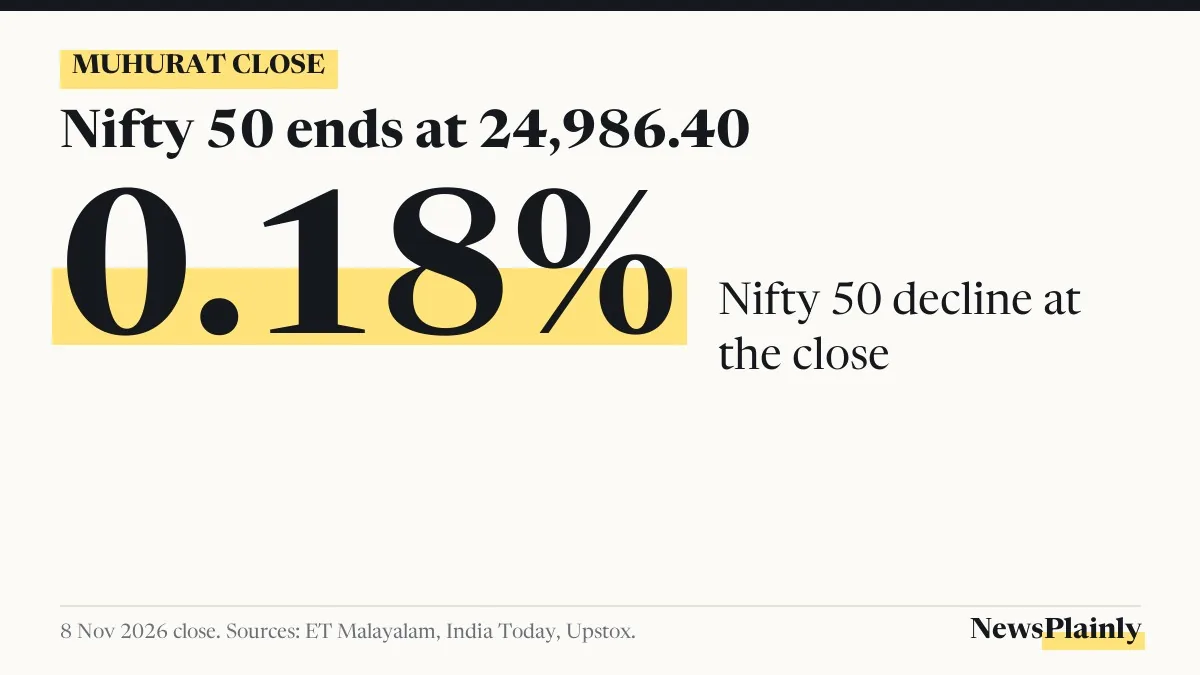
The Muhurat close on 8 November 2026 left India’s two main share indices slightly lower, reversing their positive start to the special Diwali session. The Nifty 50 finished at 24,986.40, down 43.95 points or 0.18%, while the Sensex ended at 80,999.40, down 28.62 points or 0.04%, according to the Economic Times’ Malayalam report and India Today’s closing update.
The final Nifty level was below 25,000, a mark it had crossed at the opening. Upstox’s closing coverage also reported a 0.18% decline in the Nifty and a 0.04% fall in the Sensex. This was the first special trading session of Samvat 2083, the new year marked by the market’s Diwali trading tradition.
How the Muhurat close compared with the opening
The session began with gains in both benchmarks. At the 2:20 pm opening, the Nifty 50 stood at 25,070.45 against its previous close of 25,030.35. The Sensex opened at 81,299.34 against 81,028.02 previously, Upstox reported in its account of early trading.
The distinction between those starting levels and the eventual result matters. An opening rise describes the first price level of a session. The daily change in a closing report instead compares the final level with the previous session’s close. Here, both indices began above that earlier close and finished below it.
| Benchmark | Previous close | 8 November open | Final close |
|---|---|---|---|
| Nifty 50 | 25,030.35 | 25,070.45 | 24,986.40 |
| Sensex | 81,028.02 | 81,299.34 | 80,999.40 |
By NewsPlainly’s calculation, the Nifty fell 84.05 points between the opening and the close: 25,070.45 minus 24,986.40. The equivalent Sensex movement was 299.94 points, from 81,299.34 to 80,999.40. Those figures measure the session’s reversal and are different from the smaller daily losses of 43.95 and 28.62 points.
The 25,000 mark and the closing auction
The Nifty’s final level was 13.60 points short of 25,000, calculated by subtracting 24,986.40 from that round number. Its reported daily percentage decline, 0.18%, also shows why a move across a widely watched level need not be a large percentage fall.
India Today’s update at 3:58 pm specifically gave the final figures after the closing auction, the stage used to establish closing prices for eligible securities. Earlier live updates described trading while the session was still under way. Their positive readings should not be substituted for the final results.
The special schedule put the closing auction between 3:20 pm and 3:35 pm and the post-close session between 3:50 pm and 4 pm, according to India Today’s session guide. These separate stages explain why readers could encounter several market readings during the afternoon, even after normal trading was drawing to an end.
Which shares featured on the gainers and losers lists
A small fall in the headline indices did not mean every share fell. Upstox’s session coverage listed Sun Pharma, Tata Steel, Oil and Natural Gas Corporation, Tata Motors Passenger Vehicles, Adani Ports, Power Grid, Maruti Suzuki, Bharat Electronics and UltraTech Cement among the gainers.
Its list of Nifty laggards included SBI Life, IndiGo, Bharti Airtel, Infosys, Trent, HDFC Life, Reliance Industries, Asian Paints and Grasim. These lists describe the coverage of the session; the percentage changes quoted in earlier live entries belong to their individual timestamps. They are not being presented here as each stock’s final return.
That distinction also applies to sector readings. India Today’s 2:43 pm update showed media and pharmaceutical indices rising while information technology and realty indices were lower. It was an intraday snapshot, rather than a complete closing sector table.

Samvat 2083 begins with a different result from the first quotes
Muhurat trading is the special Diwali session associated with the start of a new Hindu financial year. Investors traditionally make symbolic purchases during the period, Upstox explained. The National Stock Exchange and BSE, formerly the Bombay Stock Exchange, held this shortened session even though 8 November fell on a Sunday.
The result is a dated account of that session, rather than a forecast for the rest of Samvat 2083. The final figures and the opening-to-close comparison answer separate questions: where the market ended relative to the previous close, and how far it moved after opening. NewsPlainly’s earlier Muhurat timetable report set out the scheduled trading windows.
The National Stock Exchange’s official trading-holiday data lists 10 November for Diwali-Balipratipada and 24 November for Guru Nanak Dev’s birth anniversary in its capital-market segment. These are the next two listed holidays after the special Diwali session.
Frequently asked questions
Where did Nifty close in Muhurat trading 2026?
Nifty 50 finished at 24,986.40, down 43.95 points or 0.18%, according to the closing reports.
Did Sensex rise or fall in the Diwali session?
It opened higher but closed at 80,999.40, down 28.62 points or 0.04% from the previous close.
Why is the open-to-close fall different from the daily change?
Daily change compares the final level with the previous session's close. Open-to-close movement compares the start and end of the same session.