Representative image. PhotoPicker13, CC BY-SA 4.0, Wikimedia Commons

Why it matters
Free channel apps are now built into many smart TVs. If the ministry accepts TRAI's plan, unlicensed apps could be disabled on TVs, channels without permission would be removed, and viewers would get a grievance officer in India to complain to. Nothing changes until the ministry notifies rules.
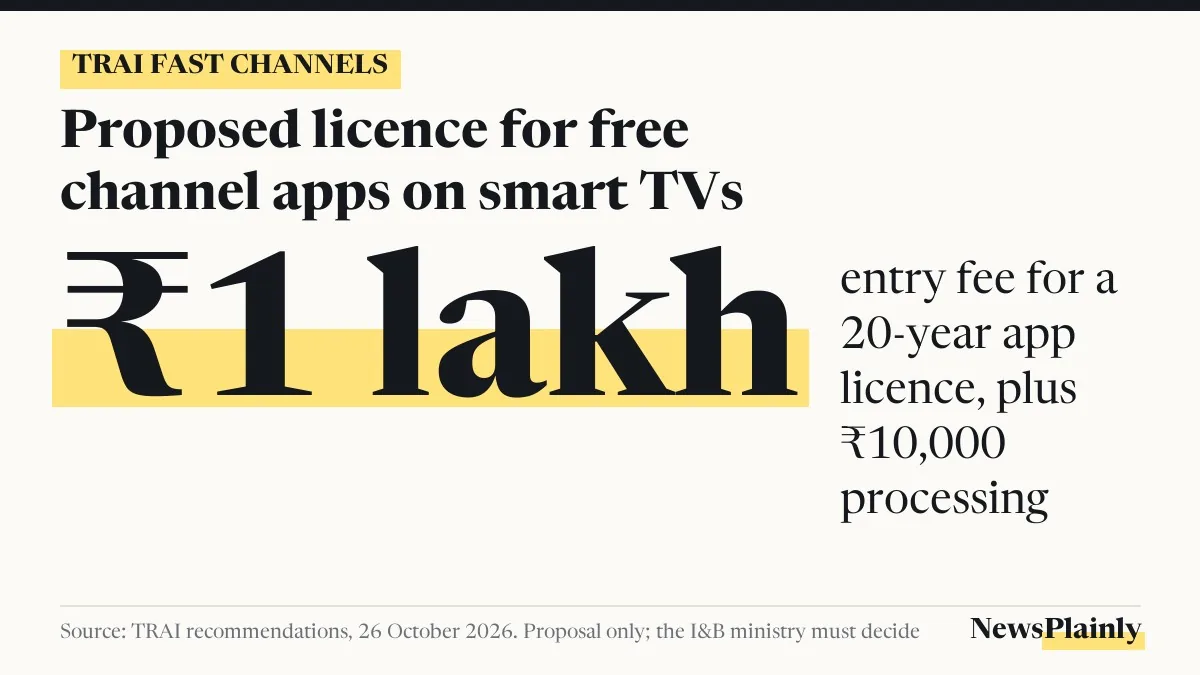
Free channel apps on smart TVs should need a government licence, with a ₹1 lakh entry fee, the Telecom Regulatory Authority of India (TRAI) has recommended. The TRAI FAST channels plan, sent to the Ministry of Information and Broadcasting on 26 October 2026, would bring FAST services (free ad-supported streaming television, apps that play live-style channels with ad breaks) under a formal authorisation, as a new sub-category of “television channel distribution services” under the Telecommunications Act, 2023. Cable and DTH (direct-to-home) operators already work under government permissions.
Nothing changes yet. These are recommendations, and the ministry has to decide whether to accept them and then notify rules under the Telecommunications Act, 2023.
What TRAI proposes for FAST channels and smart TV apps
TRAI wants a new category of licence called “Application-based Linear Television Distribution” (ALTD). Linear here means channels that play on a schedule, like ordinary TV, as opposed to on-demand shows a viewer picks. Any app, website or similar interface that gathers such channels and streams them over the internet in India would need this authorisation, according to the summary of the TRAI recommendations.
Many smart TVs ship with such smart TV apps already installed. The Hindustan Times named the Samsung TV Plus and LG Channels apps as examples of FAST services; TRAI’s report itself names no company.
The main proposals are:
- A national authorisation for app providers, valid for 20 years and renewable for 10 years at a time.
- Only approved channels. Apps could carry channels that already have central government permission, or new internet-only channels registered with the ministry. Any channel without approval would have to be removed at once.
- A government list of approved apps. The ministry would keep a “master” repository of authorised apps. TV makers and operating system providers would enable only listed apps, and would have to remove or disable any unauthorised one.
- A grievance officer in India for each app, with contact details shown prominently.
- Ratings. Viewing on these apps would be measured and counted in TV audience ratings.
Two kinds of service are left out: a broadcaster’s own app that shows only its own or group channels, and live streams on social media platforms.
What the TRAI FAST channels licence would cost
NewsPlainly added up the fees in the TRAI FAST channels plan for the two groups that would pay them.
| Who | Fees proposed | Validity | NewsPlainly total |
|---|---|---|---|
| App provider (ALTD authorisation) | ₹10,000 processing, ₹1 lakh entry (non-refundable), ₹10,000 per renewal | 20 years, renewals of 10 years | ₹1.1 lakh at the start |
| Internet-only channel (registration) | ₹10,000 processing, ₹1 lakh a year per channel, ₹10,000 per renewal | 10 years, renewals of 10 years | ₹10.1 lakh over the first 10 years |
For a channel made only for these apps, the yearly fee is what adds up. Over a ten-year registration it comes to ₹10 lakh in annual fees, plus the processing charge.
Why internet-only news channels would be kept out
The new route for internet-only channels would be open to non-news channels only. TRAI says news and current affairs have a direct bearing on public discourse and can affect public order, national security and social harmony, so they need closer oversight. Existing news channels that already hold ministry permission could still be carried on the apps.
Registered channels would have to follow the Programme Code and the Advertising Code, the content rules that already apply to cable TV. NewsPlainly has reported earlier on how those TV rules are applied to news channels. An applicant would also need a distribution agreement with an Indian company to register.
How the FAST services review came about
The push came from cable operators. The ministry’s request to TRAI, dated 15 December 2025, says it received representations from industry groups including the All India Digital Cable Federation about FAST platforms working through preloaded apps on connected TVs “without any licensing or registration framework”.
- 24 April and 16 June 2025: an association of cable multi-system operators writes to the ministry.
- 15 December 2025: the ministry asks TRAI for recommendations on regulating FAST services.
- 6 April 2026: TRAI issues a consultation paper; it receives 207 comments and 11 counter-comments.
- 10 June 2026: TRAI holds an online open house discussion.
- 26 October 2026: recommendations sent to the ministry and published.
The market is not small. TRAI’s report cites industry estimates of more than 193 million TV households in India and over a billion internet subscribers, a connected-TV audience of more than 129 million users in 2025, and FAST users growing from about 116 million in 2023 to nearly 149 million by 2027.
What it could mean for smart TV viewers
The recommendations do not ban free TV channels or add a subscription. For viewers, the visible changes would come only if the ministry adopts the rules. Smart TV apps that are not on the approved list could be disabled on the TV. Channels without permission would be taken off the apps. And viewers would have a named grievance officer in India to complain to.
Several questions are parked for later. TRAI says rules on pricing, interconnection between channels and apps, and quality of service will be framed only after the government finalises the licence framework. How viewing on these apps will be measured for ratings is also left to rating agencies to work out at that stage.
Frequently asked questions
What are FAST channels?
FAST stands for free ad-supported streaming television: apps, often preinstalled on smart TVs, that stream live-style channels for free with ad breaks.
Will FAST channels need a licence in India?
TRAI has recommended it on 26 October 2026. App providers would need a 20-year national authorisation with a ₹1 lakh entry fee. The I&B ministry has to accept this and notify rules first.
Will free channels on smart TVs stop?
The recommendations do not ban free viewing. If adopted, apps not on the ministry's approved list could be disabled, and unapproved channels removed.