Representative image. Ministry of Finance of India, GODL-India, Wikimedia Commons

Why it matters
The revised electronic hardware policy ensures that central civil servants have modern computing tools while actively channelling state procurement toward domestically manufactured electronics. It also establishes clear, transparent rules for device replacement and post-service equipment retention.
In an important administrative overhaul of official technology procurement, the Ministry of Finance has introduced revised guidelines governing the purchase and retention of electronic computing devices for civil servants. Under the updated policy framework, the central government laptop ceiling has been enhanced to ₹1.8 lakh plus taxes for domestically assembled systems, while setting a standard threshold of ₹1.5 lakh for regular models. The comprehensive directive issued by the Department of Expenditure provides clearer procurement parameters for ministries and establishes generous retention clauses for eligible personnel.
Why the central government laptop limit was revised to Rs 1.8 lakh
The revised office memorandum formally supersedes previous procurement instructions issued in July 2023. Over the past three years, technological requirements for senior administrators have expanded rapidly, driven by the rollout of paperless governance systems, secure virtual private networks, high-resolution videoconferencing platforms, and data-intensive analytical tools. Standard baseline configurations that were adequate under earlier rules often proved underpowered for handling modern cryptographic protocols and encrypted administrative workflows.
According to an Economic Times report on Finance Ministry laptop guidelines, the Department of Expenditure examined market pricing trends across enterprise-grade portable computers, tablets, notebooks and convertible devices. By recalibrating financial ceilings to match contemporary hardware pricing, the central administration aims to prevent bureaucratic procurement bottlenecks while equipping decision-makers with reliable, long-lasting hardware. Under these updated provisions, each eligible central government laptop purchase receives adequate budgetary backing without requiring recurring special dispensations.
The updated rules apply across all central ministries, departments, attached offices, subordinate formations and autonomous bodies funded through the Union budget. Rather than requiring ad-hoc financial sanctions for individual hardware requests, drawing and disbursing officers can now execute purchases within pre-approved budgetary allocations as long as unit costs comply with the new ceilings. Every sanctioned central government laptop deployment must remain strictly catalogued on departmental asset registries.
Make in India incentives and device procurement ceilings
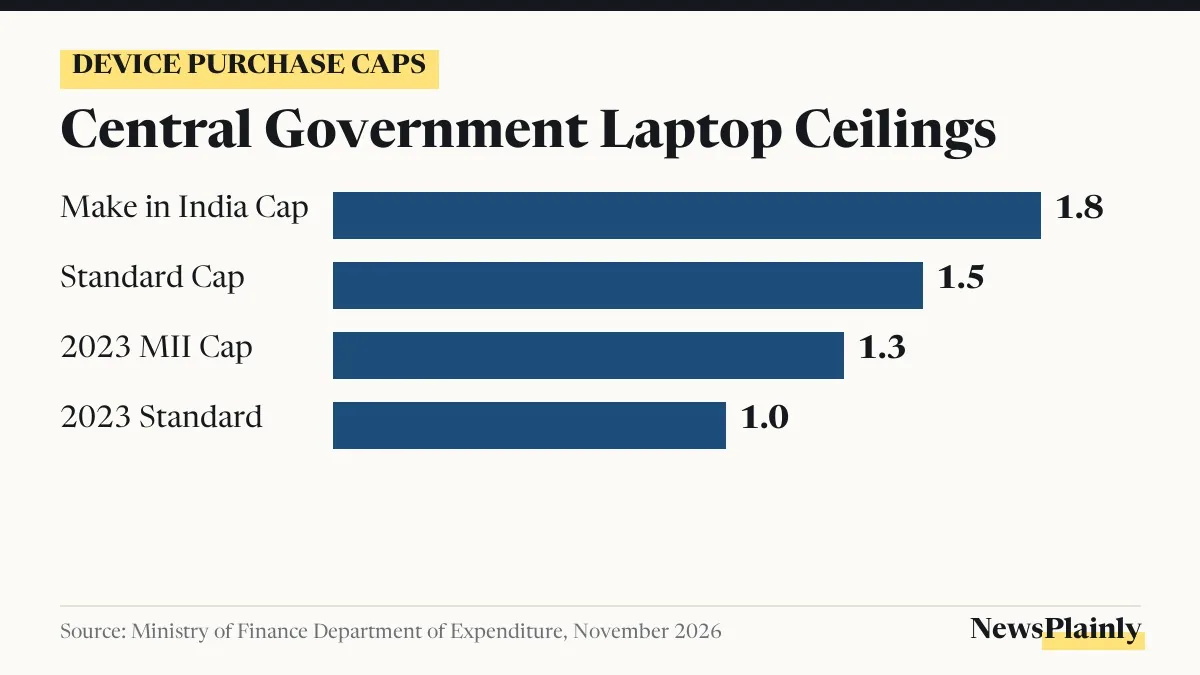
A central pillar of the revised device purchase policy is a deliberate financial incentive aimed at stimulating domestic electronics manufacturing. Under the basic threshold, central departments can spend up to ₹1.5 lakh plus applicable taxes on a portable computing device, inclusive of pre-installed operating systems and standard productivity software. However, if a department procures an electronic machine meeting Make in India (MII) certification with local value addition exceeding 40%, the allowable central government laptop price cap increases by ₹30,000 to ₹1.8 lakh plus taxes.
This tiered mechanism encourages global original equipment manufacturers to expand surface-mount assembly, printed circuit board manufacturing and domestic testing operations within India. By establishing a substantial price differential between imported and indigenously produced machines, the central government uses its extensive procurement scale to drive private capital investment into domestic electronics clusters in Tamil Nadu, Uttar Pradesh and Karnataka. Sourcing a compliant central government laptop through local supply chains directly supports these industrial manufacturing goals.
| Policy Parameter | July 2023 Guidelines | November 2026 Revised Rules | Practical Change |
|---|---|---|---|
| Standard Device Cap | ₹1.00 lakh + taxes | ₹1.50 lakh + taxes | Ceiling increased by ₹50,000 |
| Make in India Cap | ₹1.30 lakh + taxes | ₹1.80 lakh + taxes | Ceiling increased by ₹50,000 |
| Local Content Threshold | Basic MII certification | More than 40% local content | Stricter domestic value addition |
| Device Retention Term | 4 years of official service | 4 years of official service | Personal retention retained |
| Annual Depreciation Rate | 25% straight line | 25% straight line | Predictable book value formula |
Readers monitoring wider policy initiatives will recall similar domestic industry support mechanisms documented across our central government procurement and scheme approvals. The guidelines mandate that all device purchases must be executed transparently through the Government e-Marketplace (GeM) portal, ensuring competitive bidding and verified compliance with local content declarations for every acquired central government laptop.
Personal retention rules after four years of official service
One of the most consequential provisions of the revised framework concerns the long-term disposal and personal retention of issued electronic hardware. Under standard rules, portable computing devices provided to officers carry an official economic lifecycle of four years. Upon the completion of four years of active official use, the officer is entitled to retain the central government laptop, tablet or notebook for personal ownership without having to pay any salvage fee or residual book value to the government.
Before any device is formally transferred into private hands, the issuing department must execute rigorous data-sanitisation protocols. Departmental information technology units are required to remove all classified files, official communications, access credentials, proprietary software licences and government digital certificates. Once the data sanitisation certificate is issued, the equipment is officially written off the government asset register.
The memorandum also outlines fair provisions for personnel who retire, transfer or separate from service prior to completing the full four-year cycle. In such cases, an officer can choose to retain the device by reimbursing its depreciated book value. The depreciation formula applies a simple straight-line calculation of 25% per annum. For instance, an officer retaining a ₹1.6 lakh central government laptop after two years of service would pay 50% of the original cost, amounting to ₹80,000, while a machine used for three years can be retained for just 25% of its initial acquisition value.
Pay scale eligibility and department allocation quotas
To balance operational flexibility with fiscal prudence, the Ministry of Finance has tied device eligibility directly to pay levels established under the 7th Central Pay Commission (CPC). Officers serving in Pay Level 12 and above, which encompasses deputy secretaries, directors, joint secretaries, additional secretaries and special secretaries, are eligible for complete hardware coverage up to 100% of the sanctioned cadre strength.
For officers positioned between Pay Level 8 (Gazetted) and Pay Level 11, including section officers, undersecretaries and technical specialists, departments are authorized to procure devices for up to 50% of the sanctioned staff strength. However, where departmental duties involve extensive fieldwork, digital inspections, parliamentary committees or technical drafting, the administrative secretary of the ministry has been granted delegated powers to enhance the allocation quota up to 75% of sanctioned strength. This staged rollout ensures that each allocated central government laptop serves demonstrated public administration functions.
The circular emphasizes that individual officers may not receive multiple portable computing devices simultaneously. If an official requires a specialized tablet for field inspections alongside a high-performance central government laptop, administrative approval must confirm that dual deployment is strictly necessary for public duties. By coupling generous hardware limits with transparent accounting and retention norms, the central government aims to modernize administrative infrastructure while maintaining rigorous oversight over public expenditure.