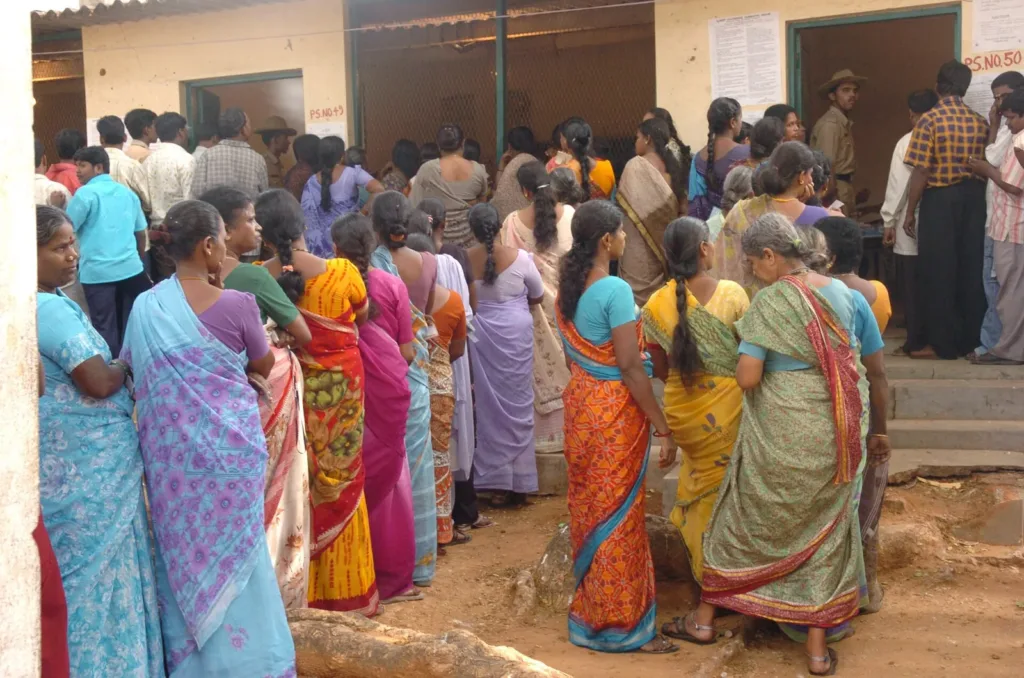
Representative image. Election Commission of India, GODL-India, Wikimedia Commons

Why it matters
Nearly one in five names on Karnataka's rolls before the SIR is not on the final list. Many of those removed were marked shifted or not found rather than ineligible, and a voter whose name is missing cannot vote until it is restored.
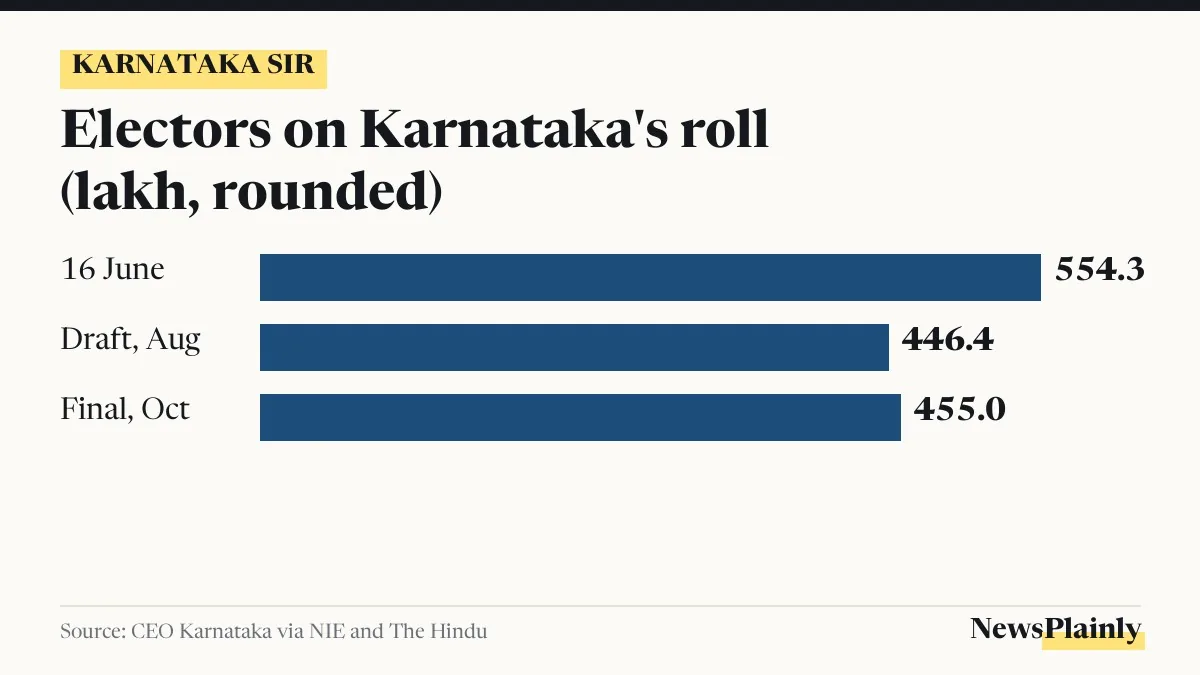
Karnataka’s final voter list after the Special Intensive Revision (SIR), the Election Commission’s house-to-house check of every name on the rolls, was published on 27 October 2026 with 4,55,00,011 electors. That is 99,32,303 fewer than the 5,54,32,314 on the rolls when the Karnataka SIR began, a fall of about 18%, The Hindu reported from the final roll on the Chief Electoral Officer’s website. The final list is only 8.64 lakh names longer than the August draft.
The constituency-wise lists are now on the website of the Chief Electoral Officer (CEO), Karnataka, the state’s top election official. CEO V Anbukkumar had said the final electoral roll would be shared with all political parties and posted online on 27 October, the New Indian Express reported on 24 October.
Karnataka SIR in numbers: start, draft and final roll
The revision began on 30 June, Hindustan Times reported. Booth level officers (BLO), the local staff who keep each polling booth’s list, went door to door and matched voters with older electoral records. The draft roll of 24 August then left out every name placed in one of five deletion categories.
| Stage | Electors | Change |
|---|---|---|
| Before the SIR (16 June 2026) | 5,54,32,314 | |
| Draft roll (24 August 2026) | 4,46,35,975 | 1,07,96,339 fewer |
| Final roll (27 October 2026) | 4,55,00,011 | 8,64,036 more than the draft |
| Final against the start | 99,32,303 fewer (17.9%) |
Put another way, the net addition equals about 8% of the 1.08 crore names removed at the draft stage. That comparison is only a rough guide: the net addition also includes first-time voters, so it is not the same as the share of deleted voters who returned, and neither the reports read nor the CEO’s 23 October press note break it down.
According to The Hindu, the final roll has over 2.29 crore women and 2.25 crore men, plus 2,841 third-gender voters. It counts more than 6.83 lakh young voters aged 18 or 19 and over 3.92 lakh voters older than 85.
Why 1.07 crore names left the draft voter list
At the draft stage, officers sorted the removed names into five groups, known as ASDDO: absent, shifted, dead, duplicate and others. The largest by far was people who had shifted or could not be found at their address. The Hindu put that group at 80.62 lakh, and Hindustan Times at 8.06 million.
- Shifted or not found: 80.62 lakh
- Dead: 16.39 lakh
- Duplicate entries: over 7 lakh
- “Others”: 3.83 lakh
The Hindu pointed out that a voter marked as shifted or not found is not necessarily ineligible. Such a voter had to fill Form 6, the application for inclusion in the roll, to get back on it. It also reported that the CEO’s office had not clearly explained what the “others” category covers, apart from saying it includes people who refused to sign.
Separately, 43,82,824 notices went to voters whose entries could not be matched with older rolls or showed what officials call logical discrepancies in their details. The CEO’s press note of 23 October says all of them were delivered and heard.
Form 6 and Form 7: what came in, and when
The deadline for claims and objections was 23 September. The CEO’s figures show how many forms arrived before it and how many came later.
| Form | Up to 23 September | Up to 22 October | After the deadline |
|---|---|---|---|
| Form 6 (add a name) | 7,87,534 | 10,42,863 | 2,55,329 |
| Form 7 (object to or delete a name) | 58,475 | 2,28,917 | 1,70,442 |
| Form 8 (correct or shift an entry) | 10,99,907 | 13,10,841 | 2,10,934 |
The 7,87,534 Form 6 applications made in time are far fewer than the 80.62 lakh voters marked shifted or not found, and that figure also includes brand new voters, The Hindu noted. Names from Form 6 filed after 23 September do not enter the final roll. The Hindu reported they will go into supplementary lists, which will be published every quarter after the SIR.
Form 7 became the sharpest point of dispute. The Congress, which governs Karnataka, accused Bharatiya Janata Party (BJP) workers of filing bulk applications to remove eligible voters, particularly in areas with large Muslim populations, Hindustan Times reported. The BJP denied this, saying its workers were using their right to flag names they believed should not be on the roll, and accused the Congress of discrediting an exercise meant to remove dead, duplicate and ineligible entries. Police complaints have been filed against people accused of submitting false Form 7s, the paper said.
The Hindu also reported that at least 61,059 Form 7 applications were filed in the names of election officials themselves, Electoral Registration Officers (EROs) and their assistants, and that none gave a reason for deletion, which the Registration of Electors Rules, 1960 require. The officials told the paper that the system “auto-generated” these forms with their digital signatures when voters could not be reached for hearings. The Election Commission has said the revision was meant to make the roll more accurate and that deletions had to follow the set procedure, Hindustan Times reported.
Name missing from the final electoral roll? What voters can do
Enrolment does not stop with the final roll. The CEO’s office says people can still apply through Form 6 (new or restored entry), Form 6A, Form 7 or Form 8, online on the ECINET app (the Election Commission’s online platform) or the voters.eci.gov.in portal, or on paper at the BLO, assistant ERO or ERO office.
- Check the list first. The constituency-wise final roll is on the CEO Karnataka website.
- Applied for inclusion before 23 September? According to The Hindu, those names were to be included in the final roll.
- Applied later, or not at all? A Form 6 filed now is processed for the quarterly supplementary lists. Officials told the New Indian Express that no form is processed without documents.
- Application rejected? Officials told the New Indian Express that electors can challenge an ERO’s decision before the district election officer and then the CEO, or go to court.
The CEO’s office has also said it will hold an enrolment drive after the SIR to add genuine voters whose names were deleted, The Hindu reported. No dates for it were given in the reports read. The CEO’s office had scheduled a press meet for 3 pm on 27 October, after this article was written.
Karnataka’s figures follow similar revisions elsewhere. In Delhi, 47.6 lakh names were cut and claims stayed low, as NewsPlainly reported earlier, while the Election Commission is defending the SIR orders before the Supreme Court in a recent affidavit.
Frequently asked questions
How many voters are on Karnataka's final electoral roll?
4,55,00,011, according to The Hindu's report on the final roll published on 27 October 2026. Before the SIR the state had 5,54,32,314 electors.
How many names were removed in the Karnataka SIR?
The draft roll of 24 August cut 1,07,96,339 names. After claims, the final roll is 99,32,303 lower than the starting figure.
My name is not on the final roll. What can I do?
File Form 6 online on voters.eci.gov.in or the ECINET app, or at the BLO or ERO office, with documents. Forms filed after 23 September go into quarterly supplementary lists.
What are the 61,059 Form 7 applications filed by officials?
The Hindu reported that 61,059 deletion forms were filed in the names of electoral registration officers without a reason. Officials said the system auto-generated them when voters could not be reached for hearings.