Representative image. Biswarup Ganguly, CC BY 3.0, Wikimedia Commons

Why it matters
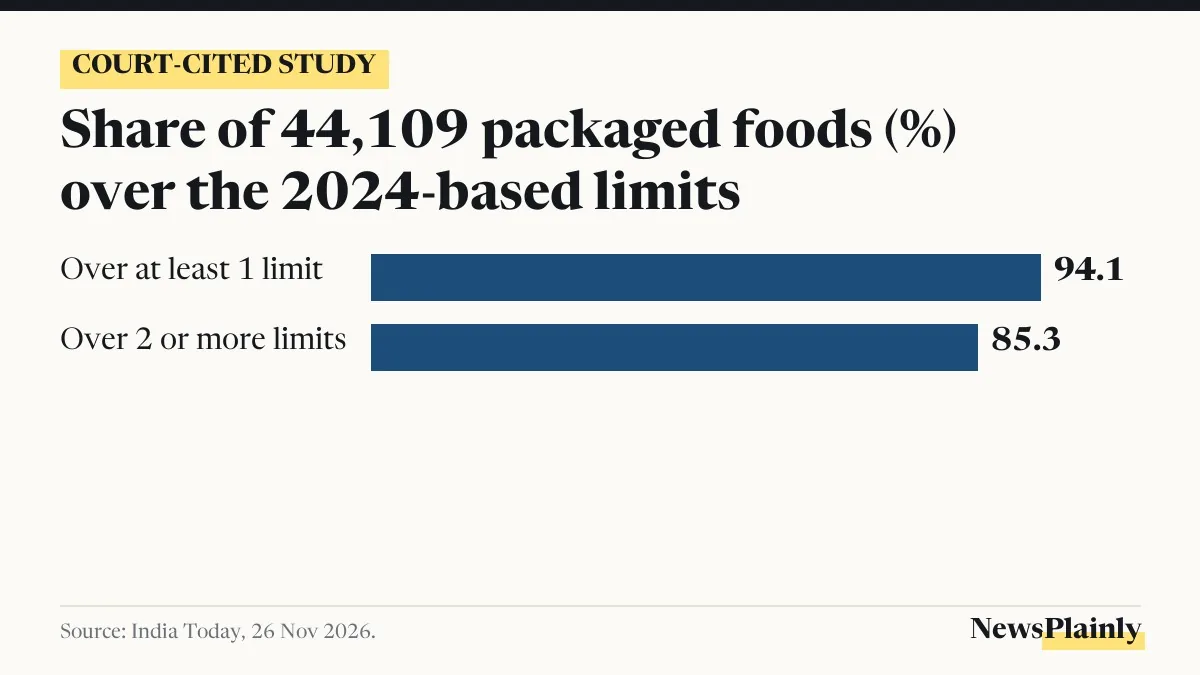
Where the limits are set decides how many packets a shopper sees with a warning. A court-cited study found 94.1% of products would cross at least one limit if the 2024-based figures were used, so too low a bar could put a warning on almost everything, and too high a bar on almost nothing. The limits are not yet written, and the earliest sum for compulsory labels is around March 2028.
Packaged foods that are high in sugar, salt or fat must carry food warning labels on the front of the pack, one for each of those nutrients, the Supreme Court ruled on 26 November 2026. A bench of Justices J B Pardiwala and K Vinod Chandran told the Food Safety and Standards Authority of India (FSSAI) to use one hexagon per nutrient, each with the words “High Sugar”, “High Salt” or “High Fat” and a standard picture, the Indian Express reported.
The court did not set the limits that trigger a warning. That job goes back to FSSAI, and it will decide how many packets in a shop actually carry a warning, and under front-of-pack labelling rules that is the main open question.
What the Supreme Court ordered on food warning labels
According to the Indian Express, the court gave FSSAI these directions on front-of-pack labelling, in order of the report:
- A separate hexagon for each nutrient of concern, so a packet can carry one, two or three hexagons, instead of one combined hexagon.
- Each hexagon to carry the words “High Fat”, “High Sugar” or “High Salt” and a standard pictorial representation.
- Hexagons sized in proportion to the front panel of the pack, at not less than 4% or 5% of it, in line with international practice.
- Thresholds to be based on total sugars and saturated fat, not the “added sugar” and “added fat” FSSAI had used.
- An exhaustive, reasoned list of foods exempt from the label. The Express said this would usually cover single-ingredient packs such as sugar, salt or oil.
- Drinks that are not high in sugar must not carry category labels identical or deceptively similar to the warning labels.
The court also asked FSSAI to act if companies respond by adding preservatives or additives that defeat the purpose of the labels, the Express reported.
How the ruling differs from FSSAI’s plan
FSSAI first proposed a star rating in 2022. It later agreed to food warning labels in court, but with one red hexagon carrying a text warning, the Indian Express said. The table sets the regulator’s court proposal against the court’s directions.
| Point | FSSAI proposal in court | Supreme Court direction |
|---|---|---|
| Hexagons | One combined hexagon | One for each nutrient |
| Sugar and fat counted | Added sugar, added fat | Total sugars, saturated fat |
| Picture | Text warning only | Standard picture plus words |
| Label size | Concerns raised that it was too small | At least 4% or 5% of the front panel |
How the limits decide who gets a label
FSSAI had built its limits on the 2024 Dietary Guidelines for Indians. India Today reported the figures: for every 100 grams of solid food, 625 mg of salt, 3 g of added sugar and 4.2 g of added fat; for every 100 ml of liquid, 175 mg of salt, 2 g of added sugar and 1.5 g of added fat. The court said these cannot be adopted as they stand because they were worked out for added sugar and added fat.
Foods flagged as high sugar, salt or fat depend on these numbers. The petitioner, 3S and Our Health Society, argued that laboratories cannot reliably separate added sugar from sugar already in a food, so enforcement would rest on what companies declare. India Today illustrated the gap with a hypothetical drink holding 10 g of sugar per 100 ml, of which only 1.5 g is declared as added. Under a 2 g added-sugar limit it would carry no warning, while a total-sugar test would count all 10 g. That is India Today’s example, not a real product.
The court was also wary of limits set too low. India Today said it cited a study of 44,109 barcode records of packaged foods: applying limits drawn from the 2024 guidelines, 94.1% of products crossed at least one limit and 85.3% crossed two or more. The court found the limits on record fall on the too-low side and warned of “label fatigue”, where nearly every packet warns and shoppers stop noticing. It also said limits set too high would let unhealthy products escape. The court did not name new limits, India Today said. FSSAI’s shelved 2022 star-rating draft had used 21 g of total sugar and 5 g of saturated fat, India Today noted.
When shoppers will see the new warning labels
Rules will take time. India Today reported that FSSAI proposed about four months to finalise the regulations, followed by a 365-day transition before compliance becomes mandatory, and that the court accepted both timelines. It will ask for a progress report after ten weeks. The Indian Express said petitioners fear companies could flood the market with unlabelled stock during the transition, and the court told FSSAI to monitor it.
By NewsPlainly’s arithmetic, four months plus one year is about 16 months, which would put mandatory labels at around March 2028 if every step runs on time. That is a sum from the reported timelines, not a date given by the court or FSSAI. Ten weeks from 26 November is 4 February 2027.
Why the ruling matters beyond the label
The judgment cites estimates that India had 101 million people with diabetes, 136 million with pre-diabetes and 315 million with hypertension in 2021, India Today said. Dr Arun Gupta, convener of Nutrition Advocacy in Public Interest, told the Indian Express the court had shown that consensus is not needed before acting on public health, and that the fight now moves to the thresholds.
Reuters, whose report Hindustan Times carried, described the order as a setback for food and drink makers such as PepsiCo, Mondelez, Coca-Cola and Nestle, which have opposed such labels. It also recalled its August report that the government had opted for a weaker regime after lobbying. Rajiv Shankar Dvivedi, lead counsel for 3S and Our Health Society, called the ruling a “landmark development”, Reuters said. None of the reports read carried a response from the companies to this judgment.
FSSAI is already pressing food businesses on safety, as in the licence suspensions reported earlier this month, so the high sugar, salt and fat limits will land on companies that are under wider scrutiny.
Frequently asked questions
What did the Supreme Court order on food packet labels?
On 26 November 2026 it ordered a separate warning hexagon for each of sugar, salt and fat on the front of packaged foods, each with the words High Sugar, High Salt or High Fat and a standard picture, the Indian Express reported.
Will every packet carry a warning?
No. A packet carries one, two or three hexagons depending on which nutrients cross FSSAI's limits, which are yet to be reset. The court wants an exemption list and warned that too-low limits cause label fatigue.
When will the warning labels appear on packs?
FSSAI proposed about four months to finalise rules and a 365-day transition, which the court accepted, India Today reported. Together that is about 16 months, or around March 2028, by NewsPlainly's sum.
Why total sugars instead of added sugar?
The petitioner argued labs cannot reliably tell added sugar from natural sugar and that fruit concentrate could dodge the label. India Today said the court found force in those concerns.