File photo of the Supreme Court of India, New Delhi. Pinakpani / Wikimedia Commons, CC BY-SA 4.0. Cropped and resized by NewsPlainly; adaptation under CC BY-SA 4.0. Representative court setting, not a photograph of the CBSE hearing.

Why it matters
Families of Class 6 students no longer have to wonder whether a third language already chosen must be dropped. Those still on two languages know the third comes next year. The Board-exam question for each class is still open in the reports read.
Students who have already taken up three languages under the Central Board of Secondary Education (CBSE) language policy can keep them, and need not go back to two, the Supreme Court said on Wednesday, 25 November 2026. The same clarification lets students who have been studying two languages carry on this year, on the condition that they take the third one next year. A bench of Chief Justice Surya Kant and Justices Joymalya Bagchi and V Mohana gave it while hearing petitions against the three-language policy, LiveLaw and Deccan Herald reported.
The Hindu says the court “orally observed” this. NewsPlainly could not find a written order, so what follows is the court’s remarks as the three outlets report them.
What the Supreme Court said on 25 November
The board had asked the court to modify its 28 September order. That order told the board to consider giving the current Class 6 batch the same transitional relaxation that Class 7 already had. CBSE argued the relief needed a second look because some students had already opted for three-language combinations, according to LiveLaw.
Justice Bagchi said, as LiveLaw quotes him, that Class 6 students who have opted for three languages “will continue for three languages” and those who have not “don’t force them”. The Chief Justice called it “a human problem” and said institutions should not read the earlier directions to push students who chose three languages back to two. The Solicitor General, Tushar Mehta, appearing for CBSE, said the board could come back to the court if difficulties remained. Senior advocate Gopal Sankaranarayanan, for the petitioners, objected to any modification without hearing them, LiveLaw reported.
Who can keep three languages, and who waits a year
The table puts together what LiveLaw, Deccan Herald and The Hindu report about the transitional relaxation. The CBSE language policy itself has not been stayed.
| Student group | What the reports say applies |
|---|---|
| Class 6, already on three languages | Can continue with three. Not to be sent back to two. |
| Class 6, on two languages | Can continue with two this year, then take the third next year, as the Chief Justice put it. |
| Classes 7, 8 and 9 | Exempt from the full three-language requirement. Can keep two foreign languages and one Indian language. It is assessed in school, not in a Board exam. |
| Class 10 Board exam | Deccan Herald says the exemption from a Board exam in the extra language continues for students now in Classes 6 to 9. The Hindu says the Class 6 batch had been slated for a compulsory third-language Board exam by 2031 before the relaxation. |
The full three-language policy, in the way LiveLaw describes it, asks that at least two of a student’s languages be native Indian languages. The court has earlier questioned how the policy treats English as “non-native” and asked for details on whether schools are ready, without staying it, LiveLaw and Deccan Herald reported.
How many Class 6 students gain from the exemption
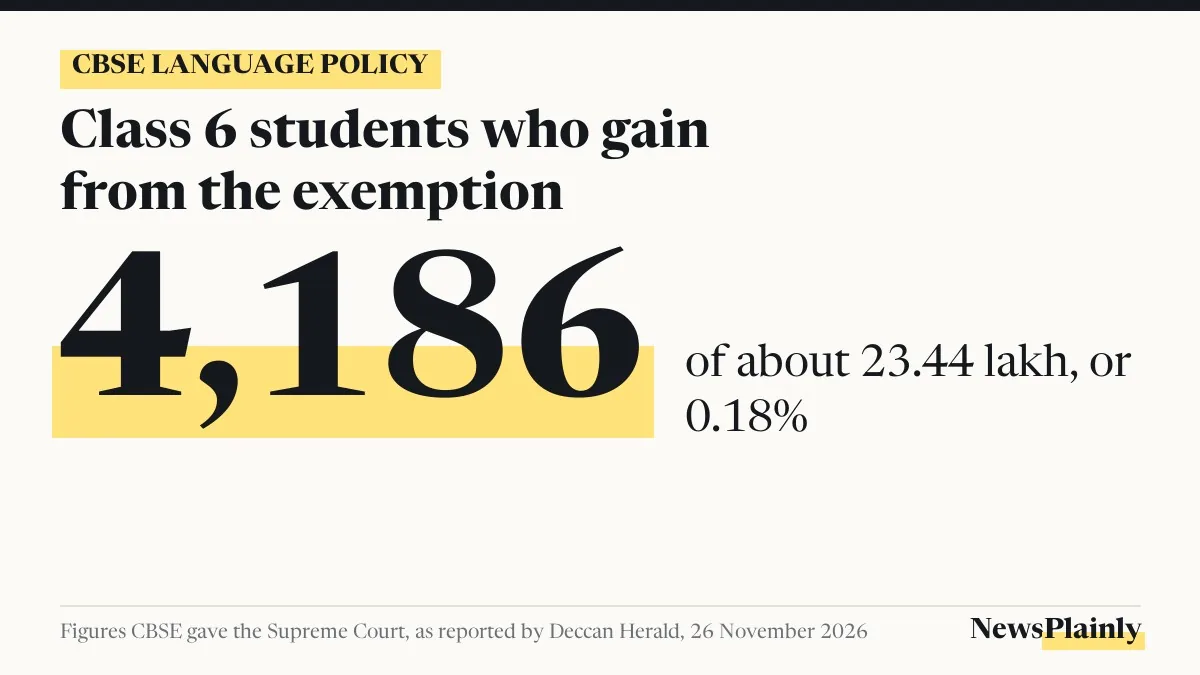
On the numbers, Deccan Herald reports what CBSE put in its application. Only 4,186 of about 23.44 lakh Class 6 students, around 0.18 per cent, would benefit from the exemption; they study in 99 affiliated schools and had opted for two foreign languages. More than 23.40 lakh Class 6 students were already studying two Indian languages, CBSE said. It added that about 45,000 students who had earlier chosen two foreign languages had moved to two Indian languages, and argued that extending the relief to the 4,186 could be unfair to them.
The board also told the court, per Deccan Herald, that third-language textbooks exist in all 22 scheduled Indian languages, and that 93 per cent of the 20,777 schools it surveyed have teachers who can teach at least two Indian languages. These are the board’s own figures as reported; NewsPlainly has not seen the application.
How the CBSE language policy works
CBSE brought in the three-language policy in line with the National Education Policy 2020 and the 2023 national curriculum framework, Deccan Herald reports. The third language is called R3. The board started it in Class 6 from the 2026-27 session and made it compulsory for Class 9 from 1 July 2026. A foreign language can be the third language only when the other two are Indian languages.
What parents and schools should check
For Class 6 students, the Chief Justice’s remarks protect choices already made, so a family that has settled on three languages for Class 6 does not need to change them. A family on two languages should expect to add a third next year. What the reports do not settle is how long the Board-exam exemption lasts for each class, because Justice Bagchi asked CBSE to look into that point and the Solicitor General raised it. The case continues, and the petitioners’ challenge to the CBSE language policy itself is still pending.
More on the board’s calendar: CBSE date sheet 2027 release: board exams from 16 February to 9 April.
Frequently asked questions
Can a Class 6 student who chose three languages keep them?
Yes. On 25 November 2026 the Supreme Court said such students can continue and need not revert to two languages, LiveLaw reported.
What if a Class 6 student studies only two languages?
They can continue with two this year, but the Chief Justice said they will take the third language next year.
Is there a Board exam in the third language?
Deccan Herald reports the exemption from a Board exam in the extra language continues for students now in Classes 6 to 9. For Classes 7 to 9 the third language is assessed in school.