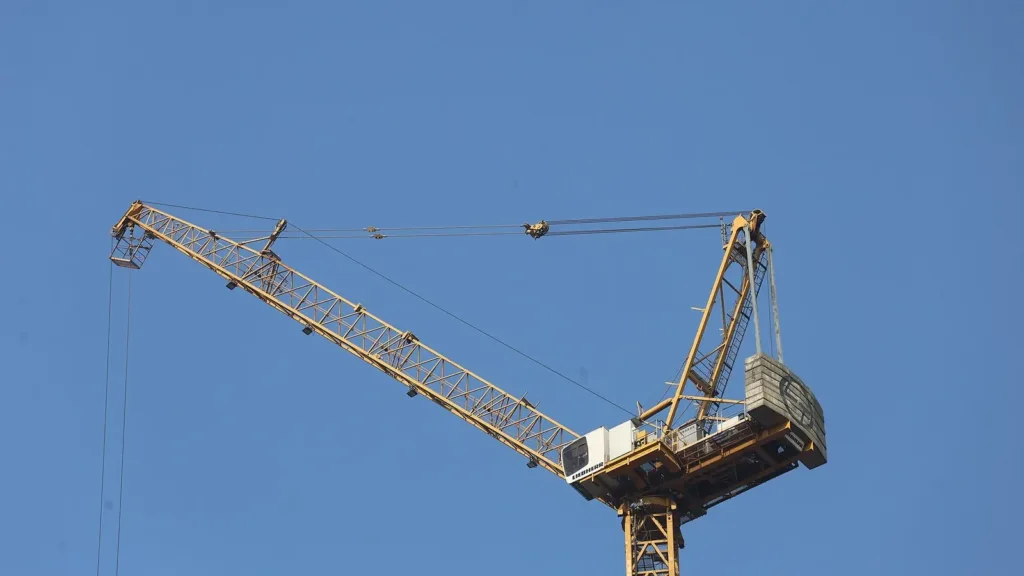
Representative file photo of a tower crane, one of the construction equipment types discussed in the scheme. Gannu03 / Wikimedia Commons, CC BY-SA 4.0. Cropped and resized by NewsPlainly; adaptation under CC BY-SA 4.0. The photograph does not identify an approved scheme beneficiary.

Why it matters
Roads, ports and housing depend on machines that India largely imports. The scheme pays makers only for extra sales, so the benefit depends on companies investing in plants, and the first incentive is two years away.
The Union Cabinet on Wednesday, 25 November 2026, approved a ₹11,000 crore construction equipment scheme under which makers of excavators, cranes, tunnel boring machines and similar machines will earn 13% to 8% of their extra sales as an incentive. Information and Broadcasting Minister Ashwini Vaishnaw announced it after the meeting chaired by Prime Minister Narendra Modi, The Hindu reported. The Ministry of Heavy Industries will run the scheme for eight years from 2026-27.
How the construction equipment scheme pays makers
The scheme has two parts, according to The Hindu and the Times of India. The main one is a sales-linked incentive for approved original equipment makers and component makers, paid on the value of their incremental sales of eligible construction equipment and parts. The rates range from 13% down to 8% over five years. The second is a grant of up to ₹375 crore to set up a dedicated testing facility for the machines, which The Hindu likens to viability gap funding.
As a simple illustration of our own, every ₹100 crore of eligible extra sales would earn ₹13 crore at the 13% rate and ₹8 crore at the 8% rate. The reports do not say which year gets which rate, or whether there is a cap per company.
| Period | What happens |
|---|---|
| 2026-27 and 2027-28 | Two-year gestation period for companies to set up manufacturing facilities |
| 2028-29 to 2032-33 | Five years in which incentives are paid |
| 2033-34 | Final year, to settle incentives on sales made in 2032-33 |
Source: The Hindu, from the official statement. No incentive is paid during the first two years.
Why the government wants India-made construction equipment
India’s construction and infrastructure equipment industry is the world’s third largest, after China and the US, the Times of India reported. The Hindu quotes the minister putting its market at ₹97,000 crore in 2024-25, while the Times of India gives about ₹97,500 crore. About 45% of the market depends on imports, Vaishnaw said, according to The Hindu. The official statement projects the market to more than double to about ₹2,28,100 crore by 2029-30, driven by roads, ports and housing.
The scheme covers seven kinds of infrastructure equipment that are fully or largely imported, The Hindu reported: tunnel boring machines, off-highway trucks, excavators, cranes, loaders, piling rigs and drilling machines. The Hindu also noted that last month China announced export controls on key machinery, including tunnel boring machines, which could hurt India’s infrastructure plans. The reports read do not say the scheme was designed as a reply to those controls.
The Press Information Bureau release could not be opened for this article, so the details above rely on the three outlets named.
Other approvals at the same Cabinet meeting
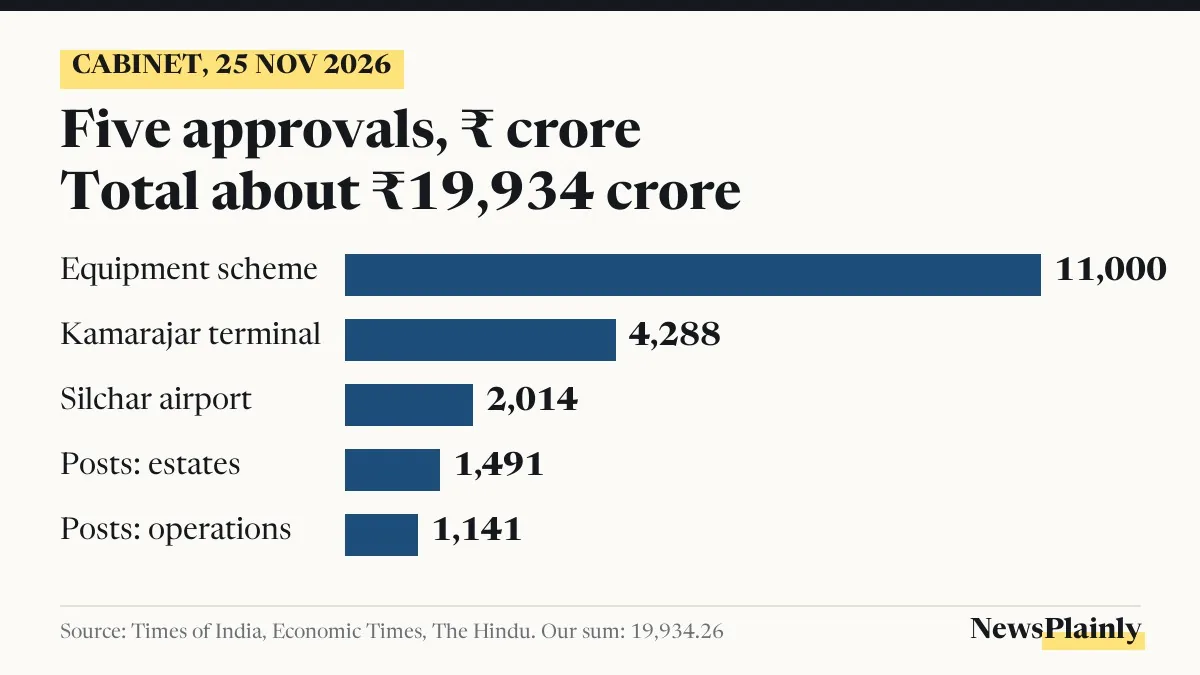
The equipment scheme was one of five approvals announced together, with a combined outlay of about ₹19,934 crore, the Times of India reported. Adding the figures in the reports gives ₹19,934.26 crore.
| Approval | Outlay |
|---|---|
| Construction and infrastructure equipment scheme | ₹11,000 crore |
| Second container terminal, Kamarajar Port, Tamil Nadu | ₹4,288.26 crore, including GST |
| New airport at Doloo, near Silchar, Assam | ₹2,014 crore |
| Estates Management Scheme, Department of Posts | ₹1,491 crore |
| Postal Operations Scheme, Department of Posts | ₹1,141 crore |
The Kamarajar terminal would be built on a public-private partnership basis, with a 900-metre-long terminal and a capacity of 2 million containers (TEUs) a year in two phases, on a 40-year concession that includes a 48-month construction period, the Times of India reported. The port’s existing container terminal handled about 0.7 million TEUs in 2025-26 against an installed capacity of 0.8 million, about 88% use, the Economic Times reported. The Silchar airport would address the limits of the existing civil enclave on defence land, with a terminal for 800 passengers at peak hours, and is to be paid for by the Airports Authority of India from its own resources, according to The Hindu. Both postal schemes cover 2026-27 to 2030-31.
For post offices, the ₹1,141 crore operations scheme upgrades rural post offices and mail and parcel movement between hubs, while the ₹1,491 crore estates scheme pays for buildings, the Times of India reported. Its largest items are ₹357.5 crore to renovate 150 postal residential colonies, ₹318 crore to renovate and brand 2,550 sub-post offices, ₹280 crore to build 190 departmental buildings on vacant land and ₹180 crore to restore 20 heritage postal buildings. India Post runs about 1.65 lakh post offices, nearly 1.5 lakh of them in rural areas.
The reports do not give the scheme guidelines, the list of eligible companies or an application window, so those will decide which infrastructure equipment makers actually get the incentive. For more business coverage, see our Business section.
Frequently asked questions
How much will the construction equipment scheme pay makers?
Eligible makers get 13% to 8% of incremental sales value over five years, according to The Hindu and the Times of India. A grant of up to ₹375 crore covers a testing facility.
Which machines does the scheme cover?
Seven categories, The Hindu reported: tunnel boring machines, off-highway trucks, excavators, cranes, loaders, piling rigs and drilling machines.
When will incentives be paid?
From 2028-29 to 2032-33, after a two-year gestation period, with 2033-34 as the final settlement year, according to The Hindu.