Representative image. Mersaleashwaran, CC BY-SA 4.0, Wikimedia Commons

हिन्दी में सारांश Summary in Hindi
- कैग ने देश की 39 सरकारी बिजली वितरण कंपनियों का एक साथ राष्ट्रव्यापी प्रदर्शन ऑडिट शुरू किया है।
- नुमान की सटीकता पर मुख्य ध्यान दिया जाएगा।
- उपभोक्ता संतुष्टि और सेवा गुणवत्ता मापने के लिए 10,000 बिजली उपभोक्ताओं का जमीनी सर्वेक्षण भी किया जाएगा।
বাংলায় সারাংশ Summary in Bangla
- সিএজি দেশের ৩৯টি সরকারি বিদ্যুৎ বণ্টন সংস্থার একযোগে দেশব্যাপী কর্মক্ষমতা নিরীক্ষা শুরু করেছে।
- এই মূল্যায়নে বিদ্যুৎ এক্সচেঞ্জ থেকে স্বল্পমেয়াদী ক্রয় এবং চাহিদার পূর্বাভাসের নির্ভুলতার ওপর বিশেষ জোর দেওয়া হবে।
- গ্রাহক পরিষেবা ও সরবরাহের মান যাচাই করতে ১০,০০০ গ্রাহকের ওপর একটি সরাসরি সমীক্ষা চালানো হবে।
Why it matters
Power distribution companies carry accumulated balance sheet losses of Rs 6.77 lakh crore and borrowings of Rs 7.11 lakh crore, with inefficient spot power purchases directly driving up consumer tariffs.
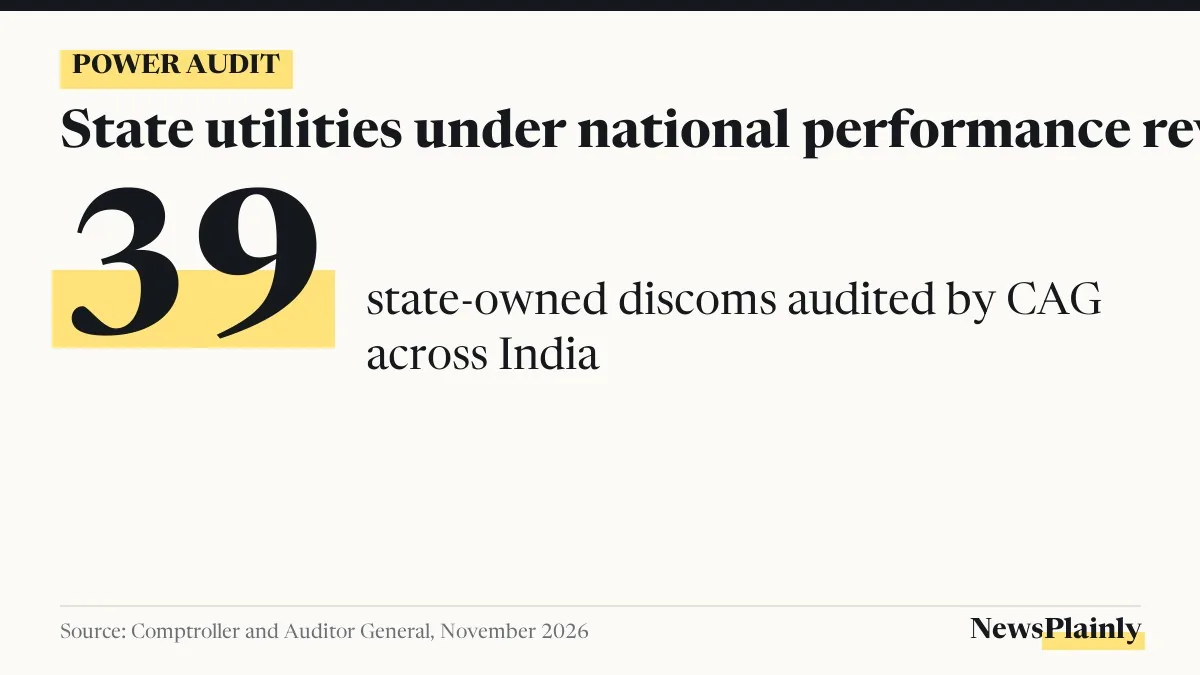
In an unprecedented sectoral oversight exercise, the Comptroller and Auditor General of India has commenced a comprehensive and unified performance evaluation of 39 state-owned power distribution companies across the country. The landmark CAG power audit departs from the historical convention of auditing individual state utilities in isolated cycles, bringing 39 discoms alongside five departmental electricity undertakings under a single investigative framework.
Led by the recently formed State Commercial Audit division, the exercise marks the opening stage of a comprehensive four-year review designed to ringfence the entire power sector. National capital expenditure across the power generation and transmission sectors is projected by government energy planners to touch Rs 50 lakh crore by 2032 and Rs 200 lakh crore by 2047, underscoring the urgent necessity of robust financial auditing.
Government auditors selected the distribution segment for immediate investigation because electricity discoms represent the operational cash nexus of the power value chain. When retail distribution utilities falter financially, cascading payment defaults ripple through transmission grids, fuel suppliers, and renewable generation plants, which the nationwide CAG power audit seeks to prevent. Despite recurring central bailout packages, state-owned distribution companies remain mired in acute fiscal stress.
Public sector discoms currently carry combined accumulated balance sheet losses of Rs 6.77 lakh crore and total outstanding borrowings reaching Rs 7.11 lakh crore. Senior officials noted that government revenue grants have expanded more than four times faster than capital investment grants. This widening divergence reveals that public subsidies are overwhelmingly absorbed by operating deficits and debt interest servicing rather than modernising power grids, upgrading local transformers, or expanding rural sub-transmission feeders.
Why the CAG power audit targets short-term energy trading
While standard auditing protocols evaluate technical parameters such as aggregate technical and commercial losses, billing precision, and collection efficiency, the current CAG power audit places critical emphasis on the commercial mechanisms of power procurement. An Indian Express exclusive on discom performance revealed that auditors are intensely examining the rapid expansion of short-term electricity trading on domestic power exchanges.
Over the past four to five years, short-term power purchases have surged from roughly 7 to 8 percent of total state power procurement to nearly 14 percent. Power exchanges account for over 56 percent of this volatile trading volume. Because exchange clearing prices can fluctuate sharply during peak evening hours, poor demand forecasting often compels state utilities to purchase emergency spot electricity at elevated tariffs.
The CAG power audit will determine whether state utilities maintain rigorous forecasting systems or whether reactive market timing causes unnecessary tariff burdens that are ultimately transferred to retail consumers. Audit teams will also evaluate long-term power purchase agreements to assess whether discoms are paying heavy fixed capacity charges for idle thermal plants while simultaneously procuring expensive merchant power on spot exchanges. This dual expense has severely undermined utility operating margins in major industrial states.
Comparing the new integrated framework with traditional audits
The operational scope of the CAG power audit introduces several structural innovations compared to earlier utility inspections. The table below compares the traditional state audit framework with the integrated multi-utility review currently underway.
| Feature | Traditional State Utility Audit | New Integrated CAG Power Audit |
|---|---|---|
| Institutional Scope | Individual state discoms reviewed in separate annual cycles | 39 state utilities and 5 departmental units reviewed simultaneously |
| Procurement Focus | Basic compliance with state electricity regulatory commissions | Deep analysis of short-term power exchanges and spot market timing |
| Consumer Input | Limited to registered consumer forum grievance records | Direct statistical field survey covering 10,000 electricity users |
| Financial Diagnosis | Standard balance sheet deficits and technical line losses | Revenue grant diversion toward debt interest versus capital assets |
| Multi-Year Vision | Single-year operational accounting checks | First phase of four-year roadmap spanning generation to renewables |
A ground-breaking dimension of the CAG power audit is the deployment of an independent consumer satisfaction survey. In collaboration with the Ministry of Statistics and Programme Implementation or accredited national polling agencies, auditors are gathering direct evidence from approximately 10,000 electricity consumers nationwide. The sample spans domestic households, agricultural pump connections, small commercial enterprises, and heavy industrial users.
Field investigators will evaluate real world supply consistency, voltage stability, metering disputes, and billing grievance redressal mechanisms. The survey questionnaire also captures customer perceptions regarding unexpected load shedding hours, customer call centre response times, and billing transparency. By gathering independent consumer data, the CAG power audit intends to establish whether recorded quality metrics match actual customer experiences across rural and metropolitan feeders.
State regulatory commissions rely on utility self-reporting for tariff revisions, which critics argue frequently understates distribution bottlenecks. The nationwide audit sample will offer an external empirical baseline to assess whether public discoms meet statutory reliability targets before petitioning regulators for tariff hikes.
Protecting national capital outlays across the power sector
The integrated methodology adopted in the CAG power audit mirrors recent sectoral evaluations conducted across freight logistics and urban mobility. By combining specialised audit wings across commercial accounting and infrastructure engineering, the auditor aims to prevent systemic leakages across interconnected institutions.
Following the completion of the distribution phase in mid-2027, the apex auditor plans to expand oversight into power transmission corporations, thermal and hydroelectric generation stations, and major renewable energy parks. Rigorous financial oversight is essential as India transitions toward renewable integration while maintaining grid stability.
Officials explained that without commercially sustainable distribution entities, long-term investments in high-voltage direct current lines and solar parks risk default. For detailed insights into commercial policy and corporate regulation, readers can explore our reports in the NewsPlainly business section.
Field investigations for the CAG power audit are already underway across several regional utilities, with initial progress reported in northern and western states. The final evaluation findings are scheduled to be submitted to state legislative assemblies and Parliament during the next financial year. By diagnosing the financial stress points in short-term power procurement, the inquiry aims to establish transparent trading safeguards, protect consumer interests, and reinforce long-term fiscal discipline across public energy utilities.