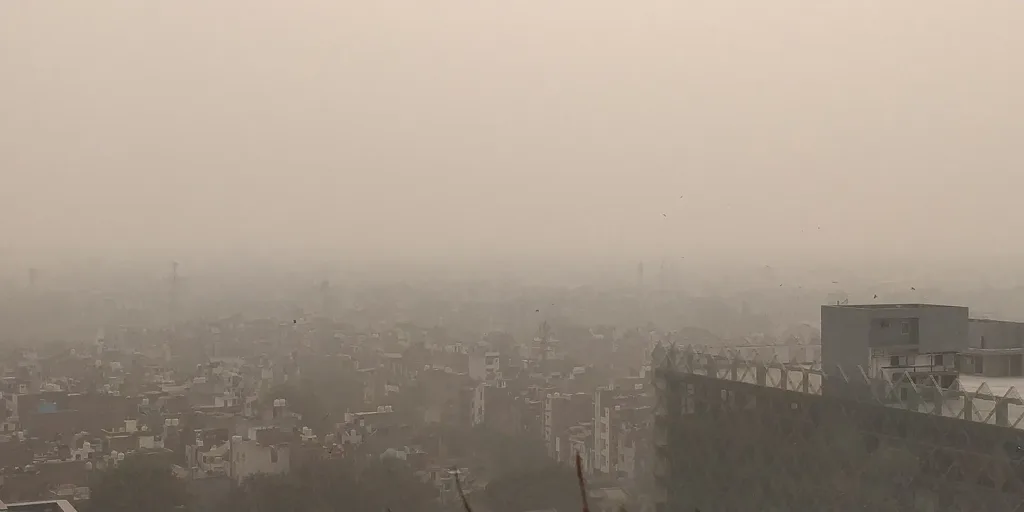
Representative image. Prami.ap90, CC BY-SA 4.0, Wikimedia Commons

हिन्दी में सारांश Summary in Hindi
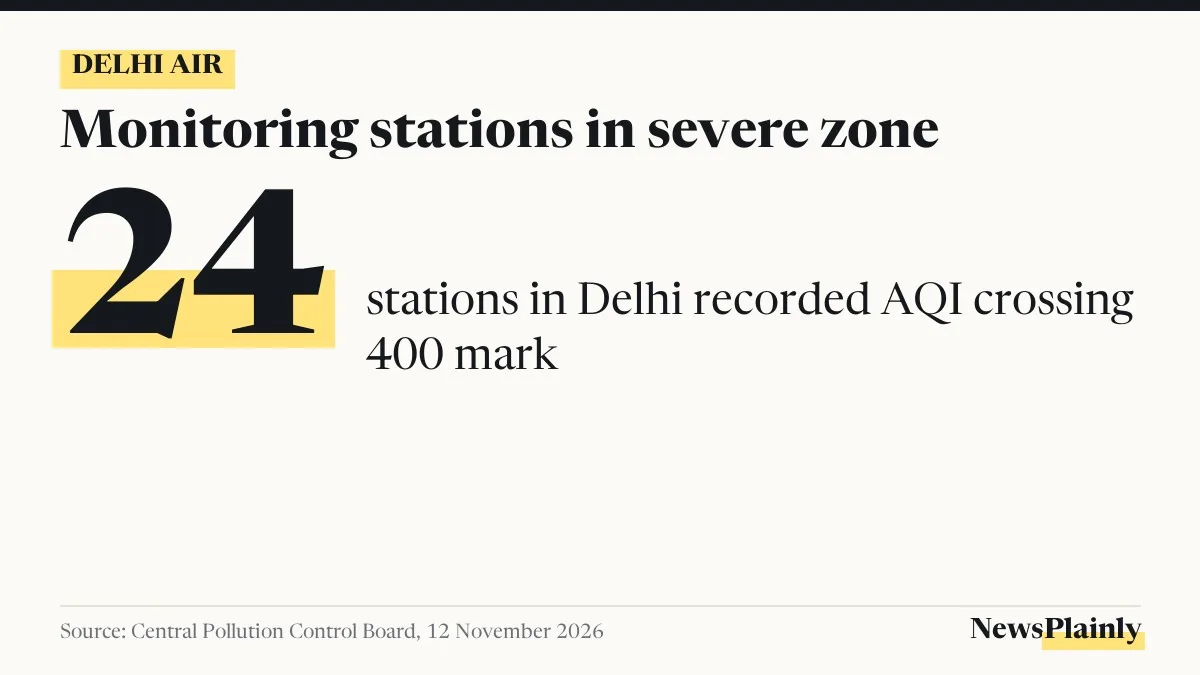
- दिल्ली में वायु प्रदूषण गंभीर स्तर पर पहुंच गया है और राजधानी के 24 निगरानी केंद्रों पर एक्यूआई 400 के पार दर्ज किया गया।
- नुसार सेकेंडरी एरोसोल और वाहनों का धुआं प्रदूषण की मुख्य वजह बनकर उभरे हैं।
- नुमान जताया है।
বাংলায় সারাংশ Summary in Bangla
- দিল্লির বায়ুদূষণ মারাত্মক রূপ নিয়েছে এবং রাজধানীর ২৪টি পর্যবেক্ষণ কেন্দ্রে একিউআই ৪০০ ছাড়িয়েছে।
- ্যারোসল এবং যানবাহনের ধোঁয়া দূষণের মূল কারণ হিসেবে চিহ্নিত হয়েছে।
- আবহাওয়া দপ্তর আগামী দিনগুলিতে সকালের দিকে হালকা কুয়াশা থাকার পূর্বাভাস দিয়েছে।
Why it matters
Severe air pollution triggers acute respiratory distress across vulnerable populations, forcing municipal agencies to intensify anti-smog spraying and vehicle emission checks across the capital region.
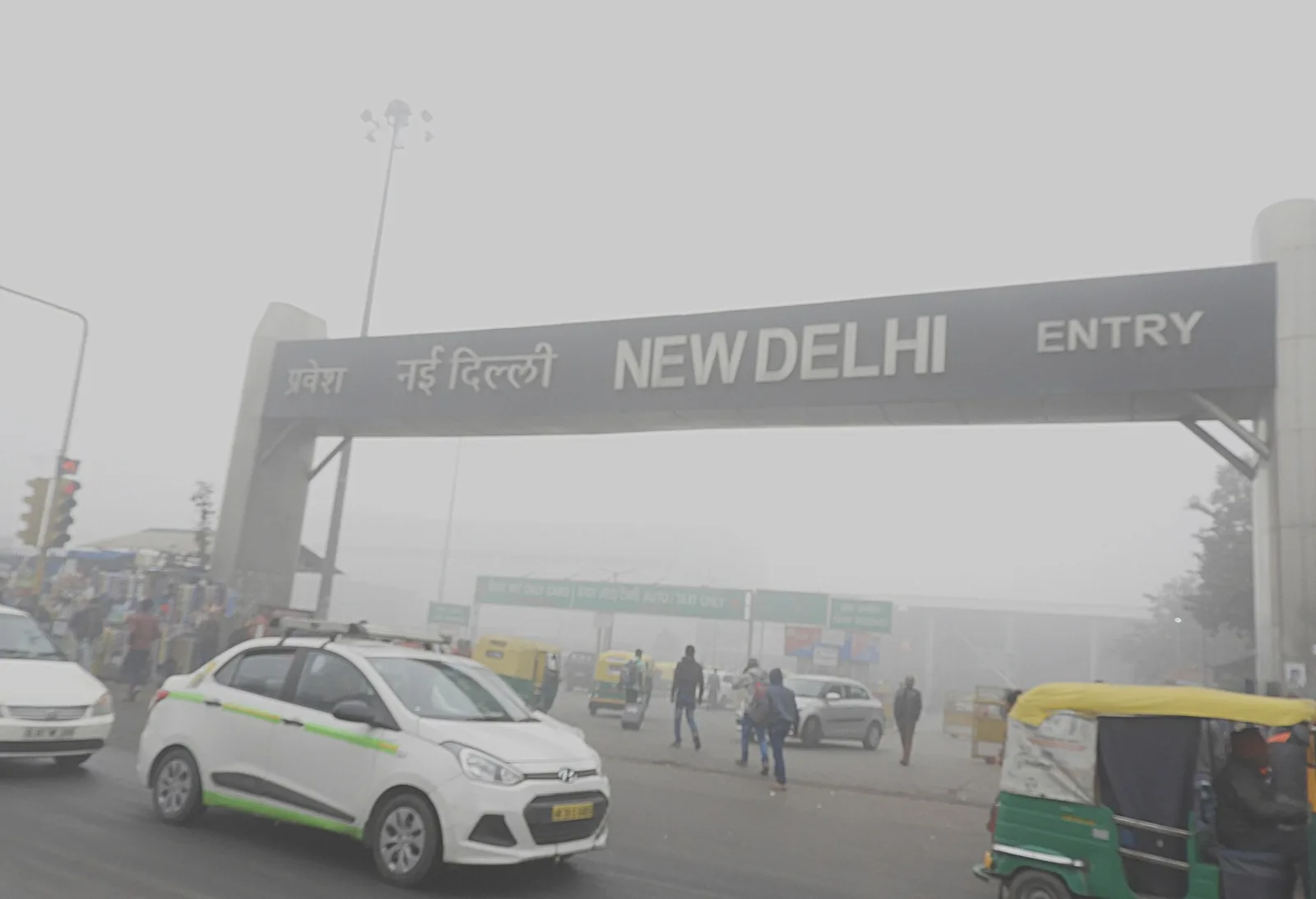
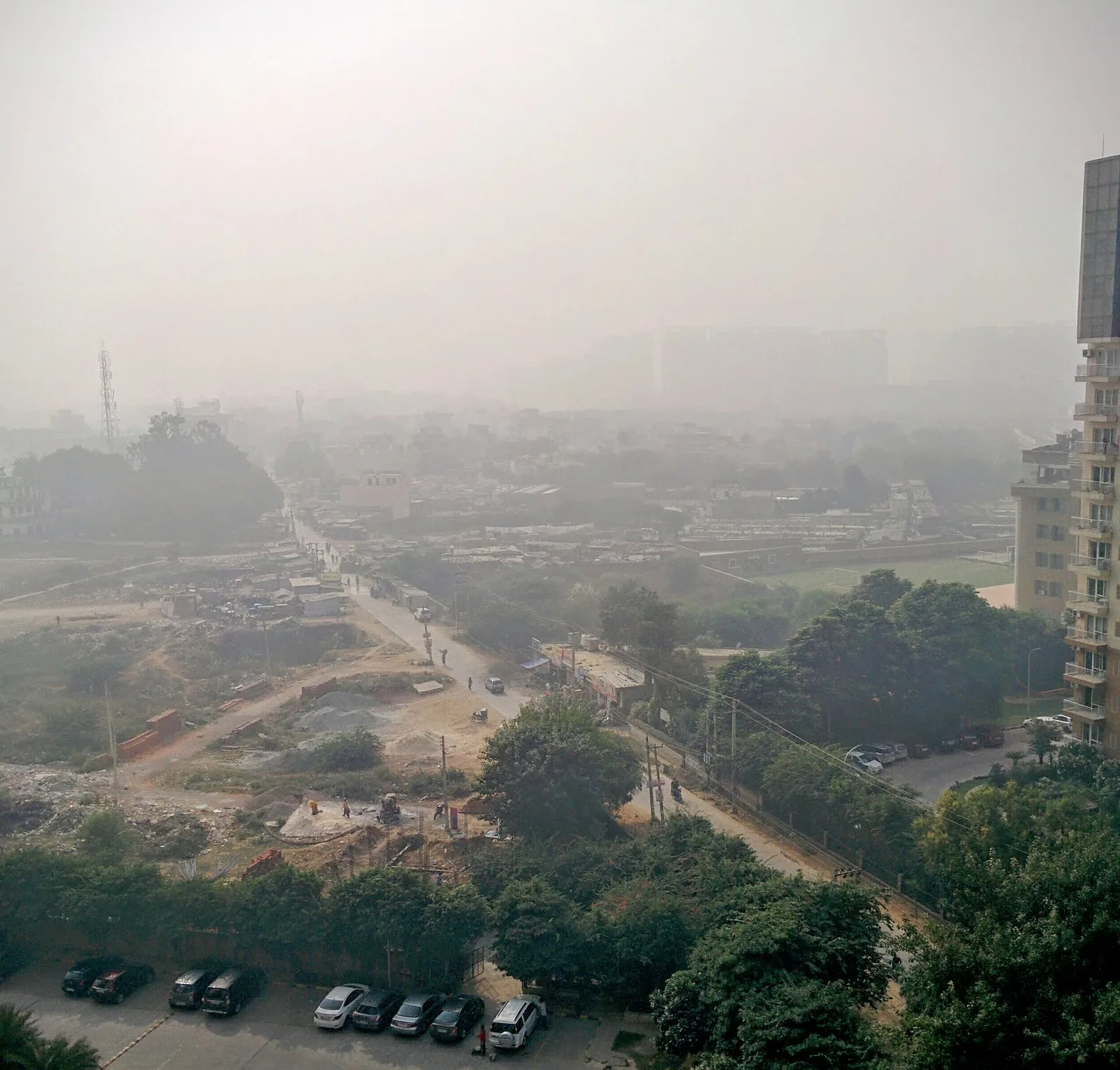
A thick blanket of toxic smog settled across the National Capital Region on Thursday as Delhi air quality deteriorated into hazardous territory, with 24 out of 57 government monitoring stations recording index values crossing the 400 mark. The citywide 24-hour average Air Quality Index rose to 350, entering the upper tier of the very poor bracket, compared to 313 recorded on Wednesday.
Monitoring data published by the Central Pollution Control Board (the national statutory environmental regulator) showed alarming localized spikes across key transit and residential hubs. The monitoring station at the Indian Institute of Technology Delhi peaked at 479, while the All India Institute of Medical Sciences area touched 417 and Anand Vihar registered 414. The surrounding satellite cities experienced similar strain, with Gurugram logging an index of 320 and Noida recording 311.
Environmental scientists tracking the toxic haze revealed that local vehicular exhaust and chemical reactions occurring directly in the atmosphere have combined to suppress Delhi air quality across urban neighbourhoods. The Indian Institute of Tropical Meteorology, based in Pune, which operates the government near real time source attribution framework, estimated that secondary organic aerosols accounted for 25 percent of fine particulate matter under 2.5 micrometres (PM2.5 particles).
Unlike dust or exhaust fumes that are released directly into the atmosphere, these secondary particles are created when chemical gases from vehicle tailpipes and industrial combustion react with sunlight over several hours. This chemical formation creates an invisible suspended layer that significantly impairs Delhi air quality during early winter mornings.
Why Delhi air quality deteriorated into the severe category
A closer look at the meteorological and chemical factors shows why Delhi air quality degraded rapidly despite the dissipation of initial festive smoke. An Indian Express report on pollution data noted that particulate residue from firecrackers still accounted for approximately 7 percent of the capital fine particulate load four days after festivities ended.
Specialists explained that firecracker smoke consists of an aerosolized combination of sulfur dioxide, carbon particles, and heavy metals that can stay suspended in stagnant winter air for extended periods without dispersing. This persistent chemical residue continues to depress Delhi air quality long after celebrations conclude.
In addition to chemical aerosols, vehicular traffic formed the largest direct local emission source. Reporting by Amar Ujala highlighted that direct tailpipe exhaust contributed roughly 17 to 20 percent of airborne particulate toxins, while domestic burning of solid biofuels and mixed fuels added another 11 percent to the overall pollution burden.
Regional atmospheric modeling showed that local Delhi sources generated roughly 38 percent of the city fine particulate matter. The remaining 62 percent drifted inward from surrounding National Capital Region districts such as Jhajjar, Gurugram, Sonipat, Rohtak, and Muzaffarnagar, illustrating how cross border emissions shape Delhi air quality each season.
Examining the sources of Delhi air quality pollution load
Understanding which activities contribute to the toxic winter smog is critical for public health advisories targeting Delhi air quality. The table below outlines the primary contributors to fine particulate matter as calculated by the Indian Institute of Tropical Meteorology modeling network.
| Pollution Source | Estimated Share (PM2.5) | Formation Mechanism | Regulatory Enforcement Measure |
|---|---|---|---|
| Secondary Organic Aerosols | 25 percent | Atmospheric reactions between vehicle gases and sunlight | Targeting volatile organic compound releases |
| Biomass and Stubble Burning | 25 percent | Agricultural residue and outdoor waste combustion | Satellite monitoring and mechanised farm subsidies |
| Direct Vehicle Exhaust | 17 to 20 percent | Diesel and petrol engine emissions on congested corridors | Enforcing Stage 3 curbs on older commercial vehicles |
| Mixed Combustion | 11 percent | Household biofuel usage, small workshops, and waste fires | Providing clean cooking fuel access and waste removal |
| Lingering Firecracker Smoke | 7 percent | Suspended heavy metals and sulfur compounds | Seasonal sales bans and localized enforcement drives |
Agricultural burning in neighbouring northern states continues to generate public discussion regarding its seasonal impact on Delhi air quality. Data released by the Indian Agricultural Research Institute showed that satellite tracking detected 339 farm fires across six northern states on Thursday. Madhya Pradesh accounted for 182 incidents, Uttar Pradesh registered 68 fires, Punjab recorded 54, Rajasthan reported 31, and Haryana had 4 fires, with Delhi recording none.
The research institute cautioned that dense cloud cover across parts of Punjab, Haryana, and western Uttar Pradesh had temporarily obstructed optical satellite instruments. Cumulatively, total residue burning events between 15 September and 12 November reached 10,805 fires, marking a 24.3 percent decline compared to 14,279 fires in 2025 and an 88.8 percent drop from the 96,622 recorded in 2020. However, Punjab experienced a localized increase, recording 5,571 fires, which is 19.5 percent higher than last season, periodically influencing Delhi air quality during northwesterly wind episodes.
Civic interventions to protect Delhi air quality ahead
In response to worsening conditions, municipal bodies have accelerated emergency mitigation measures to stabilize Delhi air quality under Stage 3 of the Graded Response Action Plan. The Irrigation and Flood Control Department began deploying high capacity anti-smog guns and mechanized water sprinklers along dust prone transit arteries, including the Ghazipur drain perimeter.
The continuous water mist is designed to wash airborne particulates out of breathing zones and reduce dust re-suspension caused by heavy road traffic. Similar dust suppression measures are underway across major construction corridors to prevent further deterioration in Delhi air quality.
Weather projections indicate that atmospheric dispersion will remain weak over the coming days. The India Meteorological Department recorded maximum daytime temperatures near 30 degrees Celsius and nighttime minimums hovering around 16.5 degrees Celsius on Thursday. Forecasters expect partly cloudy skies accompanied by morning shallow fog and mist through 15 November, keeping Delhi air quality under pressure.
Looking into next week, meteorologists anticipate nighttime temperatures will fall by 3 to 5 degrees Celsius, with minimums dropping to 13 to 15 degrees Celsius between 16 and 19 November. Medical experts from major public hospitals advised senior citizens, young children, and individuals suffering from cardiovascular or pulmonary ailments to avoid outdoor physical exertion during early morning and late evening hours. As authorities monitor environmental indicators, comprehensive reports on regulatory governance can be found in the NewsPlainly India news section.