Representative image. Vice President's Secretariat, GODL-India, Wikimedia Commons

हिन्दी में सारांश Summary in Hindi
- रविंद केजरीवाल और उनकी बेटी को जान से मारने की धमकी मिलने पर एफआईआर दर्ज की।
- तिलक नगर विधायक जरनैल सिंह को फोन पर 7 करोड़ रुपये की रंगदारी की मांग की गई थी।
- मोहाली साइबर क्राइम पुलिस ने भारतीय न्याय संहिता की विभिन्न धाराओं के तहत मामला दर्ज कर जांच शुरू की।
বাংলায় সারাংশ Summary in Bangla
- রবিন্দ কেজরিওয়াল ও তার মেয়েকে খুনের হুমকি দেওয়ায় পঞ্জাব পুলিশ এফআইআর দায়ের করেছে।
- তিলক নগরের বিধায়ক জার্নাইল সিংয়ের ফোনে ৭ কোটি টাকার তোলা চেয়ে হুমকি দেওয়া হয়।
- মোহালি সাইবার ক্রাইম পুলিশ ভারতীয় ন্যায় সংহিতার বিভিন্ন ধারায় মামলা নথিভুক্ত করে তদন্ত শুরু করেছে。
Why it matters
Extortion threats targeting high-profile political figures and their families represent a direct challenge to law enforcement and civic security. The invocation of new organised crime sections under the Bharatiya Nyaya Sanhita demonstrates how statutory authorities are deploying updated legal tools to combat digital intimidation networks.
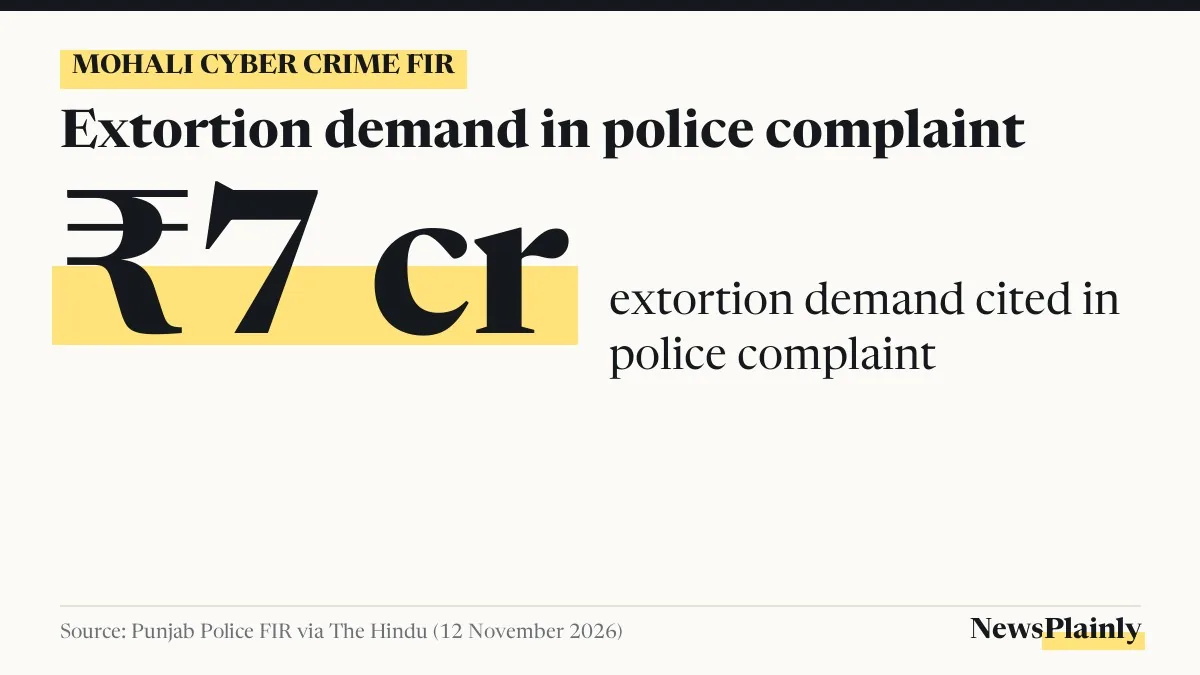
A Kejriwal death threat FIR has been formally registered by the Punjab Police after an extortionist demanded Rs 7 crore and threatened to kill Aam Aadmi Party national convener Arvind Kejriwal and his daughter Harshita Kejriwal. The First Information Report was lodged following an official complaint filed by Delhi MLA Jarnail Singh, who represents the Tilak Nagar assembly constituency in west Delhi. The threatening communications were routed through voice calls and mobile messaging platforms, prompting law enforcement agencies across state borders to initiate a coordinated technical investigation.
According to the written complaint submitted to the Senior Superintendent of Police in Mohali, Singh received both a direct phone call and a series of audio and text messages on his personal mobile device on 6 November. The caller explicitly claimed allegiance to the Lawrence Bishnoi criminal syndicate and warned that the former Delhi Chief Minister and his family would face lethal violence if the extortion amount was not remitted without delay.
Why Kejriwal death threat FIR was filed at Mohali Cyber Crime station
The decision to register the Kejriwal death threat FIR at the Cyber Crime Police Station in Sahibzada Ajit Singh Nagar (SAS Nagar) Mohali followed an evaluation of the electronic trail used by the perpetrators. Because the digital communications originated through virtual numbers and internet-based messaging conduits, cyber specialists in Punjab assumed jurisdiction to trace server logs, routing nodes and international gateway signatures.
The complaint details the exact extortion threat delivered to the legislator. As recorded in official police records, the caller stated in Hindi: “Lawrence Bishnoi gang se bol raha hun, Arvind Kejriwal ko bol de, 7 crore de do nahin to Arvind Kejriwal or uski ladki Harshita Kejriwal ko jaan se maar dunga.” The demand specifically conditioned the personal safety of the political leader and his family upon the payment of Rs 7 crore.
As The Hindu reported, Singh emphasised that the sender had deliberately used his status as an elected public representative to channel coercive demands. Singh wrote in his submission that the threats created grave public security risks given Kejriwal’s profile as a prominent national political leader and requested immediate administrative steps to guarantee security coverage.
Penal provisions invoked under Bharatiya Nyaya Sanhita
Law enforcement authorities have invoked stringent provisions of the newly enacted criminal code to address the extortion attempt. The case has been registered under Section 308 (4) for extortion, Section 351 (2) for criminal intimidation, Section 351 (4) for criminal intimidation through anonymous communication, and Section 111 (2) concerning organised crime syndicates under the Bharatiya Nyaya Sanhita (BNS), alongside corresponding sections of the Information Technology Act.
To help citizens and legal observers understand the statutory framework governing digital extortion cases, the comparative table below outlines the specific legal sections invoked in the case alongside their historical Indian Penal Code (IPC) equivalents and statutory sentencing limits:
| BNS Penal Section | Offence Classification | Corresponding IPC Section | Maximum Statutory Penalty |
|---|---|---|---|
| Section 308 (4) | Extortion putting person in fear of death | Section 386 IPC | Imprisonment up to 10 years and fine |
| Section 351 (2) | Criminal intimidation | Section 506 (Part I) IPC | Imprisonment up to 2 years, or fine |
| Section 351 (4) | Anonymous criminal intimidation | Section 507 IPC | Additional imprisonment up to 2 years |
| Section 111 (2) | Organised crime syndicate offences | New statutory provision | Life imprisonment to capital punishment |
| Section 66F IT Act | Cyber intimidation and electronic threats | IT Act 2000 provision | Imprisonment up to life sentence |
The inclusion of Section 111 represents a critical legal escalation. Introduced under the Bharatiya Nyaya Sanhita to address syndicate operations, the section allows investigators broader leeway in probing financial conduits, intercepting digital communications, and impounding assets linked to transnational extortion rings.
Security protocols and interstate investigation procedures
The registration of the case has triggered operational reviews across security agencies in both New Delhi and Punjab. Under standard protective protocols, security details assigned to former Chief Ministers and high-risk political figures undergo threat reassessments when named in direct extortion demands. The Delhi Police, which maintains primary responsibility for Kejriwal’s perimeter security in the national capital, has liaised with Punjab investigators to verify threat authenticity.
Technical teams led by cyber crime investigators have begun analysing Call Detail Records (CDRs), subscriber identity modules (SIM) origins, and Internet Protocol (IP) login metadata. Investigators are examining whether the phone numbers were spoofed via virtual private networks (VPN) or purchased through counterfeit identity documents, a common tactic employed by cyber extortionists seeking to deflect physical detection.
Interstate police coordination remains paramount in tracking cross-border cyber harassment. Because digital threats often exploit multi-layered routing across servers hosted in multiple jurisdictions, investigators from Punjab have dispatched liaison advisories to regional cyber crime cells across Haryana, Rajasthan and the National Capital Region (NCR). This structural data sharing enables telecom service providers to isolate suspicious cell towers and identify tower-dump records corresponding to the transmission timestamps.
The operational review also covers preventive measures across residential clusters and political offices in west Delhi. Local police stations have augmented patrolling around the Tilak Nagar constituency office and party administrative headquarters, ensuring that field staff and party volunteers maintain documented visitor logs during public grievance sessions. Officers noted that digital extortion threats frequently coincide with high-visibility public outreach programmes, necessitating calibrated static guarding and quick reaction teams.
The development coincides with broader law enforcement operations targeting fugitive crime networks operating from overseas jurisdictions. Central agencies, including the National Investigation Agency (NIA) and Interpol, have intensified surveillance on digital extortion cells that invoke notorious gang names to intimidate political leaders, corporate figures, and entertainment personalities across northern India.
Readers following governance and institutional actions can explore our wider NewsPlainly politics coverage to examine policy enforcement and statutory developments across states. Senior supervisory officers confirmed that forensic digital examinations remain actively underway and that comprehensive progress updates will be submitted to the competent judicial magistrate in Sahibzada Ajit Singh Nagar.