Representative image. Rangan Datta Wiki, CC BY-SA 4.0, Wikimedia Commons

Why it matters
The US is a major buyer of Indian goods, and a second duty on top of the 10% would raise what American importers pay for them. It also holds up the India-US trade deal, which the commerce secretary says cannot be signed until the new US tariff structure is in place.
New US tariffs on India are likely to be proposed this week, along with duties on 15 other trading partners, after an investigation into excess industrial capacity. The Wall Street Journal reported the plan, and three sources told Reuters the findings are due on Wednesday, 25 November, Indian Express reported. No rate for India has been named. India already pays an extra 10% under a separate US action, and the new duty is expected to come on top of it.
What the new US tariffs on India could cover
The US Trade Representative (USTR), Jamieson Greer, has been investigating whether government support in other countries has built up more factory capacity than they need, letting their firms sell cheaply in the US. The probe falls under Section 301 of the US Trade Act of 1974, the law that lets Washington respond to what it calls unfair foreign practices. The Journal’s report, as relayed by Mint, said the timing could change.
Indian Express listed the 16 partners as India, China, the European Union, Japan, South Korea, Mexico, Vietnam, Taiwan, Thailand, Malaysia, Indonesia, Switzerland, Norway, Singapore, Bangladesh and Cambodia. The duties are expected to cover most products from these economies, but steel, aluminium and cars are likely to be left out because they already face separate tariffs, Mint and India Today reported.
The new tariffs would partly replace the global import taxes the US Supreme Court struck down in February 2026, Indian Express noted. Reuters reported that Mexico and Norway are unlikely to see any immediate levy.
Where India stands: 10% today, new rate unknown
India faces an additional 10% tariff from a July action against countries accused of not blocking goods made with forced labour. Mint reported that India was first placed in a 12.5% bracket and later moved to 10%. Times of India described the same outcome as a concession India won in the first probe.
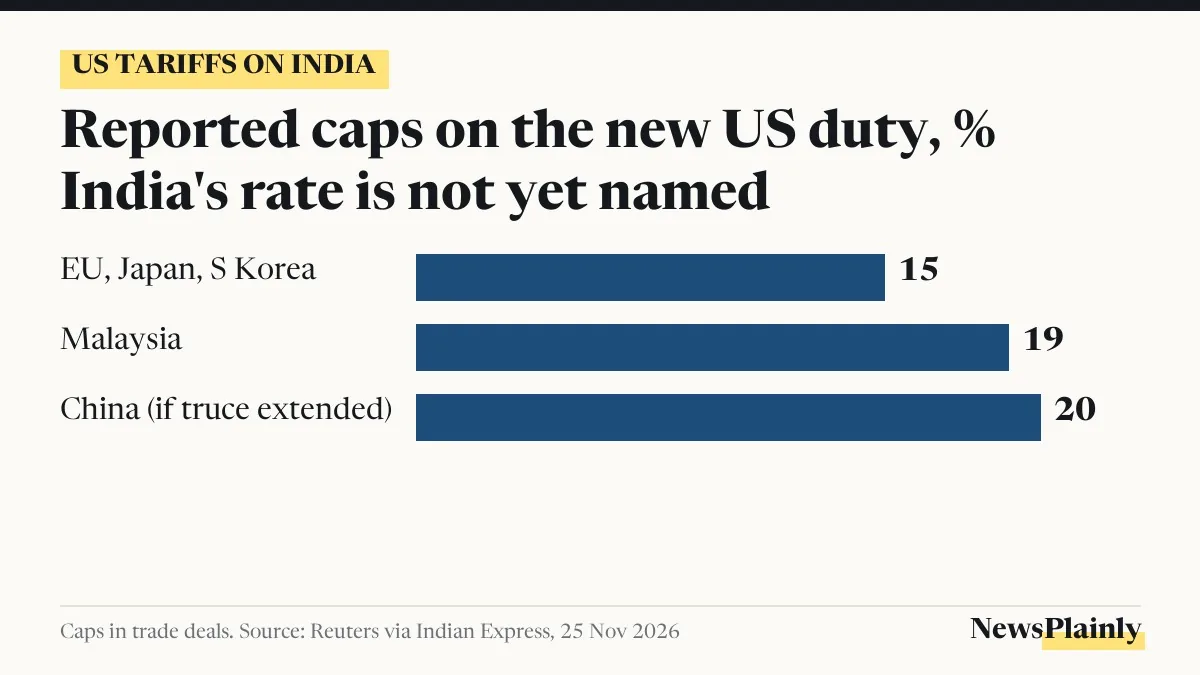
The new Section 301 tariffs would be a separate layer, and the tariffs on partners with deals are expected to follow those deals. Reporting differs by country on how high it could go:
| Partner | What the reports say about the new duty |
|---|---|
| EU, Japan, South Korea | Expected to stay at or below the 15% cap in their trade deals (Mint, Reuters via Indian Express) |
| Malaysia | 19% cap in its deal (Reuters via Indian Express) |
| China | 20% cap expected to be honoured if the trade truce, which ends on 10 January, is extended (Reuters via Indian Express) |
| India and Vietnam | Could face higher rates, depending on the terms of their own deals (Wall Street Journal via Mint) |
Ryan Majerus, a former senior Commerce Department trade official now at the law firm King and Spalding, told Reuters the administration could propose 15% to 25% for countries judged to have excess capacity, stacked on the 10% or 12.5% already in place. He added that lower rates with clauses that raise them over time were also possible.
Here is the arithmetic on that range, which is our illustration and not a forecast for India: 15% to 25% added to India’s current 10% would mean US duties of 25% to 35%, or $25 to $35 on every $100 of affected goods. Whether the new US tariffs on India would sit anywhere near that range depends on its trade deal, and the reports do not say.
Why the trade agreement with Washington is waiting
Times of India reported that the government does not expect the US tariffs on India to hurt. It said officials maintain India has no structural excess capacity, that any surplus reflects expected domestic demand, and that the government has not given subsidies to create capacity.
The timing matters for the India US trade deal. India and the US announced an interim framework on 7 February 2026, under which, India Today reported, Washington agreed to cut its reciprocal tariff on Indian goods from 25% to 18% and drop a separate 25% penalty over Russian oil purchases. The Supreme Court ruling that month struck down the reciprocal tariffs, and the framework lost its footing, which is why the India US trade deal is still unsigned.
Commerce Secretary Rajesh Agrawal said on 18 November at an event of the Federation of Indian Chambers of Commerce and Industry (FICCI) that the deal could not be formally signed until the new US tariff structure was in place. “Until the tariff architecture comes back in place, signing of a deal, I think will take some time,” he said, as quoted by India Today. He also said the legal text was in its final stages.
What happens after the findings
Publication of the findings would not end the matter, and the Section 301 tariffs on India would still be proposals. Times of India reported that USTR’s report is likely to be followed by hearings, with final tariffs expected in around 45 days, and that countries would then negotiate trade deals against the final rates. It added that litigation is expected, because the findings are similar for almost all countries, as it was for the forced-labour tariffs now being challenged in US courts.
For Indian exporters, the practical point is that any rate published this week would be a proposal, not a final US tariff on India. In the first probe, India ended with 10% against the 12.5% first proposed, Times of India noted, so the proposed rate and the final one can differ. NewsPlainly will cover the announcement when USTR publishes it. For more on trade and money stories, see our business section.
Frequently asked questions
Has the US announced new tariffs on India?
Not yet. The Wall Street Journal and Reuters report that the findings of the Section 301 excess-capacity probe are expected this week, and no rate for India has been named.
What is Section 301?
A section of the US Trade Act of 1974 that lets the US Trade Representative act against trade practices it considers unfair, including by adding duties.
Will the India-US trade deal be signed soon?
Commerce Secretary Rajesh Agrawal said on 18 November that signing will take some time until the new US tariff structure is in place.