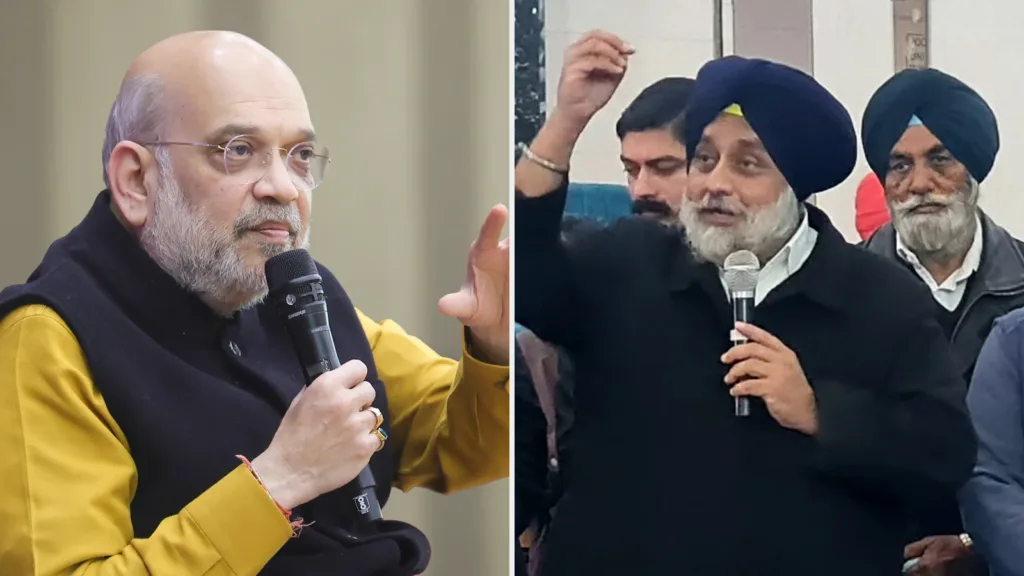
File photos, shown in separate panels: Amit Shah (left), New Delhi, 23 February 2026 — Ministry of Home Affairs / PIB, GODL-India; Sukhbir Singh Badal (right), Lambi, 9 January 2023 — Kuldeep Singh Deep / Wikimedia Commons, CC BY-SA 4.0. Cropped and arranged by NewsPlainly; Badal photo adaptation under CC BY-SA 4.0. These are separate events, not a photograph of the 24 November 2026 alliance announcement.


Why it matters
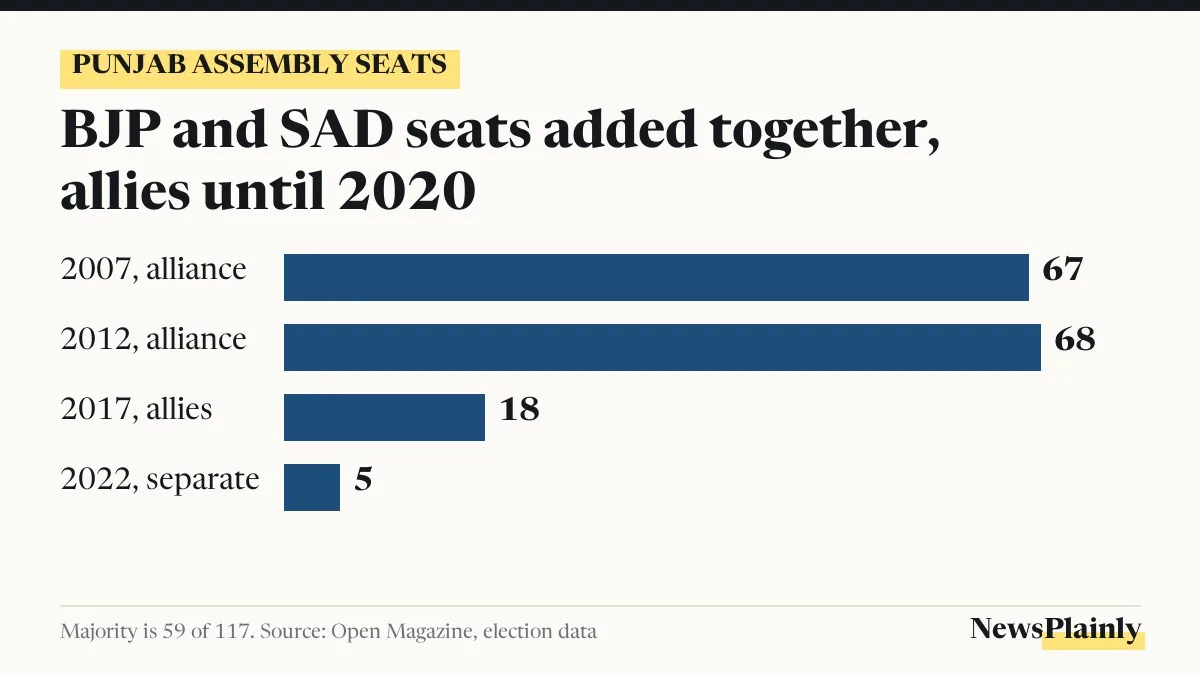
Punjab goes to the polls in 2027 with a contest that has changed shape: AAP is in government, and the BJP and SAD, who won 67 and 68 seats together in 2007 and 2012, are back together. Voters do not yet know who will contest which seats or who the chief ministerial face is, and the promises on drugs and farmers are Shah's words at a press conference, not a published plan.
The BJP-SAD alliance for the Punjab Assembly elections 2027 was announced on Tuesday, 24 November 2026. The BJP and the Shiromani Akali Dal (SAD) will contest together, and the SAD will rejoin the National Democratic Alliance (NDA). Union Home Minister Amit Shah, BJP president Nitin Nabin and SAD president Sukhbir Singh Badal made the announcement at the BJP headquarters in New Delhi, ThePrint reported, quoting the news agency ANI (Asian News International). Shah said the two parties would fight all 117 seats and that the Akali Dal would hold the chief minister’s post. How the 117 seats will be split between them has not been announced.
What the BJP-SAD alliance announced and what is still open
The SAD would be the “big brother” in the alliance and the chief minister’s post would go to it, Deccan Herald reported, quoting Shah. The Hindu said that details of the seat-sharing matrix were not immediately available, and that Shah clarified the elder brother becomes chief minister, which it read as a sign that the alliance will put forward a SAD face. No chief ministerial name has been given in any report read. Nabin said seat-sharing talks “will take place soon”, according to Deccan Herald, and Shah said a detailed manifesto would be finalised soon.
| Announced on 24 November | Not yet announced |
|---|---|
| BJP and SAD contest the 2027 Assembly elections together | How the 117 seats are divided between the two parties |
| SAD rejoins the NDA | The name of the chief ministerial candidate |
| Shah says the SAD gets the chief minister’s post | The manifesto, which Shah says will follow |
Shah named three priorities: ending the drug problem, ending corruption and strengthening what he called nationalist forces in the state. The New Indian Express reported that he said drugs would be completely eradicated from Punjab by 30 December 2029 and that farmers’ demands would be settled within three months of an NDA government being formed. These are promises made at a press conference, and the reports read carry no plan or document behind them. Badal said the alliance would win more than 100 seats and bring the Aam Aadmi Party (AAP) down to single digits, and called it an “emotional alliance”, according to Deccan Herald.
How the two parties separated and what their seat counts show
Open Magazine reported that the earlier BJP-SAD alliance lasted nearly 24 years before the SAD left in September 2020 over the Centre’s three farm laws, when Harsimrat Kaur Badal resigned from the Union Cabinet. The laws were repealed in November 2021, and the two parties contested the 2022 election separately, after the Akali Dal BJP pact had ended: the BJP on 73 seats and the SAD on 97, according to Open. Before the split, the SAD fought 94 seats and the BJP 23.
Open, citing election data, gives the seats the BJP and SAD won together: 67 in 2007 (SAD 48, BJP 19), 68 in 2012 (56 and 12), 18 in 2017 (15 and 3) and 5 in 2022 (3 and 2). The winners were the Congress with 77 seats in 2017, and AAP with 92 in 2022, when the Congress won 18. A party needs 59 seats for a majority in the 117-member house. NewsPlainly’s reading of those numbers: the combination held a majority-sized tally in 2012 and is now starting from 5.
What the BJP says drove it, and the first reactions
The Indian Express, citing unnamed BJP leaders, said Prime Minister Narendra Modi had pushed the party to contest the Punjab Assembly elections 2027 with the Akalis and that Shah then dropped tough conditions that had held up the talks. It also said the BJP’s vote share in Punjab rose from 9.63 per cent in the 2019 Lok Sabha election to 18.56 per cent in 2024, and that the party’s internal surveys indicated each side alone could win about a dozen seats. That account comes from those leaders and is not confirmed by the parties on record.
The opposition reacted the same day. Punjab Congress president Pargat Singh called the BJP-SAD alliance “directionless” and said the two parties came together out of “greed” for power, The Hindu reported, quoting the Press Trust of India (PTI). AAP leader Arvind Kejriwal said such parties unite for power, part and unite again, and AAP’s Jarnail Singh said “zero plus zero will always remain zero”, the Times of India reported. These are the speakers’ own claims.
For Punjab voters the decisions that follow the Akali Dal BJP tie-up are the seat split, the chief ministerial face and the manifesto. Ahead of the Punjab Assembly elections 2027, we reported earlier this month on AAP MLAs joining the BJP and on AAP’s first list of 40 candidates; with the alliance, the contest now has the AAP government, the Congress and a BJP-SAD front.
Frequently asked questions
Have the BJP and Akali Dal formed an alliance for Punjab?
Yes. They announced on 24 November 2026 that they will contest the 2027 Assembly elections together and the SAD rejoins the NDA, according to the reports read.
Who will be the chief minister candidate of the BJP-SAD alliance?
No name has been given. Amit Shah said the Akali Dal, as the 'big brother', will hold the chief minister's post.
How many seats will each party contest?
Not announced. Shah said the two will fight all 117 seats; Nitin Nabin said seat-sharing talks will take place soon.
Why did the BJP and SAD split in 2020?
The SAD left in September 2020 over the Centre's three farm laws, which were repealed in November 2021, Open Magazine reported.