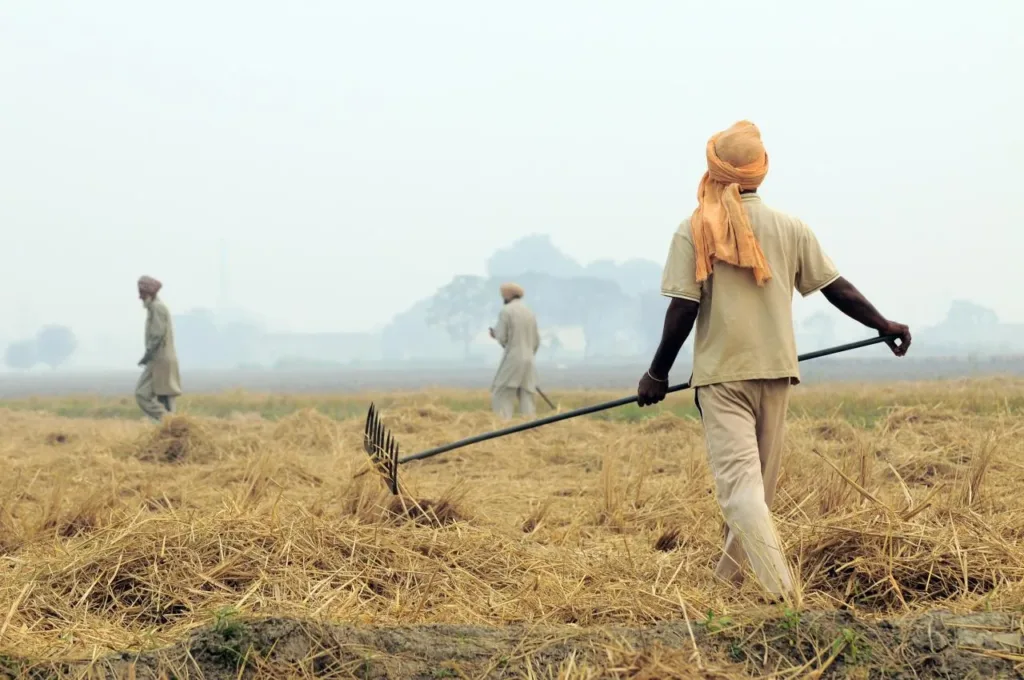
Representative image. CIAT, CC BY-SA 2.0, Wikimedia Commons

Why it matters
Smoke from paddy residue fires adds to the pollution that pushes Delhi-NCR's air into the 'very poor' band each November, and Delhi is already under GRAP Stage II curbs. For Punjab's farmers, burning now brings FIRs and fines, while the window to sow wheat closes in mid-November.
Punjab stubble burning has picked up sharply as the paddy harvest enters its final weeks. Satellites counted 1,612 paddy residue fires in the state between 15 September and 2 November 2026, and 565 of them came in the last three days of that period, according to the daily bulletin of the Indian Agricultural Research Institute (ICAR-IARI).
The total is still lower than at the same point in any year since 2021, IARI’s bulletins show. But the jump comes as smog returns to Delhi-NCR (the National Capital Region), and as the BJP and Punjab’s Aam Aadmi Party (AAP) government trade charges over how the state is dealing with farm fires.
How fast Punjab stubble burning rose this week
IARI’s CREAMS lab (Consortium for Research on Agroecosystem Monitoring and Modeling from Space) counts fires spotted by satellites on farmland and publishes the figures every day. Its bulletin for 2 November shows 292 fires in Punjab on Saturday, 31 October, 175 on Sunday, 1 November, and 98 on Monday, 2 November. The Indian Express, reporting the same IARI data, said Saturday’s 292 was the highest single-day count of the season so far.
Added up, those three days give 565 fires. That fits with the Hindustan Times, which reported a count of 1,047 on 30 October: 1,612 minus 565 is exactly 1,047. In other words, about 35% of the season’s fires so far were detected in three days (NewsPlainly’s calculation from the bulletin’s figures).
Punjab has the largest share of the 3,535 residue fires IARI has counted since 15 September across the states it watches. Rajasthan follows with 738, then Madhya Pradesh with 614, Uttar Pradesh with 349, Uttarakhand with 176, Haryana with 44 and Delhi with 2.
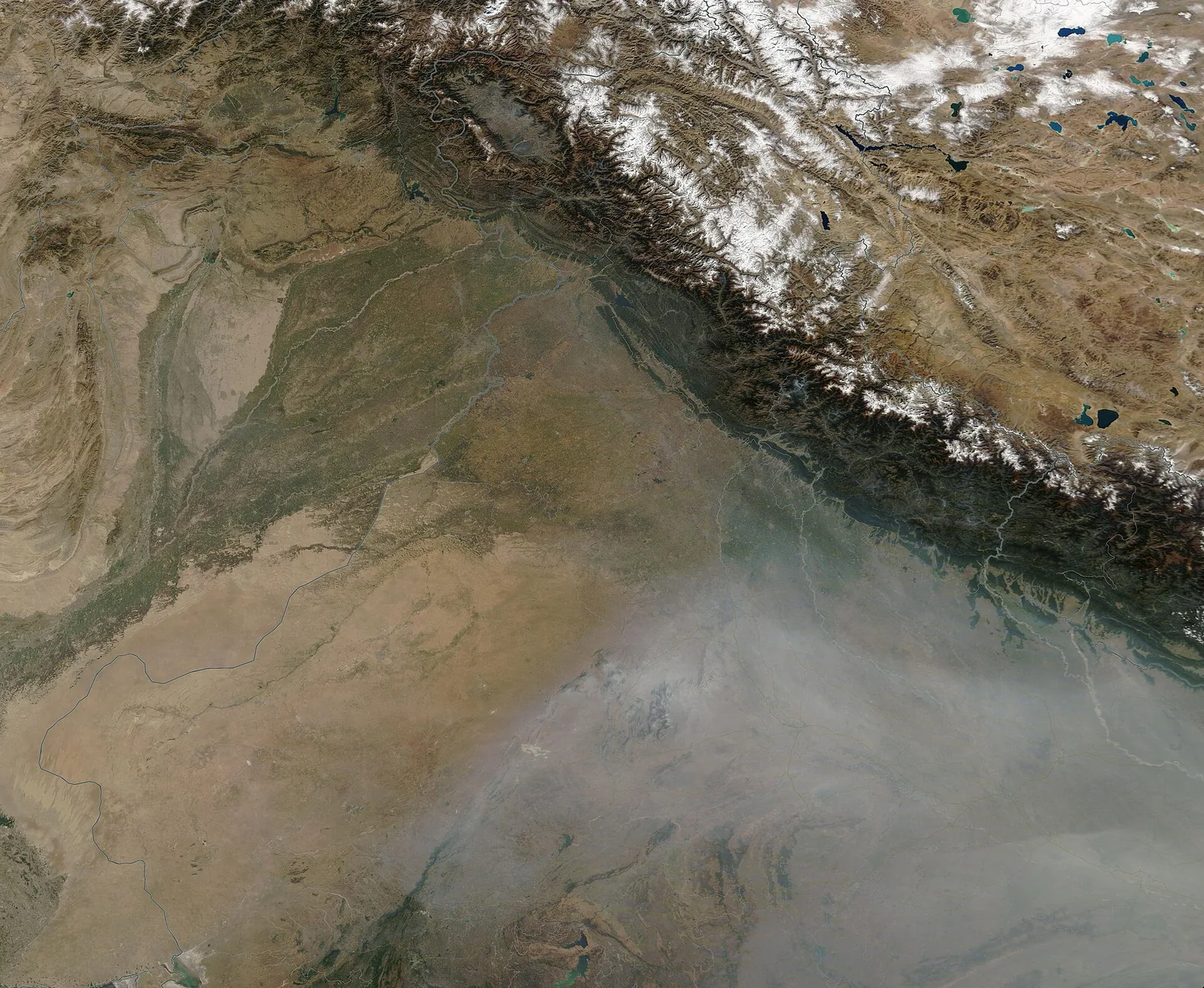
Tarn Taran leads the farm fires, Malwa now catching up
Tarn Taran district alone accounts for 489 of Punjab’s fires, followed by Ferozepur with 193 and Amritsar with 192, according to official figures carried by the Hindustan Times, Deccan Herald and The Indian Express. Tarn Taran’s share works out to about 30% of the state total. Deccan Herald reported that more than 90% of the paddy area in Tarn Taran and Amritsar has already been harvested.
Amritsar and Tarn Taran, in the Majha region, accounted for most fires in the early weeks. The Hindustan Times reported that fires are now rising in the Malwa belt of central and southern Punjab as harvesting moves there: Sangrur had 76 cases, Bathinda 68, Patiala 54 and Faridkot 49.
Enforcement figures have climbed too. Deccan Herald, citing official data, reported 423 FIRs linked to stubble burning, including 258 in Tarn Taran, 49 in Ferozepur and 26 in Amritsar. They were filed under section 223 of the Bharatiya Nyaya Sanhita (BNS), which covers disobeying an order issued by a public servant. In Faridkot, police booked six farmers on 2 November, The Tribune reported.
Fines have followed as well. Environmental compensation of ₹29.15 lakh has been imposed in 573 cases, of which ₹19 lakh had been recovered by 2 November, the Hindustan Times reported, citing a report of the Commission for Air Quality Management (CAQM). The same report said burning was confirmed on the ground at 663 of the 1,380 fields inspected.
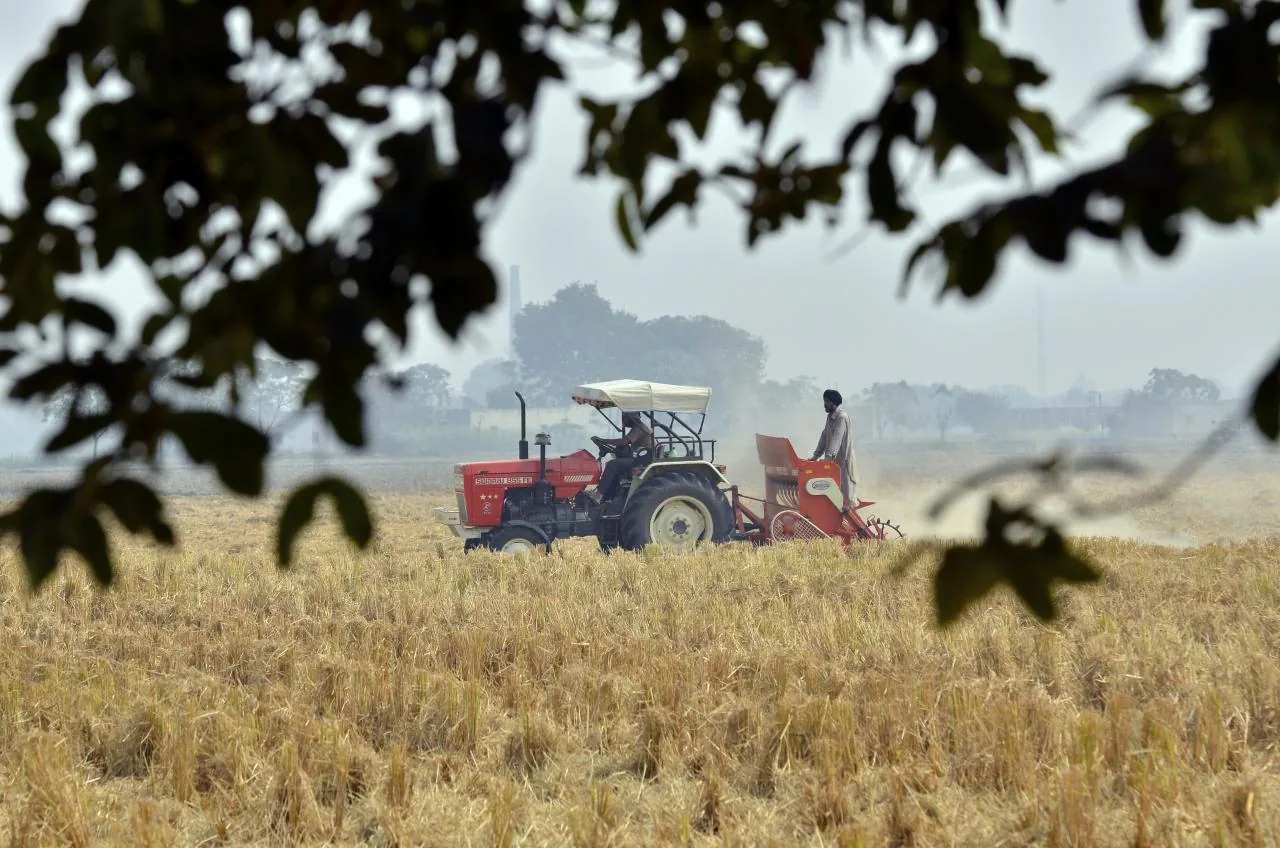
Paddy residue burning on 2 November, year by year
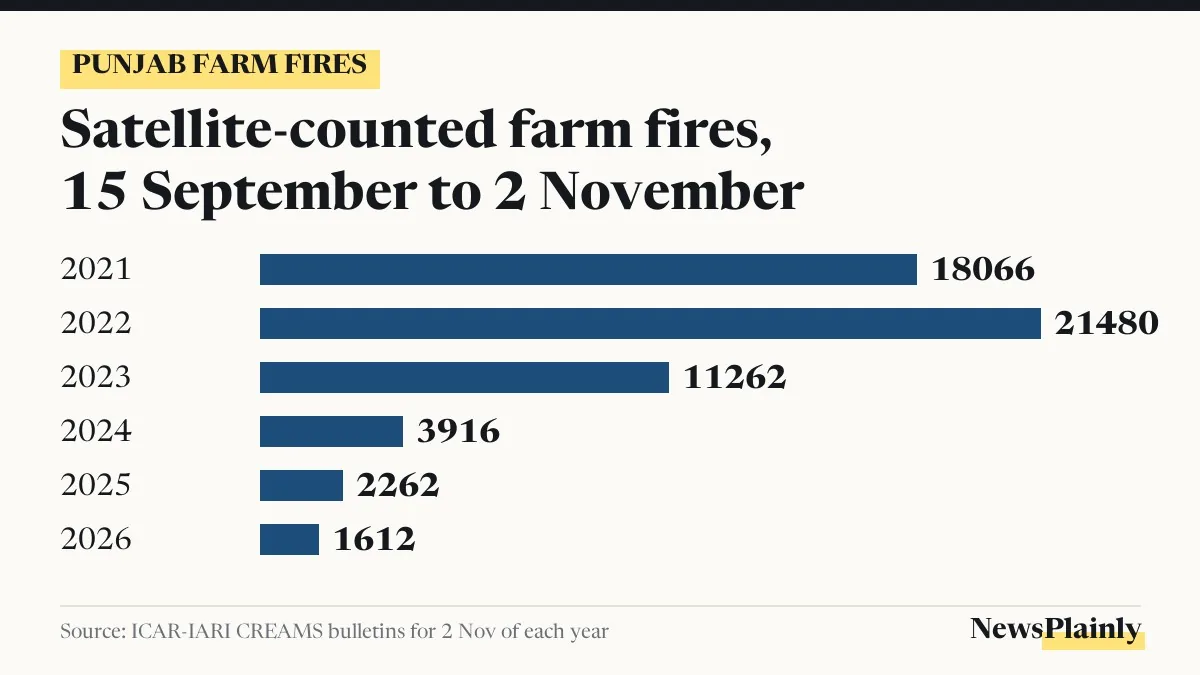
IARI’s bulletins for 2 November in each year from 2021 all count from 15 September. Putting those six bulletins side by side shows how far the count has fallen at this point of the season.
| Year | Punjab fires, 15 Sep to 2 Nov | Fires on 2 Nov alone | 2026 compared |
|---|---|---|---|
| 2021 | 18,066 | 3,001 | 91% lower |
| 2022 | 21,480 | 3,634 | 92% lower |
| 2023 | 11,262 | 1,668 | 86% lower |
| 2024 | 3,916 | 379 | 59% lower |
| 2025 | 2,262 | 178 | 29% lower |
| 2026 | 1,612 | 98 | – |
The comparison needs one caution. A count of fires on a given date also depends on how much paddy has been cut. The CAQM report cited by the Hindustan Times put this year’s harvest at 77.38% of the paddy area by 2 November, against 85% at the same time last year. So a lower count now does not, on its own, show what the season’s final number will be. Punjab recorded 5,114 farm fires across the whole 2025 season, the paper reported.
Satellite counts also have limits: they record fires a satellite detects as it passes overhead, not every field that is burnt.
BJP and AAP spar over stubble FIRs and ads
The numbers have become part of a political row. At a press conference in Delhi on Tuesday, 3 November, Delhi Environment Minister Manjinder Singh Sirsa of the BJP accused Punjab’s AAP government of spending ₹20 crore to ₹25 crore on advertisements claiming there was no stubble burning in the state, while registering FIRs against farmers for the same thing, according to The Times of India and ABP Live. He displayed what he said were district-wise copies of those FIRs.
Sirsa also alleged that Punjab police and officials were facilitating the burning, and questioned the appointment of former AAP spokesperson Reena Gupta as chairperson of the Punjab Pollution Control Board (PPCB), alleging it was meant to influence pollution data. These are his allegations. The Times of India and ABP Live reports of the press conference did not carry a response from the AAP or the Punjab government.
What the smoke means for Delhi-NCR air
On Monday, 2 November, CAQM moved Delhi-NCR to Stage II of the Graded Response Action Plan (GRAP), the set of pollution curbs that tightens as air quality worsens. Our report on the GRAP Stage 2 curbs lists what changed. Delhi’s air quality index (AQI) went from 117 on 31 October to 261 on Sunday and 324, in the “very poor” band, on Monday, The Indian Express reported.
CAQM linked the rise to unfavourable weather. The Indian Express said farm fires were adding to the load, including fires across the border in Pakistan’s Punjab that its analysis of NASA satellite data picked up. The Indian Institute of Tropical Meteorology (IITM) has forecast “very poor” air in Delhi until 5 November, the paper reported.
Wheat sowing deadline puts pressure on fields
Officials quoted without names by the Hindustan Times said they expect more fires as 15 November, the end of the best window for sowing wheat, gets closer and farmers clear fields quickly. The Punjab Pollution Control Board monitors farm fires from 15 September to 30 November, so the count will keep running for four more weeks. Our earlier report on Punjab’s farm fires covers the first wave in October.
Frequently asked questions
How many stubble burning cases has Punjab reported in 2026?
1,612 paddy residue fires between 15 September and 2 November 2026, according to ICAR-IARI's satellite bulletin. Tarn Taran has the most, with 489.
Is Punjab stubble burning lower than last year?
Yes, so far. On 2 November 2025 the count was 2,262, so this year's 1,612 is about 29% lower. But less paddy has been harvested this year (77% against 85%), so the final season total is not yet known.
What action is taken against farmers who burn stubble in Punjab?
Deccan Herald reported 423 FIRs under BNS section 223. Environmental compensation of ₹29.15 lakh has been imposed in 573 cases, of which ₹19 lakh has been recovered, the Hindustan Times reported.