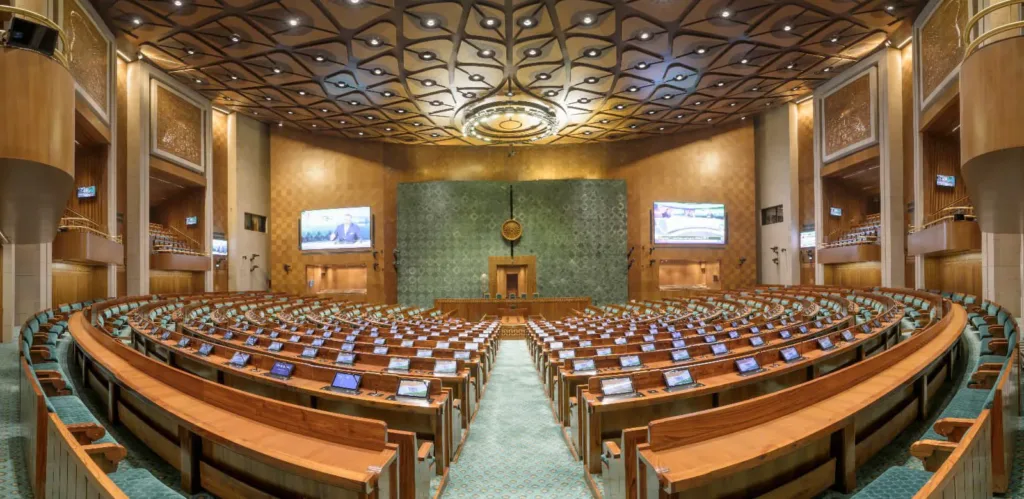
Representative image. Ministry of Parliamentary Affairs, GODL-India, Wikimedia Commons

Why it matters
The bill decides how many MPs each state sends to the Lok Sabha and whether the 33% women's quota is in place for the 2029 polls. Reports differ on how many votes the government has, and the bill text is not out, so the numbers here are claims and counts, not a result.
The Centre has called a four-day special parliament session from 30 November to 3 December, and an amended delimitation bill is expected to be its main business, though the government has not officially confirmed the agenda. Parliamentary Affairs Minister Kiren Rijiju said on 26 November that the Lok Sabha will meet from 30 November and the Rajya Sabha from 2 December, with both Houses due to end on 3 December, The Hindu reported.
The first attempt failed. On 17 April the Lok Sabha defeated the Constitution (131st Amendment) Bill, 2026, which tied delimitation (redrawing constituency boundaries and adding seats) to 33% reservation for women, by 298 votes to 230. The women’s reservation bill and delimitation travelled together then and are expected to again. What decides the second attempt is arithmetic, set out below.
What the special parliament session covers
The Monsoon Session was adjourned on 13 August but never formally ended, so the government is reconvening the same session. The Hindu counted 26 November as the 104th day since the adjournment. The Lok Sabha and Rajya Sabha secretariats have confirmed there will be no Question Hour, Zero Hour or private members’ business, Hindustan Times reported.
The special parliament session starts after a Cabinet meeting. The Union Cabinet is scheduled to meet at 1 pm on Friday, 27 November, at Sewa Teerth in New Delhi. The Hindu said the meeting is to clear the amended legislation. Hindustan Times said the Centre had not confirmed the Cabinet’s agenda. This article was written at about 10 am, before that meeting, so nothing the Cabinet decides is reflected here.
What the amended bill is reported to change
The text of the delimitation bill is not public. The Hindu, citing sources, listed three changes: a uniform 50% increase in each state’s share of Lok Sabha seats, a further 25-year freeze on using the 1971 Census to fix each state’s proportional strength, and use of the 2011 Census to redraw constituencies inside each state. The paper noted that this repeats the formula of the Constitution (84th Amendment) Act of 2001.
The April women’s reservation bill raised the Lok Sabha ceiling to 850 and tied the 33% women’s quota to the 2029 polls, according to Hindustan Times. The Indian Express reported that the government had promised a 50% rise in seats for every state but the bills did not say so in writing, and that the plan to use 2011 Census figures caused confusion. Two linked bills, the Delimitation Bill, 2026 and the Union Territories Laws (Amendment) Bill, 2026, were never taken up after the amendment failed.
Delimitation bill vote count: what the Centre needs
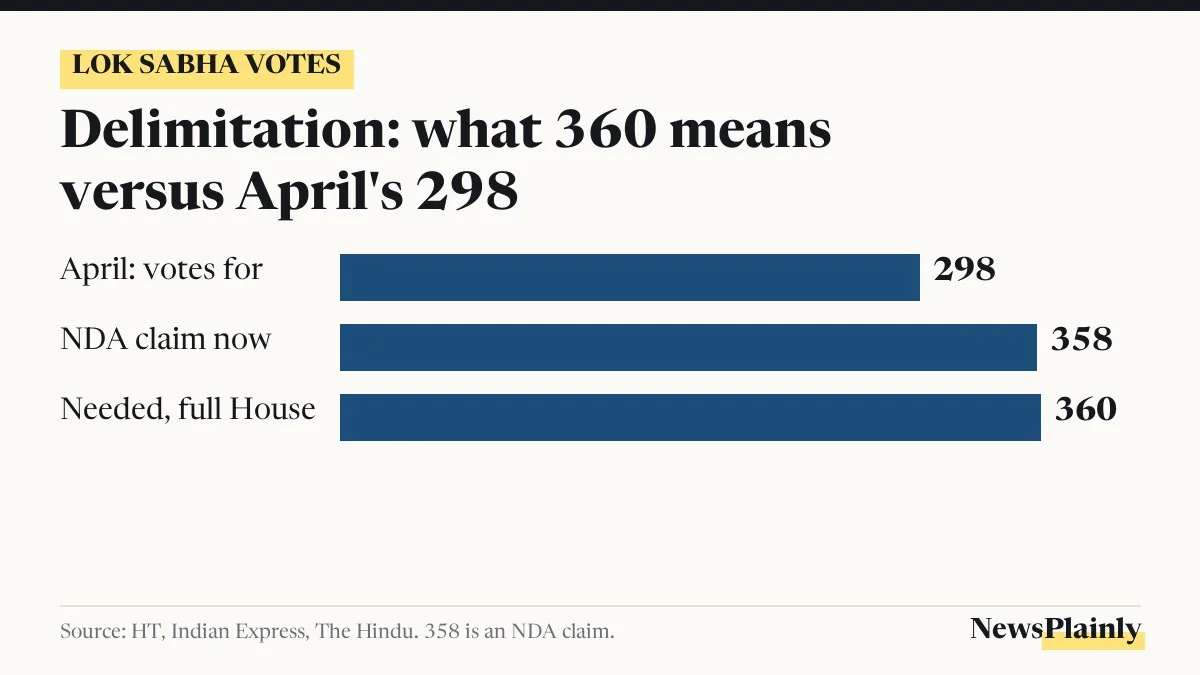
A Constitution amendment needs a two-thirds majority of members present and voting, and not less than half of the House’s total strength. It must also be ratified by at least half the states, Hindustan Times explained. The Lok Sabha has 540 members, so the Centre needs 360 votes if everyone is present, and the Opposition needs 180 to stop it.
| Lok Sabha | Figure |
|---|---|
| Members in the House | 540 |
| Votes needed if all are present | 360 |
| 17 April result | 298 for, 230 against (528 voting) |
| Votes needed on 17 April | 352 |
| Support claimed by a senior NDA leader | At least 358 |
| Votes that block the bill | 180 |
By NewsPlainly’s calculation, the government’s April count of 298 is 62 short of 360. The unnamed NDA leader’s figure of 358, given to The Hindu, would leave it two short of the full-House mark. Hindustan Times said its own calls to NDA leaders for comment went unanswered.
In the Rajya Sabha, the two outlets count differently. Hindustan Times puts the government at 154 against 163 needed in a House of 244. The Hindu puts the NDA at 152 against 164. That is a gap of 9 or 12 votes depending on the count. Hindustan Times named the Biju Janata Dal (5 members) and the YSR Congress (4) as the parties the government needs.
Who has moved since April
Twenty Trinamool Congress MPs broke away and joined the little-known Nationalist Citizens Party of India. The Trinamool has challenged the move, and Speaker Om Birla is reviewing it. The NCPI faction filed its reply on 24 November, The Hindu reported. Hindustan Times added that official records still list the rebels as Trinamool MPs because the merger is pending, and that a senior member of the group said, without being named, that they support the delimitation bill.
Six Shiv Sena (UBT) MPs joined the Eknath Shinde-led Shiv Sena. The lone Shiromani Akali Dal MP is expected to back the women’s reservation bill and delimitation with the government after the BJP-SAD alliance for Punjab. The Hindu said it had also learnt that the YSR Congress’s four MPs will back the bill.
Two larger parties are undecided. The Dravida Munnetra Kazhagam (DMK), with 22 Lok Sabha members, has made no public statement, The Hindu said. A DMK leader told Hindustan Times the party might back the delimitation bill if it gets written assurance of a proportional increase for Tamil Nadu. The Nationalist Congress Party (Sharadchandra Pawar), with eight members, is also undecided. Its working president, Supriya Sule, set three conditions: the women’s quota implemented, a 50% rise in seats in every state, and Opposition representation on the delimitation commission.
The Congress is opposed. General secretary K.C. Venugopal said the party would not allow the bill to pass, and Jairam Ramesh said the government announced the session hoping to secure a two-thirds majority, The Hindu reported.
Why the 1971 Census freeze matters to Tamil Nadu
The split of seats between states has been frozen on the 1971 Census since 1976, extended once in 2001. The Indian Express noted that the freeze ends automatically when the data of the ongoing Census is released. Swapnil Tripathi of the Vidhi Centre for Legal Policy told The Hindu that if no amendment is passed, the freeze simply lapses.
That is why southern parties are watching the wording. A senior DMK leader argued to The Hindu that if post-2026 Census figures were used, Tamil Nadu could lose as many as 12 Lok Sabha seats. Tamil Nadu’s present share is 7.2% of the House, according to The Indian Express. This is the DMK’s estimate, not an official calculation.
What to watch from 27 November to 3 December
The Cabinet meeting on 27 November is the first marker. After that comes the publication of the delimitation bill itself, which the DMK and the NCP (SP) have both said they want to read before deciding. The Lok Sabha vote would come during the sitting that begins on 30 November, and the Rajya Sabha takes it up from 2 December. If both Houses pass it, half the state legislatures must still ratify it.
Frequently asked questions
When is the special sitting of Parliament?
The Lok Sabha meets from 30 November and the Rajya Sabha from 2 December. Both Houses are due to end on 3 December, Parliamentary Affairs Minister Kiren Rijiju said on 26 November.
How many votes does the delimitation bill need in the Lok Sabha?
A two-thirds majority of members present and voting. With all 540 members present that is 360 votes; the Opposition needs 180 to block it, according to Hindustan Times.
What is delimitation?
Delimitation is the redrawing of constituency boundaries and the number of seats after a Census. The distribution of seats between states has been frozen on 1971 Census figures since 1976.
Will there be Question Hour during the special sitting?
No. The Lok Sabha and Rajya Sabha secretariats have confirmed there will be no Question Hour, Zero Hour or private members' business, Hindustan Times reported.