Illustration: NewsPlainly. Not a photograph of the event.
Why it matters
Census data is used to plan public services and welfare programmes, and this round also records caste. Most households now know the weeks in which an enumerator will call and when they can fill in their own details online instead.
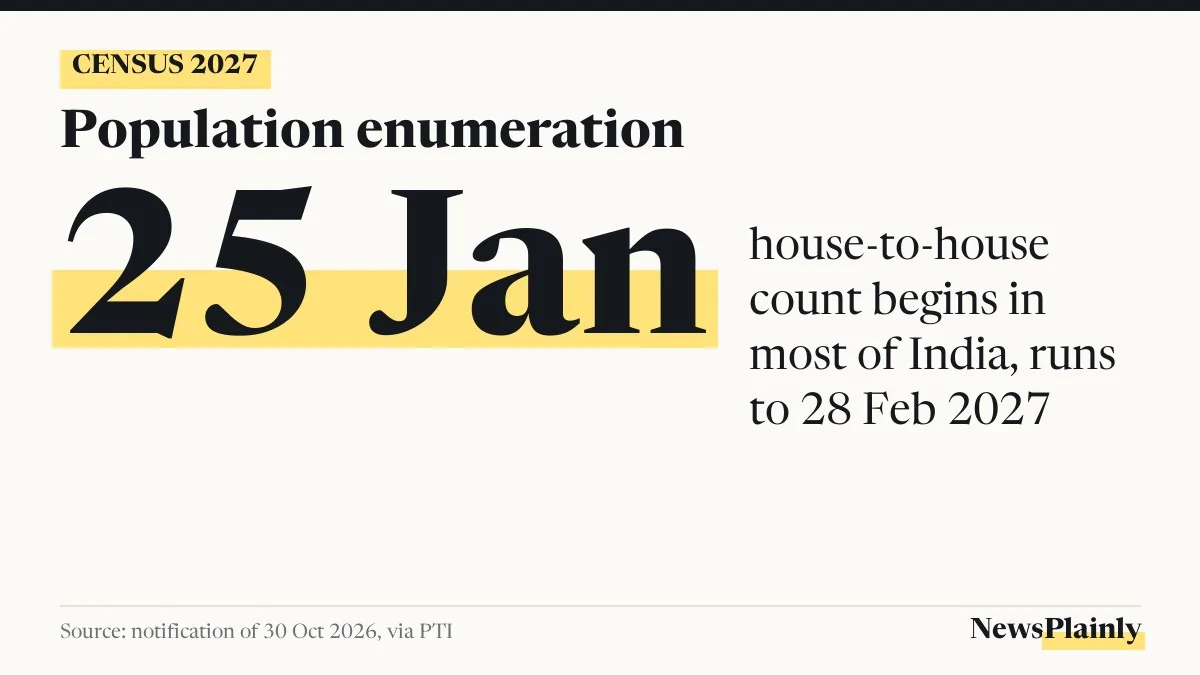
Census 2027 dates for most of India are now fixed: enumerators will go from house to house to count people from 25 January to 28 February 2027, and households can fill in their own details online from 10 January to 24 January. The schedule is in a notification issued by Registrar General of India and Census Commissioner Mritunjay Kumar Narayan, the Press Trust of India (PTI) reported on 30 October 2026.
The count will describe India as it stood at midnight (00:00 hours) on 1 March 2027, the census reference date for this round of population enumeration. A short revisional round from 1 March to 5 March 2027 will catch births, deaths and households missed in the main round.
Census 2027 dates: what the 30 October notification says
This is the second and final phase of the census, called population enumeration. Here the enumerator records details of every person in a household. The first phase, house listing, recorded buildings, homes and the amenities in them. The census website lists its notified window as 1 April to 30 September 2026.
According to PTI, the 25 January schedule covers every state and Union territory except Manipur, Goa, Uttar Pradesh, Punjab, Uttarakhand and Ladakh, and the snow-bound “non-synchronous” areas of Himachal Pradesh and Jammu and Kashmir. Non-synchronous areas are places counted at a different time from the rest of the country, usually because winter snow makes travel hard. PTI described the excluded states as poll-bound and snow-bound regions. For Manipur, the notification uses the words “till further declaration”, PTI reported, and gives no date.
The notification was issued under section 3 of the Census Act, 1948, read with rules 6A and 6D of the Census Rules, 1990. When NewsPlainly checked the Census of India website on the evening of 30 October, it had not yet posted this notification; the dates above are as reported by PTI.
Census dates by area: who is counted when
Most of the excluded areas are not left out of the census. They were given their own dates in two earlier gazette notifications, which NewsPlainly read in full on the Census of India website. Joining those with the new schedule gives the full picture of the second phase.
| Area | Self-enumeration (online) | House-to-house count | Revisional round | Reference date (00:00 hours) |
|---|---|---|---|---|
| Ladakh; snow-bound areas of Jammu and Kashmir, Himachal Pradesh, Uttarakhand | 17 to 31 Aug 2026 | 1 to 30 Sep 2026 | 1 to 5 Oct 2026 | 1 Oct 2026 |
| Goa, Uttar Pradesh, Punjab, rest of Uttarakhand | 16 to 30 Nov 2026 | 1 Dec 2026 to 4 Jan 2027 | 5 to 9 Jan 2027 | 5 Jan 2027 |
| Rest of India (except Manipur) | 10 to 24 Jan 2027 | 25 Jan to 28 Feb 2027 | 1 to 5 Mar 2027 | 1 Mar 2027 |
| Manipur | No dates: “till further declaration”, PTI reported | |||
The snow-bound areas were scheduled to be counted in September 2026. Goa, Uttar Pradesh, Punjab and the rest of Uttarakhand get a December window, with a reference date of 5 January 2027. Each area’s figures describe the population at its own census reference date, so the census 2027 dates differ by up to five months across the country.
Census self-enumeration: what households can do from 10 January
Census self-enumeration is optional. It lets a household enter its own details online before the enumerator arrives. Under the new schedule, the window for most of India is the 15 days from 10 January to 24 January 2027, just before door-to-door work begins on 25 January.
A household that skips it is still counted, because the house-to-house round follows straight after. The notifications and reports read by NewsPlainly do not set out the portal steps for this phase, so the exact process will be clear only when the window opens.
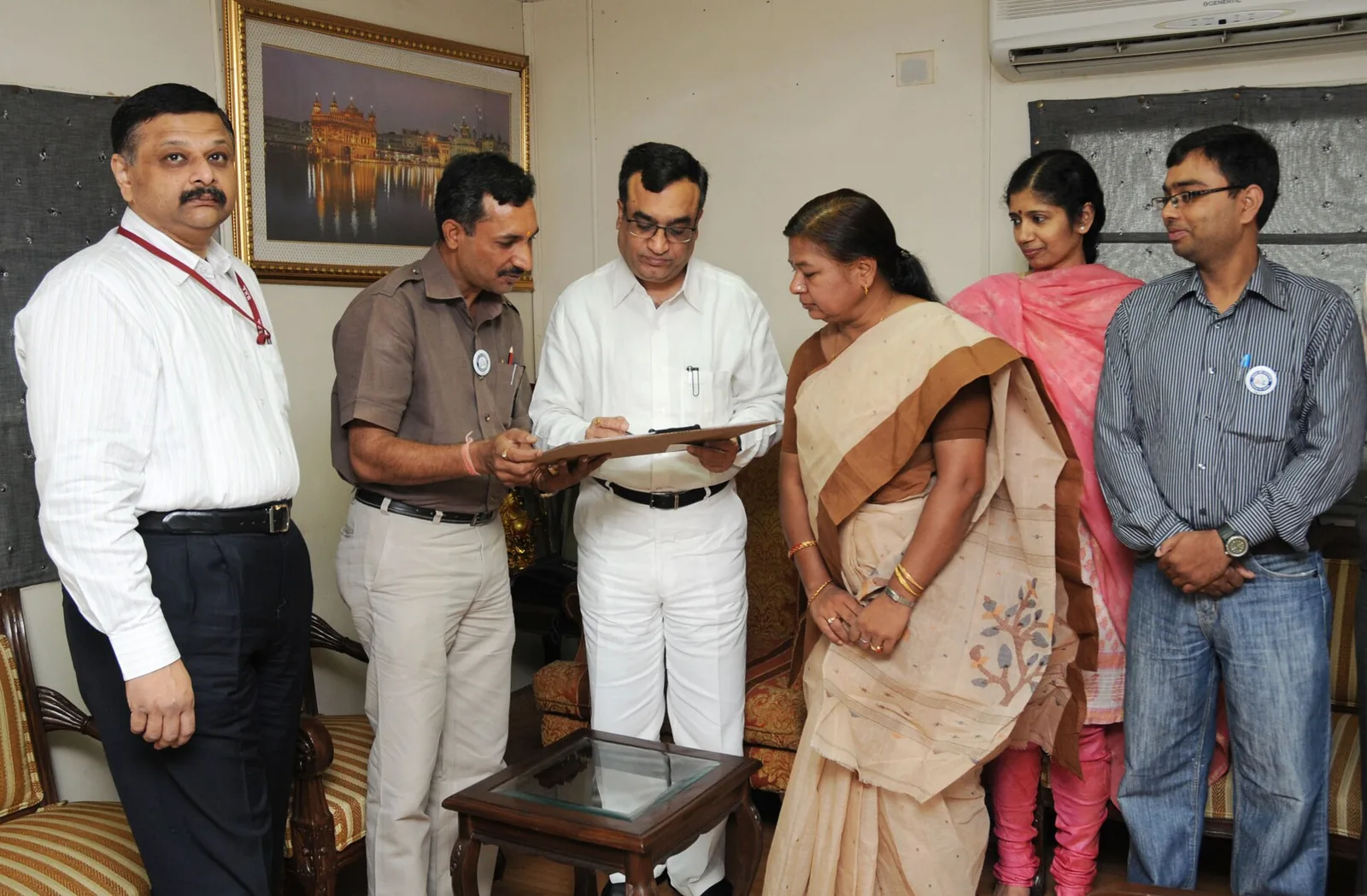
Self-enumeration was also offered in the first phase. An official photograph shows Prime Minister Narendra Modi filling in the Census 2027 self-enumeration form on 1 April 2026, the day the house listing window opened.
What the census will ask: 40 questions, including caste
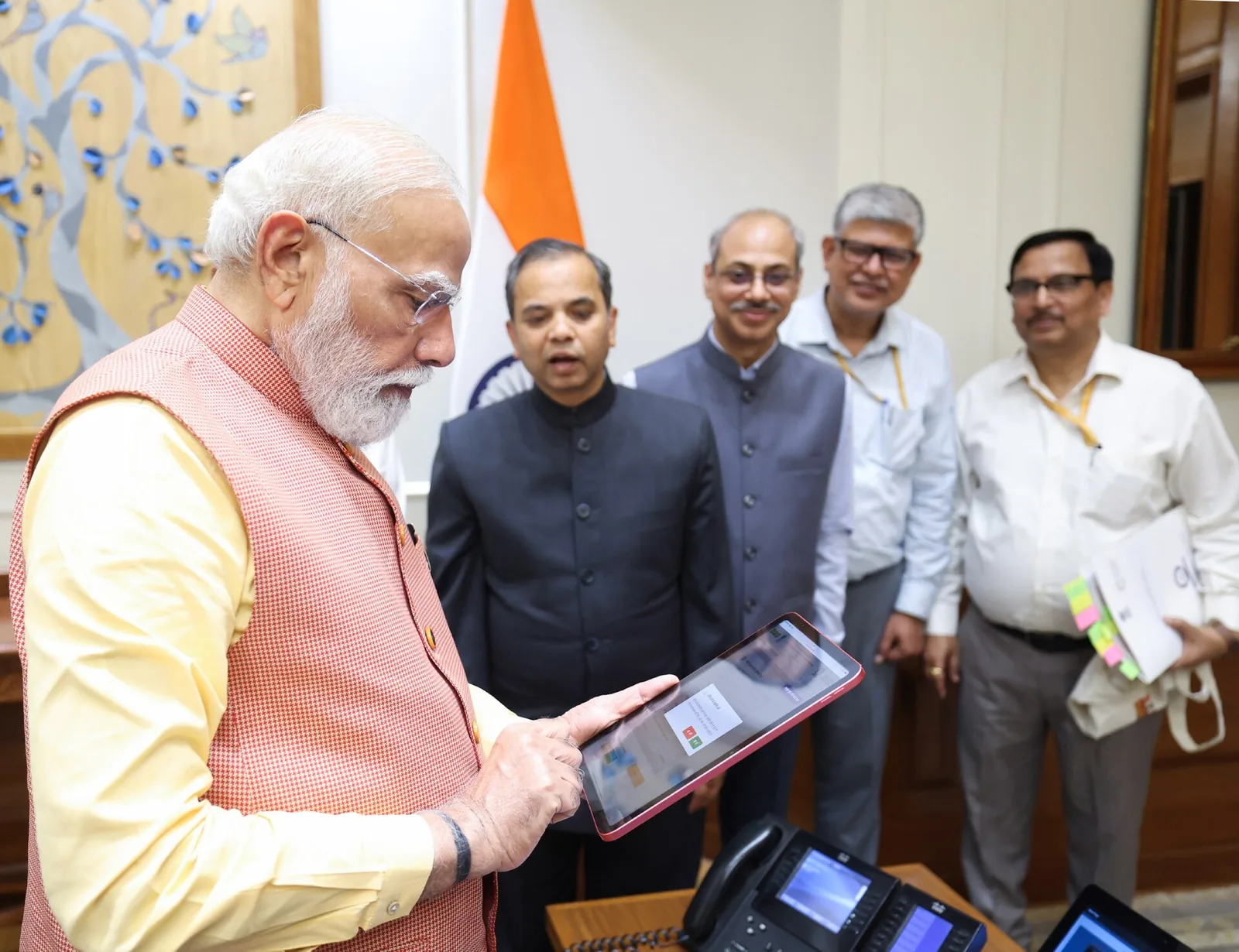
The questions for population enumeration were notified on 14 August 2026 in gazette notification S.O. 4505(E). It lists 40 items that census officers may ask about every person in a household. Grouped by topic, they cover:
- Basic details: name, relationship to the head of household, sex, date of birth and age, marital status, age at marriage and spouse’s name.
- Identity and background: nationality as declared, religion, Scheduled Caste or Scheduled Tribe status and caste, father’s and mother’s particulars, disability, and mother tongue and other languages known.
- Education: literacy and digital literacy, whether the person attends an educational institution, and the highest level and subject studied.
- Work: whether the person worked in the last year, the kind of work, occupation, industry, class of worker, whether they are looking for work, and how they travel to work.
- Migration: birthplace, last place of residence, reason for moving, how long they have lived in the present village or town, and permanent address.
- Children: children surviving and ever born alive, asked of currently married, widowed, divorced and separated women, and children born in the last year, asked of currently married women.
- Documents and services: place of Covid-19 vaccination, total number of bank accounts, mobile number, Aadhaar number and voter ID number (each “if available”), passport number for Indian passport holders, and whether the person has a driving licence.
Item 10 is where caste is recorded. The list itself shows the limits on the document questions: mobile, Aadhaar and voter ID numbers are asked “if available”, and the passport number only of those who hold an Indian passport. For the driving licence, the item is only whether the person has one.
What happens after the population enumeration
Once the revisional round ends on 5 March 2027, population enumeration for most of the country is complete. The dates for Manipur remain open. The notifications read by NewsPlainly do not give a date for the first results.
For households, the practical steps are simple. Those who want to fill in their own details have the 10 to 24 January window; the list of questions above shows what will be asked about each family member; and outside the areas with separate dates, the enumerator’s visit falls between 25 January and 28 February 2027.
Frequently asked questions
When will the census enumerator come to my house?
In most of India, between 25 January and 28 February 2027. Goa, Uttar Pradesh, Punjab and non-snow-bound Uttarakhand are counted from 1 December 2026 to 4 January 2027.
What is the census self-enumeration window?
10 January to 24 January 2027 for most of India, according to the notification as reported by PTI. It is optional; the house-to-house count follows from 25 January.
What is the census reference date?
00:00 hours on 1 March 2027 for most of India. It is 5 January 2027 for Goa, UP, Punjab and the rest of Uttarakhand, and 1 October 2026 for snow-bound areas.
Will Census 2027 ask about caste?
Yes. Item 10 of the 40 questions notified on 14 August 2026 covers Scheduled Caste, Scheduled Tribe and caste.