
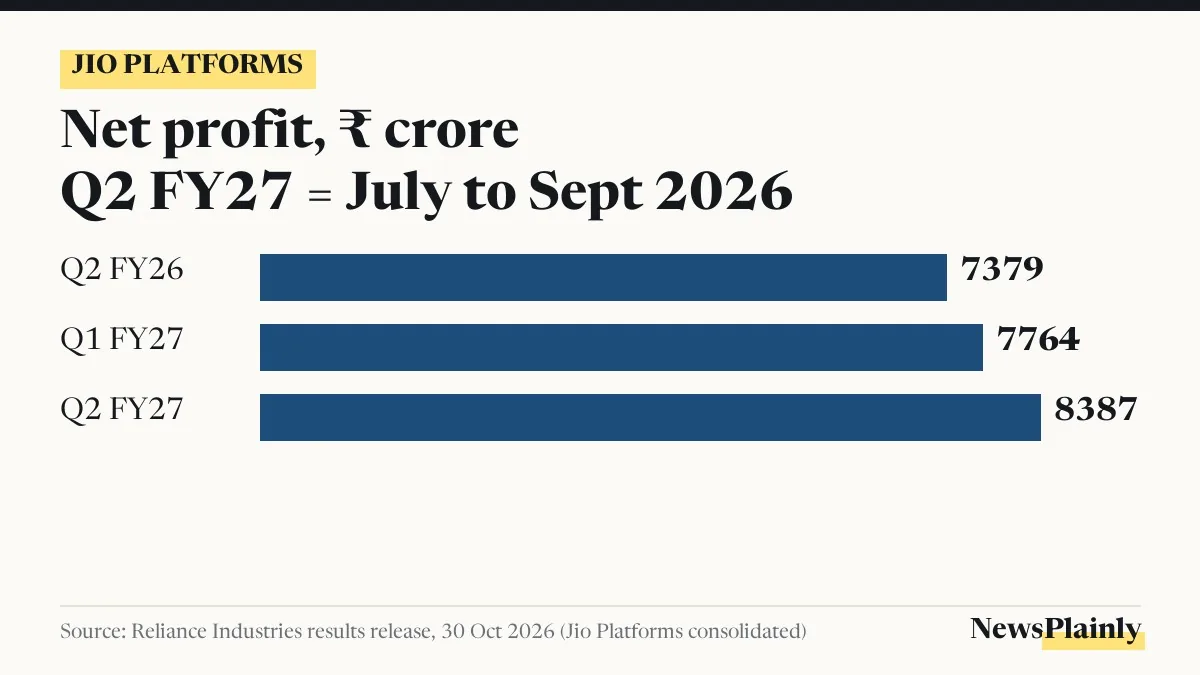
Illustration by NewsPlainly. The bars are decorative, not a chart of Jio's results; the figures are in the table below.
Why it matters
Jio Platforms is now a listed company with retail shareholders, and these are the first results they can judge it on. The figures show earnings growing faster than revenue, but higher interest costs from 5G spending held profit growth to 13.7%. Many debut-day buyers used borrowed money, which makes price swings matter more to them.
Jio Platforms Q2 results, the first since the company listed on the stock exchanges, showed a net profit of ₹8,387 crore for July to September 2026, up 13.7% from ₹7,379 crore a year earlier. Revenue from operations rose 11.4% to ₹40,475 crore, according to the results release Reliance Industries published on 30 October 2026, after the market had closed.
The numbers arrived two days after the Reliance telecom and digital arm made its stock market debut on 28 October. Its operating margin widened, its customer base passed 542 million, and Jio ARPU (average revenue per user, what a typical customer pays in a month) rose to ₹218.8. Profit grew more slowly than operating earnings, though, as finance costs jumped by about 40%.
Jio Platforms Q2 results in one table
The release compares the September quarter, Q2 of financial year 2026-27 (FY27), with the June quarter and with the same quarter of FY26 (2025-26). EBITDA (earnings before interest, tax, depreciation and amortisation) is a common measure of operating profit; the company calculates its margin on revenue from operations.
| Item | Q2 FY27 | Q1 FY27 | Q2 FY26 | Change in a year |
|---|---|---|---|---|
| Revenue from operations | ₹40,475 cr | ₹39,173 cr | ₹36,332 cr | +11.4% |
| EBITDA | ₹21,879 cr | ₹20,865 cr | ₹18,757 cr | +16.6% |
| EBITDA margin | 54.1% | 53.3% | 51.6% | +2.5 points |
| Finance costs | ₹3,009 cr | ₹2,980 cr | ₹2,145 cr | +40.3% |
| Net profit | ₹8,387 cr | ₹7,764 cr | ₹7,379 cr | +13.7% |
| Customers | 542.4 million | 533.3 million | 506.4 million | +7.1% |
| Monthly ARPU | ₹218.8 | ₹215.6 | ₹211.4 | +3.5% |
| Monthly churn | 1.6% | 1.6% | 1.9% | down 0.3 points |
Against the June quarter, NewsPlainly’s arithmetic from the same table puts net profit up 8.0% (from ₹7,764 crore), revenue from operations up 3.3% and EBITDA up 4.9%. Gross revenue, which includes items such as goods and services tax, was ₹47,485 crore, up 11.3% in a year.
Behind the Jio Platforms Q2 results, both parts of the business grew by double digits, the release says: connectivity revenue by 11% and digital services by 16%.
Why Jio Platforms net profit grew slower than EBITDA
EBITDA rose 16.6% while Jio Platforms net profit rose 13.7%. The gap comes from costs below the operating line. Finance costs climbed to ₹3,009 crore from ₹2,145 crore a year earlier, and depreciation rose 14.0% to ₹7,611 crore. The company links the higher finance costs to 5G assets it capitalised in March 2026, that is, network spending it moved onto its books as finished assets. Interest on money borrowed for an asset usually stops being added to the asset’s cost at that point and is charged against profit instead.
The release says EBITDA growth, which also lifted Jio Platforms net profit, came from higher revenue and operating leverage, in other words revenue growing faster than the costs of running the network. The margin of 54.1% compares with 51.6% a year earlier, an increase of 250 basis points (100 basis points make one percentage point).
Some early reports gave Jio Platforms net profit as ₹8,389 crore and the margin gain as 181 basis points. The company’s own table shows ₹8,387 crore and 250 basis points, and those are the figures used here.
Subscribers, Jio ARPU and the 30 million broadband mark
Jio ARPU rose to ₹218.8 from ₹215.6 in the June quarter. The release says promotional offers for fixed broadband customers offset part of the gain from a better mix of subscribers and higher use.
Jio added 9.1 million customers in the quarter, taking the base to 542.4 million. Monthly churn, the share of customers who leave each month, stayed at 1.6%. Each customer used 44.2 GB (gigabytes) of data a month on average, and total data traffic rose 22.1% in a year to 71.3 billion GB.
The company says it crossed two milestones during the quarter: 300 million 5G users, up 66 million in 12 months, and 30.0 million fixed broadband subscribers. Jio AirFiber, its wireless home broadband service, had 15.1 million users and accounted for more than 75% of the fixed broadband additions over the past year.
Managing director Akash Ambani said in the release that the company was entering “a new era as a listed company” and would keep building capabilities in satellite communications, 6G intellectual property and AI.
Jio share price against the ₹1,119 IPO price
The results came after trading hours, so the Jio share price has not yet reacted to them. On 30 October the stock ended at ₹1,431.30 on the National Stock Exchange (NSE), up 0.68% from ₹1,421.60 the day before, according to Upstox, citing exchange data. That gave a market value of over ₹13.18 lakh crore. The Economic Times reported that the stock had gained more than 28% over its first three sessions.
As NewsPlainly reported, the shares opened at ₹1,358 on 28 October, 21.36% above the ₹1,119 issue price in the initial public offering (IPO).
What ₹1,119 at the IPO is worth now (NewsPlainly’s calculation): ₹1,431.30 minus ₹1,119 is ₹312.30 a share, or 27.9%. A retail investor who got one lot of 12 shares paid ₹13,428; at the 30 October close that lot was worth ₹17,175.60, a paper gain of ₹3,747.60 before brokerage, charges and tax. The gain is real only when shares are sold, and the price can fall as well as rise.
Profit per customer (NewsPlainly’s calculation): dividing the ₹8,387 crore net profit by 542.4 million customers gives about ₹155 per customer for the quarter, or about ₹52 a month. Set against Jio ARPU of ₹218.8, that is roughly a quarter. This is a rough guide only. It uses the customer count at the end of the quarter, the profit includes the digital services business as well as mobile, and ARPU is the company’s own measure.
Borrowed money on debut day and what brokerages say
Retail investors borrowed ₹2,227 crore through the margin trading facility (MTF) to buy Jio shares on 28 October, Mint reported, citing exchange data. MTF lets an investor buy shares with money lent by the broker, paying interest and putting up only part of the price. Of that amount, ₹2,182 crore was on the NSE. Mint said the NSE’s MTF book grew by ₹2,337 crore that day and 93% of the increase went into Jio shares, and that only HDFC Bank, Reliance Industries and BSE Ltd had larger margin positions than Jio. An analyst quoted by Mint pointed out that borrowed positions add pressure if a stock falls sharply.
Brokerages started coverage around the listing. Motilal Oswal set a target of ₹1,350 and Nomura ₹1,340, both with buy ratings, Business Upturn reported on 28 October; both views assume Jio raises mobile tariffs after listing and rivals follow. The business channel CNBC-TV18 reported that at least four brokerages had begun coverage, with targets between ₹1,340 and ₹1,435. The Jio share price at the 30 October close was already above the Motilal Oswal and Nomura targets. Targets are forecasts by those firms, not guarantees, and this article is not investment advice.
What the results do not tell us
The release does not say whether or when Jio will raise tariffs, the assumption behind the brokerage targets cited above. It says ₹27,500 crore of the IPO money has gone to prepay foreign currency loans, known as external commercial borrowings, taken by its main subsidiary Reliance Jio Infocomm. That happened after the quarter ended, so any saving on interest is not in these numbers, and the release does not put a figure on it.
Beyond the Jio Platforms Q2 results themselves, some gaps remain. Mint’s margin funding figures are for the debut day. The material reviewed does not show how much of that borrowing was still open by 30 October. How the stock responds to the results will show only when trading resumes after the weekend.
Frequently asked questions
What was Jio Platforms' Q2 FY27 net profit?
₹8,387 crore for July to September 2026, up 13.7% from ₹7,379 crore a year earlier, according to the results Reliance Industries released on 30 October 2026.
What is Jio's ARPU now?
Monthly average revenue per user was ₹218.8 in Q2 FY27, against ₹215.6 in the June quarter and ₹211.4 a year earlier.
How much is the Jio share above its IPO price?
It closed at ₹1,431.30 on the NSE on 30 October, before the results, which is 27.9% above the ₹1,119 issue price on NewsPlainly's calculation.
Why did profit grow less than EBITDA?
Finance costs rose 40.3% to ₹3,009 crore and depreciation rose 14.0%. The company links the higher finance costs to 5G assets capitalised in March 2026.