File photo: Bhandardara reservoir, Maharashtra, 11 June 2016. Not an image of the April 2026 heatwave. Representative image. Sid712, CC BY-SA 4.0, Wikimedia Commons

Why it matters
The India exposure estimate shows the scale of one heat event. Different reporting periods and measures need to stay visible so a global temperature figure is not confused with local weather or a death toll.
The WMO heat report released on 9 November 2026 puts this year among the four warmest on record and estimates that 14.65 crore people in India were exposed to extreme heat during an April heatwave. The global temperature figure is provisional: it covers January to September, rather than the completed year.
The World Meteorological Organization (WMO) issued its State of the Climate Update at the opening of the United Nations climate conference (COP31), in Antalya, Türkiye. It warned that a strengthening El Nino could add to heat and extreme-weather risks into 2027. The update brings together temperature, ocean, ice and water indicators.
What the WMO heat report measures
Global mean near-surface temperature was about 1.47°C above the 1850 to 1900 average during the first nine months of 2026, WMO said in its published account of the update. The estimate, based on nine international datasets, carries an uncertainty range of plus or minus 0.13°C.
That number is a temperature anomaly: the difference from an earlier baseline. It does not mean that the planet’s average temperature was 1.47°C, or that every Indian city was that much warmer. A global average and a local heatwave describe different things.
WMO said the four years from 2023 to 2026 occupy the four warmest positions in the record. The final place of 2026 still depends on the rest of the year. Its January to September estimate should not be treated as a completed annual result.
| Period | Temperature above 1850 to 1900 | Coverage |
|---|---|---|
| 2023 | 1.46°C | Full year |
| 2024 | 1.55°C | Full year |
| 2025 | 1.43°C | Full year |
| 2026 | About 1.47°C | January to September only |
Representative image. Sid712, CC BY-SA 4.0, Wikimedia Commons
The India estimate counts exposure, not deaths
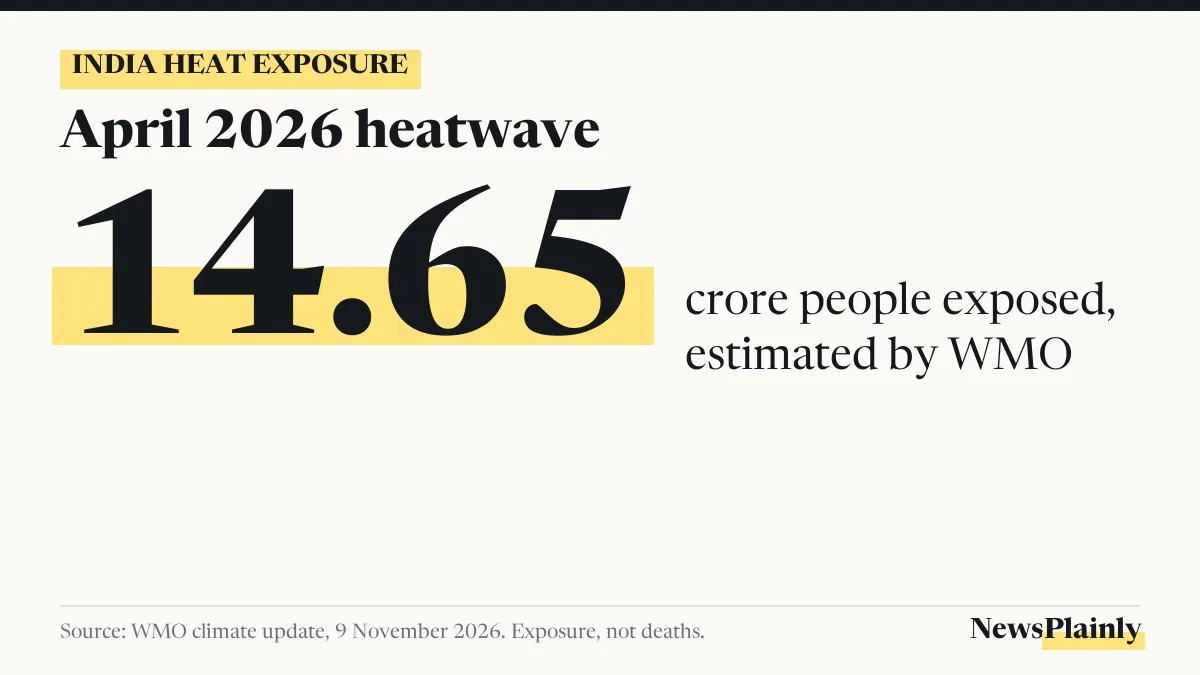
WMO estimated that 146.5 million people in India were exposed to extreme heat in an April 2026 heatwave. NewsPlainly’s unit conversion divides that figure by ten to express it as 14.65 crore people.
This is an estimate of people exposed during that event. It is not a death toll, a count of hospital admissions or a total for every heatwave across India during the year. Keeping the event and the measure together matters when comparing it with other climate and health figures.
The figure gives the report a direct India connection alongside the global indicators. Heat exposure and the international negotiations are related parts of the wider climate story, but this scientific update does not itself announce a new Indian rule or assistance payment. NewsPlainly’s earlier COP31 preview explains the talks and India’s finance priorities.
Why El Nino adds to an already warmer system
El Nino is the warm phase of a recurring Pacific Ocean climate pattern. WMO said it had intensified since August and was expected to reach record strength by December. That is a forecast, not a December observation already made.
The organisation explained that El Nino releases heat from the ocean rather than creating new heat. Greenhouse gases are also trapping energy, increasing the imbalance between energy arriving from the sun and energy leaving the planet. The ocean absorbs about 90% of that excess heat, according to WMO.
Preliminary measurements through July point towards a tenth consecutive year of record ocean heat content. Global mean sea level also reached a record high in the satellite record, which began in 1993. These measures concern stored ocean heat and sea level, rather than the temperature of the air alone.
WMO described El Nino as increasing risks from extreme heat, drought and heavy rainfall into 2027. The global assessment does not provide a district-by-district Indian forecast. It cannot be used to assign a particular rainfall outcome to a specific farm or city.
For agriculture, WMO highlighted higher risks in key growing seasons, particularly where food insecurity is already high and production depends heavily on rainfall. That is a broad risk assessment, not a prediction of a particular Indian crop loss.
The next complete assessment is due in March
The organisation plans to issue its final State of the Global Climate 2026 report in March 2027. The November update uses information available up to September where possible, with earlier cut-offs for some measures, including ocean heat.
WMO also reported that the number of countries saying they had multi-hazard early warning systems rose from 56 in 2015 to 136 in 2025. That counts reported systems, not a guarantee that every person receives a warning. The organisation said sustained observations and forecasts remain essential as climate risks increase.
Frequently asked questions
Is 2026 already confirmed as the hottest year?
No. WMO places it among the four warmest, while the 1.47°C estimate covers January to September. The full-year assessment is still pending.
Does 14.65 crore mean heat-related deaths?
No. It is WMO's estimate of people exposed to extreme heat during an April 2026 heatwave in India.
Does the report predict rainfall for a particular Indian district?
No. The global assessment describes climate risks and does not provide a district-specific Indian forecast.