
Representative image. SnapMeUp, CC BY-SA 4.0, Wikimedia Commons

Why it matters
These rules decide how the regulator checks that medical colleges have the teachers, patients and facilities they claim. If penalties for false records are weaker, students could end up in colleges that fall short, and patients could be treated by less well trained doctors. The NMC says the checks remain; how it enforces them will show who is right.
MSMER 2023, the rulebook the National Medical Commission (NMC) used since September 2023 to keep India’s medical colleges up to standard, has been withdrawn. The NMC, which regulates medical education and doctors in India, signed the withdrawal on 14 October 2026 and it took effect when it was printed in the Gazette of India, the government’s official journal, in an issue dated 16 October. The decision has split opinion: patient-safety activists say it weakens penalties for colleges and doctors who file false records, while the NMC says nothing that protects standards has gone.
What the MSMER 2023 withdrawal notice actually says
The notification is short, under a page in English. It cancels the Maintenance of Standards of Medical Education Regulations, 2023, using the commission’s powers under sections 10, 24, 25 and 57 of the NMC Act, 2019, read with the General Clauses Act, 1897. It is signed by NMC secretary Dr Raghav Langer. The regulations it cancels were notified on 19 September 2023 and printed in the Gazette two days later, so they lasted just over three years.
Three things survive, the Gazette notice says. First, medical colleges must still file an Annual Disclosure Report (ADR), the yearly statement of their faculty, buildings, hospital beds and patient load, under sections 24(i) and 25(h) of the NMC Act. Second, anything already done under the 2023 rules stays valid: approvals, renewals, orders, and liabilities already incurred. Third, cases, appeals and inquiries that were pending on the day of withdrawal will be finished under the old rules.
Anything that arises from the withdrawal date onward falls under the NMC Act and whatever other regulations are in force, the notice adds. It does not name a replacement regulation, and The Hindu reported that there is none.
Why activists say medical colleges now face weaker penalties
The 2023 rules carried their own fines. Colleges could face penalties of up to ₹1 crore for specified violations, and faculty, heads of department, deans or directors who submitted false declarations or records, including patient records, could be fined up to ₹5 lakh each, The Hindu reported.
Dr Babu K.V., an ophthalmologist and medical activist, told the newspaper that the ₹5 lakh personal penalty sat in clause 8(2)(c) of the September 2023 regulation, and that this was the clause that made individual doctors answerable. In his view, removing it is a “dilution of regulatory oversight”.
Bejon Kumar Misra, founder of the Patient Safety and Access Initiative of India Foundation, said scrapping a detailed framework without spelling out equal safeguards creates uncertainty over how false disclosures and deficiencies in colleges will be handled. He has written to the Union government, asking the Union Health Ministry and the NMC to explain which enforcement steps remain, The Hindu reported. His concern is that inflated patient records or thin clinical training could go unnoticed and, in the end, affect patients.

The NMC’s answer: an overlap removed, not a safeguard
The NMC rejects the charge of dilution. In a press release on 22 October, reported by ANI, the commission said the 2023 rules had created a second system of inspection, annual renewal and enforcement run by its two education boards, the Undergraduate Medical Education Board (UGMEB) and the Postgraduate Medical Education Board (PGMEB). That overlapped with the Medical Assessment and Rating Board (MARB), which section 26 of the NMC Act empowers to inspect colleges and act against those found short.
The commission said it removed the duplication after “judicial observations” and a review of the law. It did not name the court case. A senior official told The Hindu the decision had been misread, and that the legal team had recommended streamlining.
According to the NMC, the only procedural change is that colleges no longer need the extra annual renewal under MSMER 2023. The minimum standard requirements for undergraduate and postgraduate courses, covering faculty, infrastructure, clinical material, attendance and teaching, still apply in full. MARB can still inspect colleges, including without notice, and act against them under regulations 30 and 31 of the Establishment of Medical Institutions, Assessment and Rating Regulations, 2023, the commission said.
NMC president Dr Abhijat Sheth told Medical Dialogues that “regulatory simplification must not be mistaken for regulatory relaxation”.
Old rules and new position side by side
NewsPlainly compared what the notice, the NMC’s statement and the critics say about each part of the old framework:
| Item | Under MSMER 2023 | After withdrawal |
|---|---|---|
| Annual Disclosure Report | Required | Still required (notice, para 2) |
| Extra annual renewal by education boards | Required | Removed (NMC statement) |
| Fine on colleges for violations | Up to ₹1 crore | Rule-specific fine gone; NMC says MARB can still act |
| Personal fine for false records | Up to ₹5 lakh, clause 8(2)(c) | Clause deleted, critics say; NMC says oversight intact |
| Cases pending on withdrawal date | Under MSMER 2023 | Continue under MSMER 2023 (notice, para 3) |
What none of the sources settles is whether a college found to have faked faculty or patient records after 16 October can be fined, and by how much. The NMC has said MARB can take “appropriate action” but has not listed the penalties.

What it means for 846 medical colleges and students
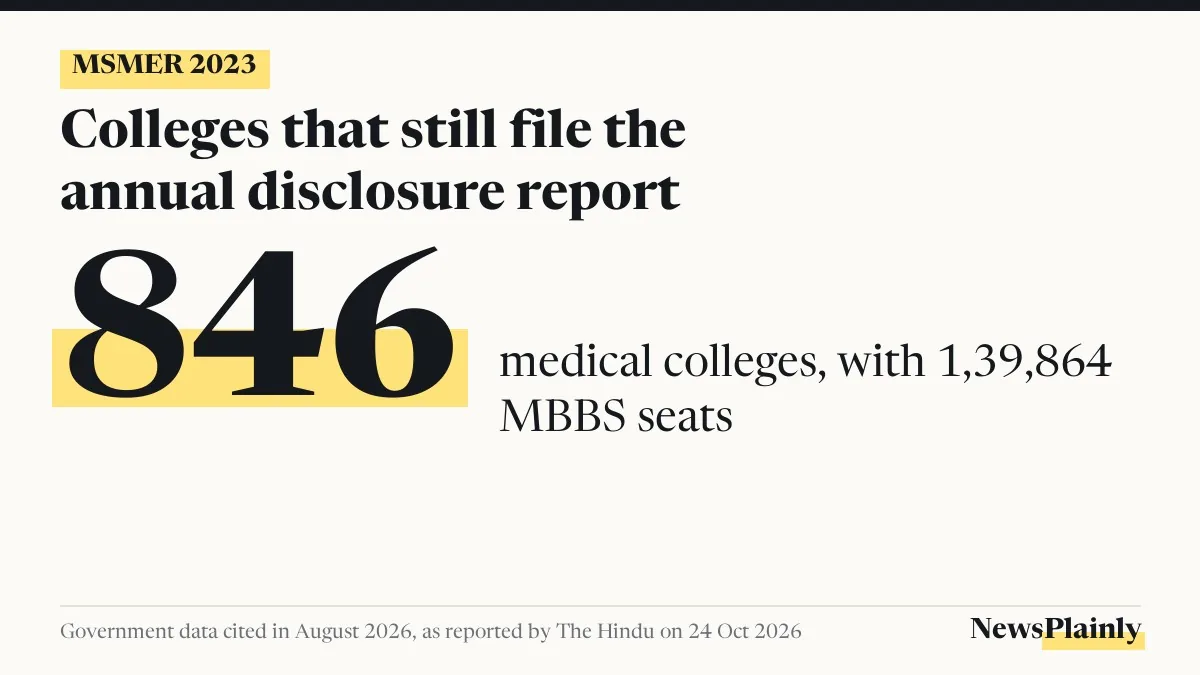
The stakes are large. India had 846 medical colleges, 1,39,864 MBBS (the basic medical degree) seats and 86,360 postgraduate seats according to government data cited in August 2026, The Hindu reported. Every one of these colleges files the annual disclosure, and students choosing a college often rely on whether it meets NMC standards.
The withdrawal also comes soon after a nationwide agitation demanding more accountability in the undergraduate medical entrance examination, the newspaper noted.
For colleges, the immediate change is one less renewal process each year. For students and patients, the question raised by activists is about checks: whether inspections by MARB, without the old fine schedule, will catch false disclosures. Earlier this week NewsPlainly reported on another rule tightening hospital practice, a Health Ministry ban on reusing single-use devices.
Frequently asked questions
What is MSMER 2023?
The Maintenance of Standards of Medical Education Regulations, 2023, were NMC rules notified in September 2023 that set up annual checks, renewal and penalties for medical colleges.
When was MSMER 2023 withdrawn?
The NMC signed the withdrawal notice on 14 October 2026, and it took effect from its publication in the Gazette issue dated 16 October 2026.
Do medical colleges still have to file annual disclosure reports?
Yes. The notice says the Annual Disclosure Report requirement continues under sections 24(i) and 25(h) of the NMC Act, 2019.
Are penalties for false records removed?
Activists say the specific fines of up to ₹1 crore for colleges and ₹5 lakh for staff are gone. The NMC says its Medical Assessment and Rating Board can still inspect colleges and act against them.