Representative image. BSEINDIA, CC BY-SA 3.0, Wikimedia Commons

Why it matters
Lakhs of Indians pay for trading courses run by social media personalities. This order draws a line between teaching and giving paid stock calls without registration, and sets out how participants of this academy are to be repaid.
Avadhut Sathe refund: the Securities and Exchange Board of India (SEBI), the stock market regulator, has ordered stock market trainer Avadhut Sathe and his company, Avadhut Sathe Trading Academy Private Limited, to repay ₹546.17 crore in course fees to participants within five months. In a 171-page final order dated 23 October 2026, SEBI’s quasi-judicial authority N Murugan found that the academy gave stock tips and trading calls without being registered to do so, under the label of education.
The order also bars Sathe and the academy from the securities market for at least two years and imposes penalties totalling ₹11.5 crore on the academy, Sathe and fellow director Gouri Sathe.
What the SEBI final order directs
The main directions, taken from paragraphs 537 to 539 of the order, are:
- Refund: the academy and Sathe must jointly repay ₹546.17 crore collected as fees, within five months of receiving the order, through a dedicated bank account.
- Interest: they must also pay ₹67.87 crore, simple interest at 12% a year from 10 October 2025, into SEBI’s Investor Protection and Education Fund (IPEF), a fund the regulator uses for investor awareness and protection.
- Market ban: the academy and Sathe cannot buy, sell or deal in securities for two years, or until the refund is complete, whichever is later. Gouri Sathe is barred for six months.
- Penalties: ₹6 crore on the academy, ₹4 crore on Avadhut Sathe and ₹1.5 crore on Gouri Sathe, payable within 45 days.
- Frozen accounts: their bank accounts stay frozen for withdrawals, except to move money into the refund account, and they cannot sell assets except to pay refunds.
The order also tells all three to stop offering unregistered investment advice or research, and not to use live or historical market data to predict where a particular stock will move.
Why SEBI says the courses were investment advice
In India, anyone who gives stock-specific buy or sell advice for a fee must register with SEBI as an investment adviser or research analyst. The SEBI final order found that none of the three was registered in either role.
The order says that during live market sessions, and in WhatsApp groups that participants paid an annual fee to join under a mentorship programme, Sathe named specific stocks and gave entry and exit points, stop-loss levels (prices at which to cut a loss) and price targets. It held that calling the programme educational did not change the nature of that activity.
SEBI also found that the academy promoted selected profitable trades and participant testimonials suggesting steady high returns, while its analysis showed those trainers and participants were in net losses. It had issued an administrative warning about misleading promotion on 1 March 2024, and the order says the misleading material continued after that.
The academy disputed this. Its reply, recorded in the order, said it offered structured market education, that about 97% of instruction in its flagship course, called GEO, which runs over 230 hours, used historical data, and that live demonstrations made up about 3%. SEBI rejected that defence for the sessions and WhatsApp messages it examined.
Where the ₹546 crore Avadhut Sathe refund comes from
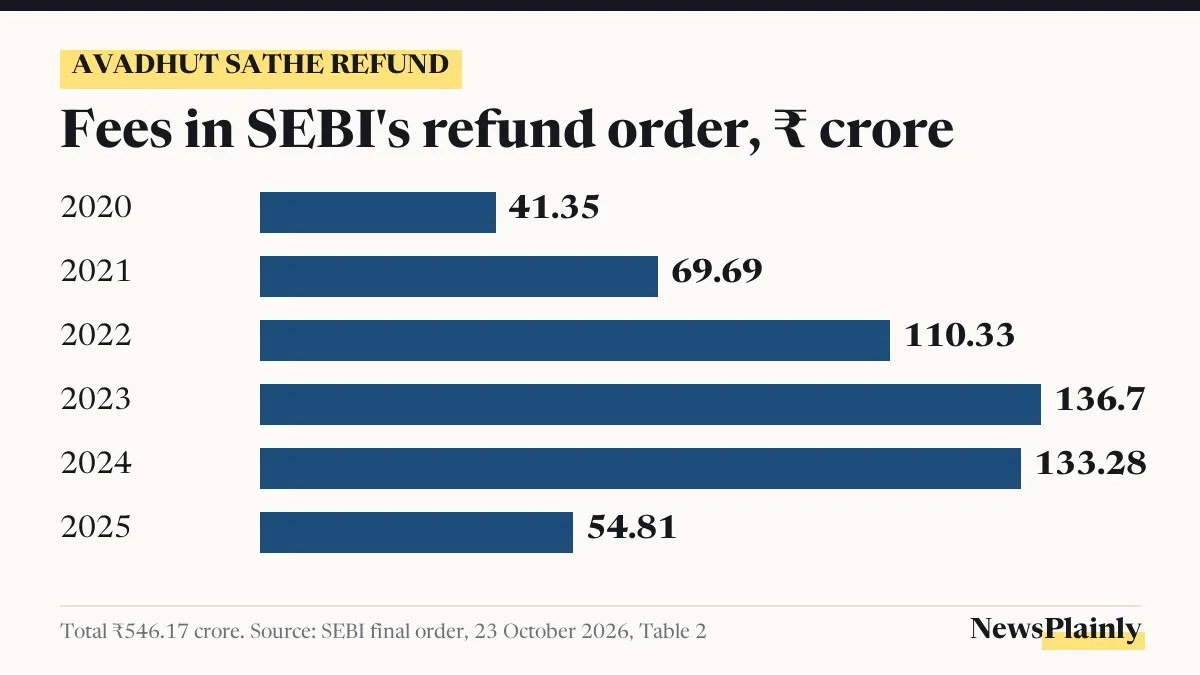
The order says the academy collected ₹601.38 crore from course participants between July 2015 and October 2025. SEBI ordered the Avadhut Sathe Trading Academy to refund only the course fees it had direct evidence for, ₹546.17 crore across eight courses from 2020 to 2025. By NewsPlainly’s calculation, that is about 91% of everything collected.
| Year | Fees in refund (₹ crore) | Of which GEO course |
|---|---|---|
| 2020 | 41.35 | 37.50 |
| 2021 | 69.69 | 61.71 |
| 2022 | 110.33 | 79.15 |
| 2023 | 136.70 | 105.06 |
| 2024 | 133.28 | 100.17 |
| 2025 | 54.81 | 39.90 |
| Total | 546.17 | 423.49 |
The GEO course alone accounts for about 78% of the refund. Fees peaked at ₹136.70 crore in 2023 and stayed close to that in 2024, the year of SEBI’s warning, before dropping in 2025, when the investigation began.
How SEBI set the penalties and the ban
The penalties come under two sections of the SEBI Act. Section 15EB covers investment advisers and research analysts who break the rules, with a ceiling of ₹1 crore: the academy and Avadhut Sathe were each fined that ₹1 crore maximum, and Gouri Sathe ₹50 lakh. Section 15HA covers fraudulent and unfair trade practices, where the penalty can go up to ₹25 crore or three times the profit made, whichever is higher. SEBI used it for the misleading promotional videos.
In weighing the amounts, the order treats the ₹546.17 crore as the measured loss caused, calls the conduct repetitive, and counts the fact that misleading promotion continued after the March 2024 warning as an aggravating factor. Gouri Sathe was treated differently. The order says her liability rests on neglect in overseeing the company as a director, and that the findings do not show she personally gave the advice or gained from it, which is why her ban is six months rather than two years.
How the Avadhut Sathe refund will reach participants
The order puts the duty to organise refunds on the academy and Sathe, not on participants or on SEBI. Within 30 days of receiving the order, they must publish a public notice in all editions of one English and one Hindi national newspaper and one local-language paper, setting out how to claim a refund and whom to contact.
Refunds can be paid only by electronic transfer or another banking channel that leaves an audit trail. Any money left unclaimed goes to SEBI, which holds it in an escrow account for one year for eligible participants before moving the rest to the investor fund. After the refunds, the academy must file a completion report certified by a peer-reviewed chartered accountant.
How the Avadhut Sathe case got here
SEBI appointed an investigating authority on 24 July 2025, searched the academy’s premises on 20 and 21 August 2025 with a special court’s approval, and passed an interim order on 4 December 2025 that impounded ₹546 crore. The Securities Appellate Tribunal (SAT), which hears appeals against SEBI, partly allowed Sathe’s appeal on 22 January 2026 over that impounding; Moneylife reported the tribunal reduced the amount to be secured to ₹100 crore in a fixed deposit.
The final order can also be challenged before the tribunal. Sathe and the academy had not commented publicly on it in the reports NewsPlainly checked.
Frequently asked questions
How much does Avadhut Sathe have to refund?
₹546.17 crore, jointly with his academy, within five months of receiving SEBI's order dated 23 October 2026, plus ₹67.87 crore in interest paid into SEBI's investor fund.
How will participants get their money back?
Within 30 days the academy must publish notices in English, Hindi and local-language newspapers explaining how to claim. Refunds must be paid electronically.
Why did SEBI act against the academy?
SEBI found the academy gave stock-specific recommendations, targets and stop-loss levels in live sessions and paid WhatsApp groups without registering as an investment adviser or research analyst.