Representative image. Indrajit Das, CC BY-SA 4.0, Wikimedia Commons

Why it matters
Kotak is one of India's largest private banks, with 5.1 crore customers, so its numbers show how the RBI's dollar deposit drive has flowed into bank balance sheets. The extra deposits funded faster loan growth but cost the bank part of its margin, a trade-off other lenders that raised FCNR(B) money may also report. Falling bad loans point to steady repayment by its borrowers.
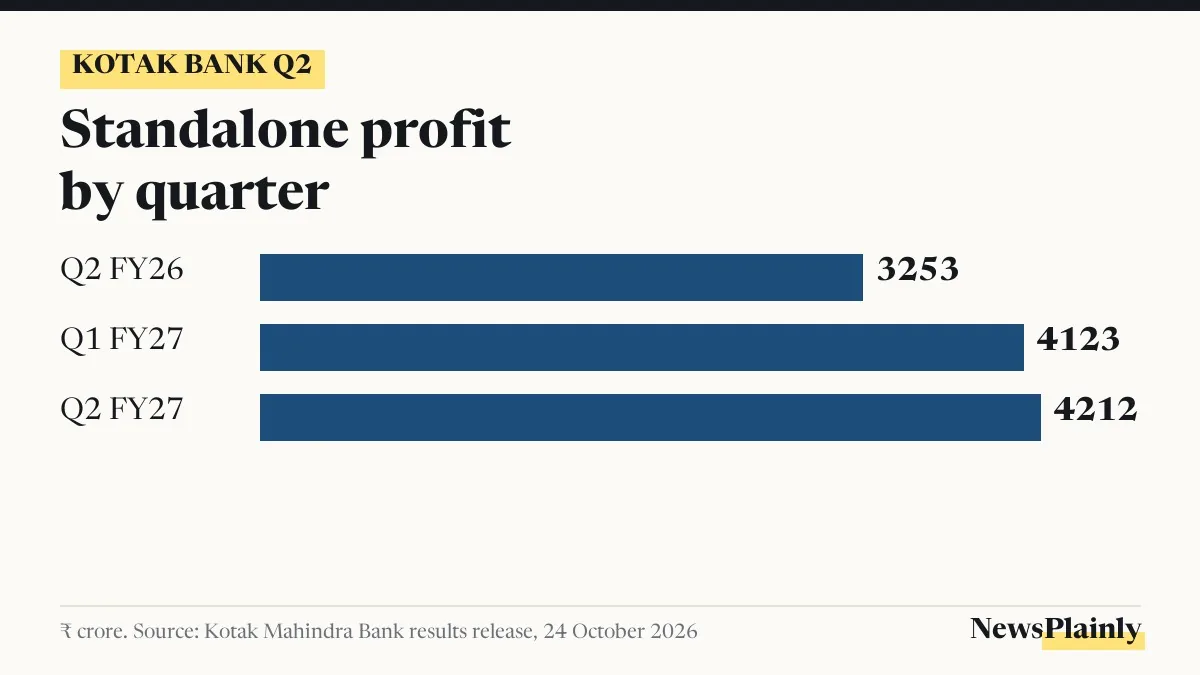
Kotak Bank Q2 results show a standalone profit of ₹4,212 crore for July to September 2026, the second quarter (Q2) of financial year 2026-27 (FY27), up 29% from ₹3,253 crore in Q2 of FY26 (2025-26), Kotak Mahindra Bank said on Saturday, 24 October 2026. The quarter was shaped by one big inflow: about ₹55,344 crore of dollar deposits from non-resident Indians, which lifted loans and deposits but pulled down the bank’s lending margin.
The board approved the unaudited numbers at a meeting in Mumbai. Counting subsidiaries such as Kotak Securities and the group’s life insurer, consolidated profit came to ₹5,645 crore, up 26% on the year and 3% on the April to June quarter.
Kotak Bank Q2 results: the key numbers
According to the bank’s results release, net interest income (NII), the gap between what the bank earns on loans and pays on deposits, rose 16% to ₹8,459 crore. Fee income grew faster, up 21% to ₹2,926 crore. Operating expenses rose 14%, slower than income, so operating profit climbed 21% to ₹6,382 crore.
Provisions, the money a bank sets aside for loans that may go bad, fell 15% to ₹803 crore. That helped profit grow faster than income. Customers numbered 5.1 crore at the end of September, and the bank had 2,327 branches.
| Measure | Q2 FY26 | Q1 FY27 | Q2 FY27 |
|---|---|---|---|
| Standalone profit | ₹3,253 cr | ₹4,123 cr | ₹4,212 cr |
| Net interest income | ₹7,311 cr | ₹7,928 cr | ₹8,459 cr |
| Net interest margin | 4.54% | 4.53% | 4.31% |
| Cost of funds | 4.70% | 4.46% | 4.52% |
| Credit cost | 0.79% | 0.46% | 0.35% |

Why the net interest margin fell to 4.31%
The net interest margin (NIM) measures how much a bank earns on its loans and investments after paying for its funds, as a share of those assets. Kotak’s slipped to 4.31% from 4.53% in the previous quarter and 4.54% a year ago. The bank said in its release that the drop came largely from the FCNR(B) money it raised during the quarter.
FCNR(B) stands for Foreign Currency Non-Resident (Bank) deposits: fixed deposits that Indians living abroad keep in dollars or other foreign currencies, repaid in the same currency. Kotak raised about ₹55,344 crore this way and lent about ₹16,110 crore through its branches abroad, the release says. Its cost of funds edged up to 4.52% from 4.46% in April to June.
The wave of these deposits was not Kotak’s alone. The Reserve Bank of India (RBI) opened a special dollar-rupee swap window on 8 June 2026 to draw in foreign currency while the rupee was weakening, All India Radio reported. Banks raised $127.23 billion through FCNR(B) deposits by 31 August, when the RBI shut that window a month early because it had met its aim, ThePrint reported, citing RBI data. The rupee was at 94.93 to the dollar at the end of last week, as NewsPlainly reported on the Iran tensions.
What the FCNR deposits did to Kotak’s balance sheet
Total deposits stood at ₹6,51,491 crore on 30 September, up 23% from a year earlier. Without the FCNR(B) money, deposit growth was 13%, the bank said. Net advances, the loans on its books after provisions, rose 25% to ₹5,77,295 crore; leaving out loans made against those deposits and a portfolio bought from group company Kotak Mahindra Investments, loan growth was 19%.
Here is what that means in plain numbers, by NewsPlainly’s calculation from the release. The ₹55,344 crore of new FCNR(B) money is about 8.5% of the bank’s total deposits at the end of September. Loans grew by about ₹1,14,607 crore over the year (₹5,77,295 crore minus ₹4,62,688 crore), and the ₹16,110 crore lent through branches abroad is about 14% of that increase.
The inflow also changed the mix of deposits. The CASA (current account and savings account) ratio, the share of this cheaper money in total deposits, fell to 38.2% from 42.3% a year ago, because the dollar deposits are term deposits. Leaving them out, the ratio was 41.8%. The credit to deposit ratio, which shows how much of its deposits a bank has lent, rose to 88.6% from 87.5%.
Kotak Bank NPA: bad loans fall to 1.04%
Asset quality got better. Kotak Bank NPA figures, which track non-performing assets (loans where repayments have stopped for 90 days or more), show gross NPA at 1.04% of loans, down from 1.39% a year earlier. Net NPA, after money set aside, was 0.24% against 0.32%. Fresh bad loans, which banks call slippages, dropped 24% to ₹1,230 crore.
The bank holds provisions against 78% of its bad loans, up from 77%. Its capital adequacy ratio, a measure of the cushion a bank keeps against losses, was 21.9%, far above the RBI’s minimum. Credit cost, the annual cost of bad loans as a share of loans, came down to 0.35% from 0.79% a year ago.
How the group’s other businesses did
Most subsidiaries earned more than a year ago but less than in April to June. Kotak Mahindra Life Insurance posted ₹198 crore against ₹49 crore a year earlier, the biggest jump in the group. Kotak Securities, the broking arm, was nearly flat at ₹348 crore, down from ₹533 crore in the previous quarter. The asset management company earned ₹287 crore and Kotak Mahindra Prime, the car loan arm, ₹251 crore.
Return on equity, profit as a share of shareholders’ money, was 11.65% for the bank alone on an annual basis. Book value per share rose 16% to ₹196, after the share split that took effect on 14 January 2026.
Kotak Mahindra Bank shares, CEO change and what comes next
The results came out on a Saturday, so shareholders will see the market’s response when trading opens on Monday, 26 October. A leadership change is also due: the RBI approved Anup Kumar Saha as managing director and chief executive for three years from 1 January 2027, the bank told stock exchanges on 1 October. He will take over from Ashok Vaswani, and the appointment still needs shareholders’ approval.
The RBI’s window for external commercial borrowings and overseas foreign currency loans under the same swap scheme stays open until 31 December 2026, according to ThePrint. The FCNR(B) deposits Kotak raised this quarter will stay on its books, so their cost will keep showing up in its margin in the quarters ahead.
Frequently asked questions
What was Kotak Mahindra Bank's Q2 FY27 profit?
Standalone profit was ₹4,212 crore for July to September 2026, the second quarter (Q2) of financial year 2026-27 (FY27), up 29% year on year. Consolidated profit, including subsidiaries, was ₹5,645 crore, up 26%.
Why did Kotak's net interest margin fall?
The margin fell to 4.31% from 4.53% in the previous quarter. The bank said this was largely because of the FCNR(B) dollar deposits it raised during the quarter.
What are FCNR(B) deposits?
They are fixed deposits that non-resident Indians hold in foreign currencies such as the US dollar with Indian banks. The money is repaid in the same currency.
Who will be Kotak Mahindra Bank's next CEO?
The RBI approved Anup Kumar Saha as MD and CEO for three years from 1 January 2027. He succeeds Ashok Vaswani; shareholders still have to approve the appointment.