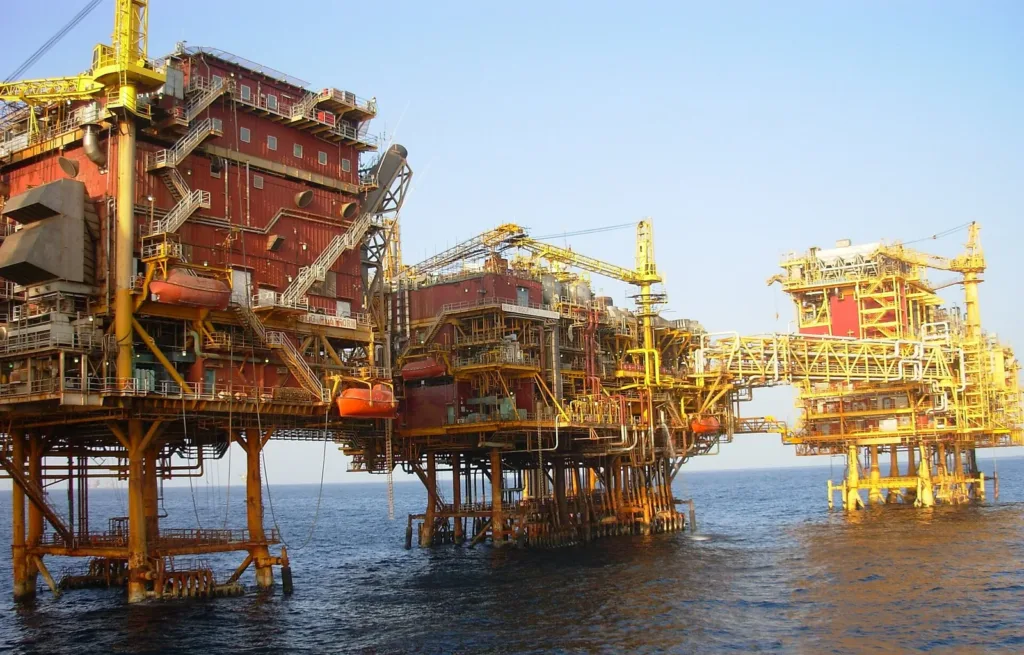
Representative image. Nandu Chitnis from Pune, India, CC BY 2.0, Wikimedia Commons

Why it matters
India imports most of the oil and gas it uses, so finds in its own deep waters would cut the import bill that feeds into fuel prices. The rules decide whether companies actually drill: the state now carries part of the risk of a dry well, but keeps a claim on any success. Taxpayer money is at stake on both counts.
The Samudra Manthan scheme will pay up to ₹675 crore towards each risky deepwater oil and gas well drilled off India’s coast, and the government will take that money back only if the well strikes a commercial find. The petroleum ministry set out these terms in the scheme’s operational guidelines, released on 22 October 2026, nearly three months after the Union Cabinet approved the ₹84,084 crore programme.
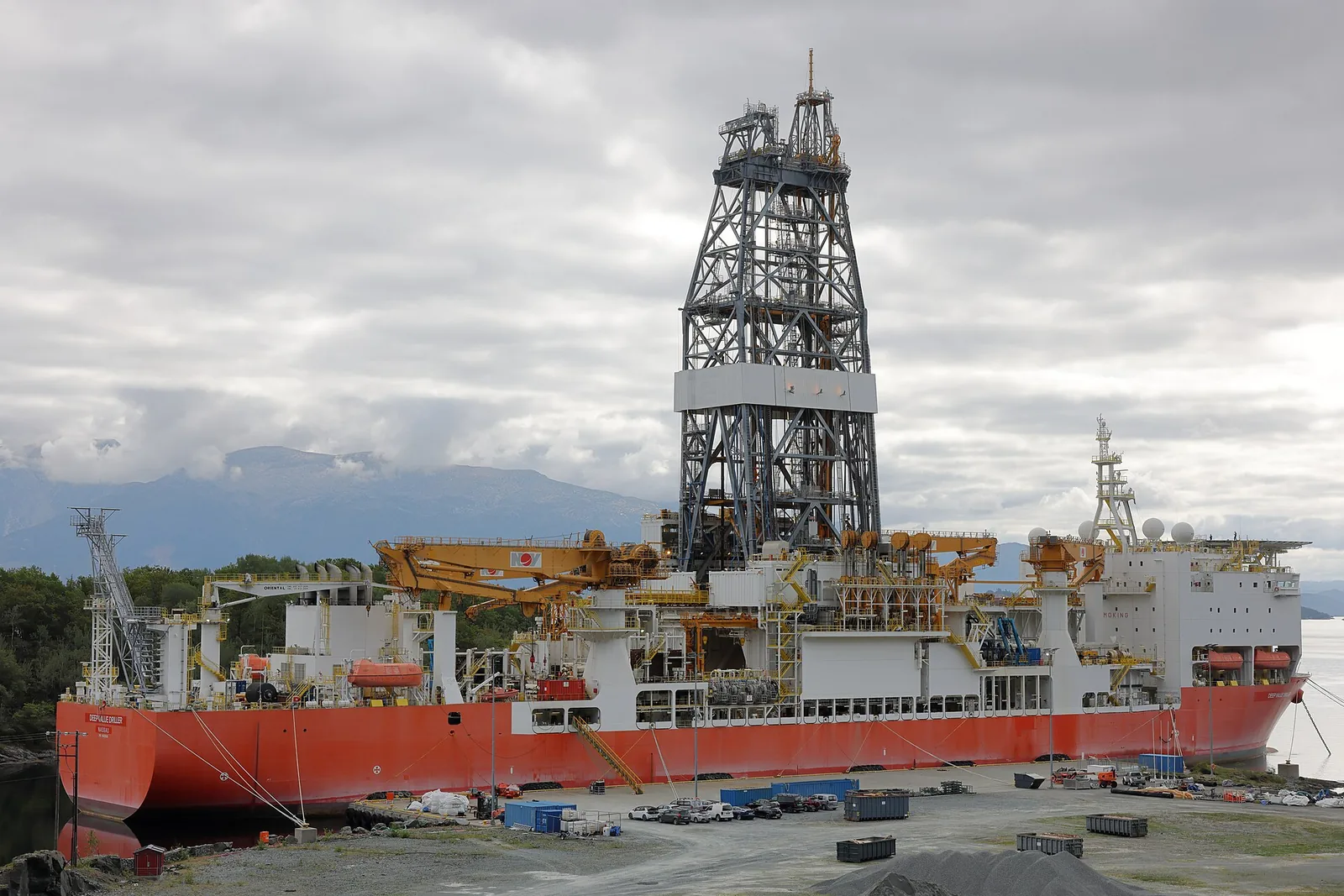
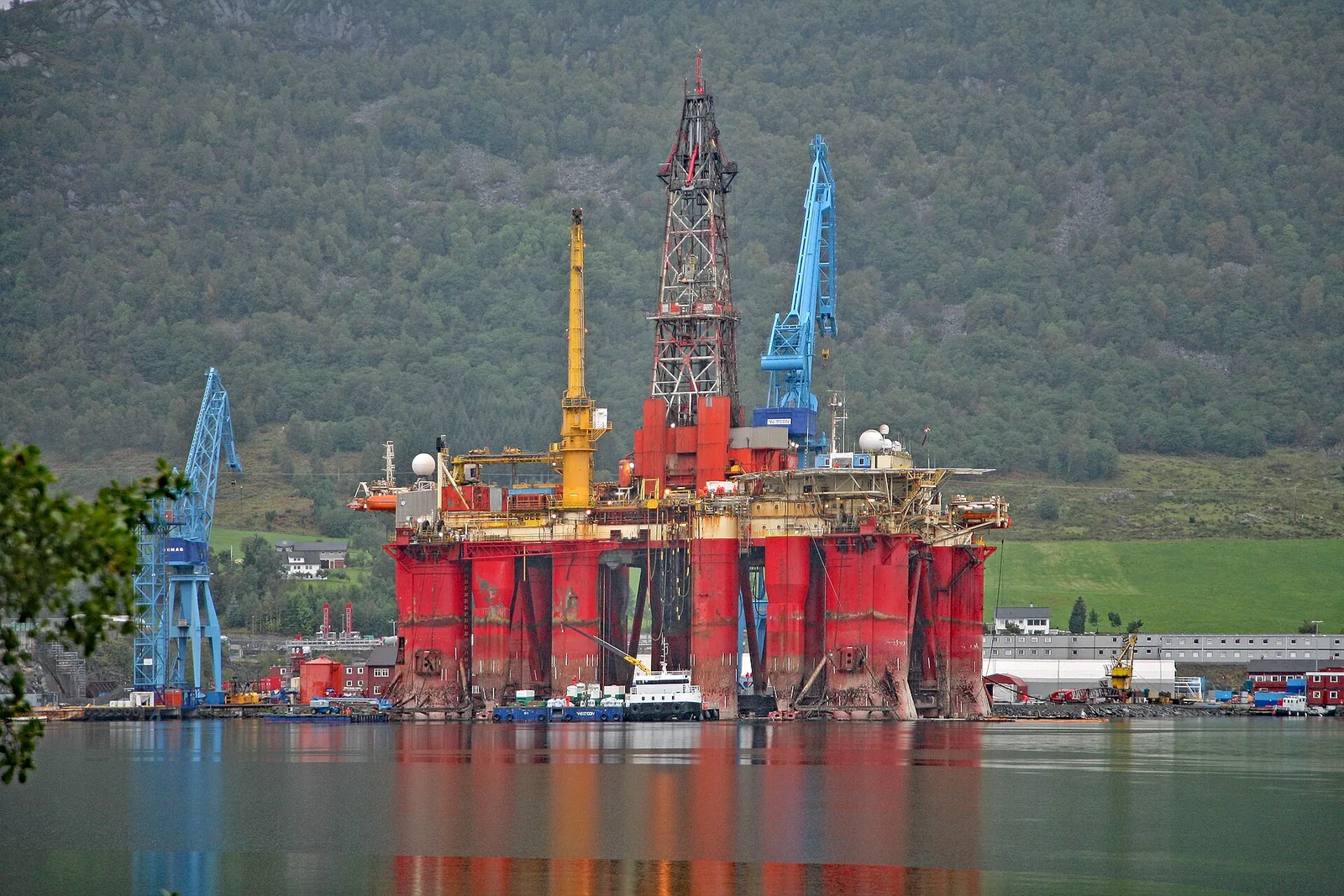
Deepwater means sea depths beyond 400 metres; ultra-deepwater begins at 1,500 metres. Wells there are expensive and many come up dry, which is why offshore exploration in these waters has been slow. The guidelines turn the scheme’s broad promise into rules on who can apply, how much they get and when the money flows.
How Samudra Manthan scheme support for each deepwater well works
The scheme backs 60 wells. Fifty six are exploratory wells, drilled to look for oil or gas, and each gets up to half its actual cost, with a ceiling of ₹675 crore. The other four are stratigraphic wells, drilled mainly to study the rock layers of a basin. These can be funded in full up to ₹1,350 crore each, but only state-owned companies, or groups led by them, can apply for these four, the news sites PSU Watch and Millennium Post reported from the guidelines.
Money is released in two steps. An operator receives 40% of the approved support when drilling reaches 40% of the approved depth, and the remaining 60% once the well is complete and its report is approved. Any cost above the cap is the company’s to bear, and support does not rise automatically for overruns, delays or changes in scope.
The guidelines also list what the scheme will never pay for. Blowout control costs are excluded “under any circumstances”, according to the text quoted by PSU Watch, as are corporate overheads, interest, penalties and public relations spending.
When the government gets its money back
This is the core trade of the Samudra Manthan scheme. If a funded well is dry, or finds hydrocarbons that cannot be produced profitably, the support is written off and the government absorbs the loss. If the well leads to a commercial discovery, the money becomes recoverable from the operator’s revenue, The Hindu reported.
Repayment starts after seven years of commercial production, or once the operator has recovered 50% of its exploration and development costs, whichever comes first. It is paid in yearly instalments with no adjustment for inflation, so the amount returned is the same rupee figure that was paid out.
Eligibility is narrow. Only blocks awarded under the Revenue Sharing Contract regime, the bidding model India has used since 2016, qualify. Older production sharing and coal-bed methane blocks are left out unless the government notifies otherwise. Development wells, which bring an already found field into production, get nothing, and neither do sidetrack wells drilled off an existing hole.
What a ₹675 crore cap means for one deepwater well
Using the Samudra Manthan scheme’s rules, NewsPlainly worked out how support would flow for a single exploratory well at two cost levels. A typical deepwater well costs about $125 million to $150 million, according to explainers published after the Cabinet decision, so the cap matters.
| Well cost | 50% of cost | Government pays | At 40% depth | Company pays |
|---|---|---|---|---|
| ₹1,000 crore | ₹500 crore | ₹500 crore | ₹200 crore | ₹500 crore |
| ₹1,600 crore | ₹800 crore | ₹675 crore (cap) | ₹270 crore | ₹925 crore |
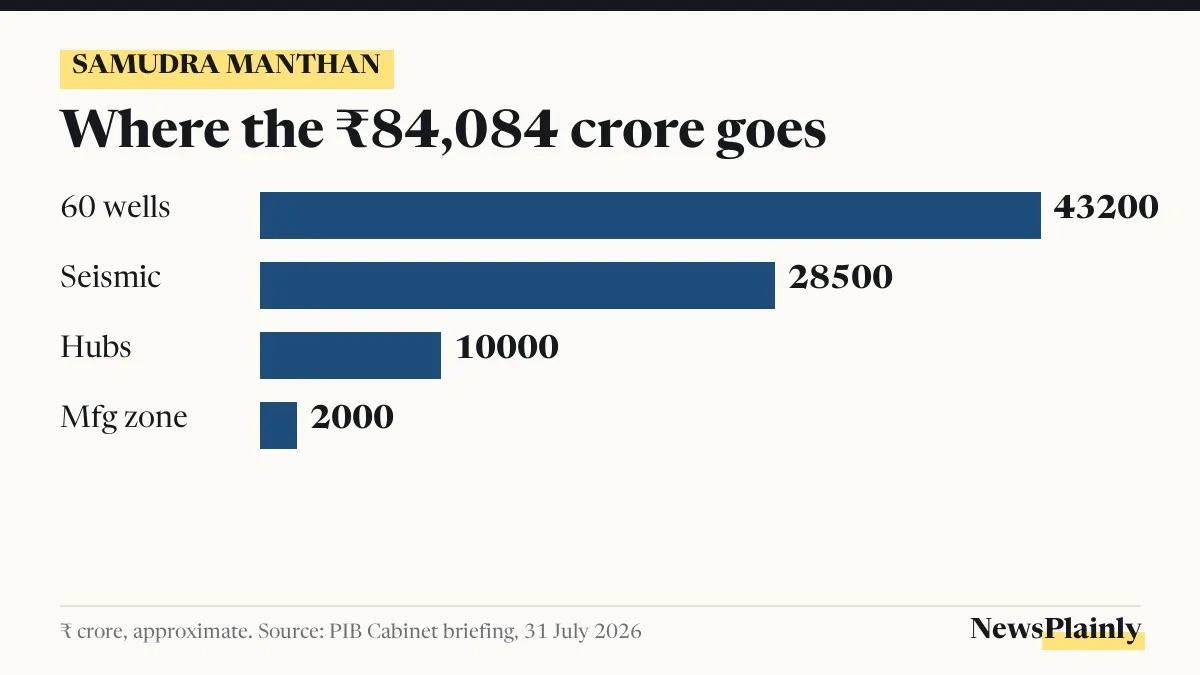
At full use of every cap, well support adds up to ₹43,200 crore: 56 wells at ₹675 crore make ₹37,800 crore, and four stratigraphic wells at ₹1,350 crore make ₹5,400 crore. That is about 51% of the scheme’s ₹84,084 crore outlay, and it matches the ₹43,200 crore the Cabinet set aside for drilling.
What changed in the Samudra Manthan scheme since the Cabinet decision
The Cabinet approved the scheme on 31 July 2026. Its briefing deck, published by PIB, gave the headline amounts. The guidelines add the conditions. Reading the two side by side shows what operators now know that they did not in July.
| Point | Cabinet briefing, 31 July | Guidelines, 22 October |
|---|---|---|
| Wells covered | 60 deepwater and ultra-deepwater wells, about ₹43,200 crore | 56 exploratory wells (50%, up to ₹675 crore) and 4 stratigraphic wells (100%, up to ₹1,350 crore) |
| Who can apply | Open to public and private operators | Same for exploratory wells; stratigraphic wells only for state-owned firms or groups they lead |
| Dry wells | Not specified | Support not recovered |
| Successful wells | Not specified | Recovered from revenue, no inflation adjustment |
| Spending years | Up to 2030-31 | 2026-27 preparatory; Phase I spending 2027-28 to 2030-31 |
The briefing also listed the other parts of the outlay: about ₹28,500 crore for seismic surveys, roughly ₹10,000 crore for shared offshore infrastructure and about ₹2,000 crore for a manufacturing and services zone. The guidelines themselves do not give a component-wise budget split, Millennium Post noted.
The offshore exploration plan beyond the deepwater well grants
A second track offers viability gap funding, a government grant that makes an otherwise loss-making project workable, for shared infrastructure. Several small discoveries in the Mahanadi and Kutch basins stay unused because none alone can pay for pipelines and processing, the guidelines say. Support would go to hubs such as subsea manifolds, trunk pipelines and shared floating production units, first in the Mahanadi basin with token funding for Kutch, paid in four 25% tranches tied to construction progress.
A third track would fund one or more oil and gas manufacturing and services zones with jetties, warehouses and testing labs. Underneath all of it is a seismic survey programme run by the Directorate General of Hydrocarbons (DGH), the ministry’s technical arm. Two-dimensional surveys will be fully paid for by the government, while three-dimensional surveys will use a model in which the contractor co-invests and earns from licensing the data.
Petroleum Secretary Neeraj Mittal wrote in the preface that the scheme could add more than 600 million tonnes of oil equivalent to India’s reserves. The Cabinet briefing put the possible extra output at 10 to 15 million tonnes of oil equivalent a year, with a peak of 20.
What happens next for offshore exploration
Each deepwater well proposal will first be vetted by a Technical Assessment Board, then appraised by an executive committee chaired by the petroleum secretary, before the minister sanctions the money. An operator that paid damages instead of drilling a well it had promised will not qualify, and no funds will be released while such an obligation is pending.
The scheme notification provides for a mid-term review after 30 deepwater wells are drilled, and an independent evaluation at the end of Phase I that will decide whether a second phase follows. State-run Oil and Natural Gas Corporation (ONGC) has already begun drilling its first deepwater well in the Mahanadi basin under the mission, The Hindu reported. For how oil prices are squeezing state-run fuel retailers, see our report on Bharat Petroleum’s second-quarter results.
Frequently asked questions
What is the Samudra Manthan scheme?
A ₹84,084 crore central scheme approved on 31 July 2026 to fund offshore seismic surveys, deepwater wells, shared infrastructure and a manufacturing zone for oil and gas, running to 2030-31.
How much does the government pay per deepwater well?
Up to 50% of actual cost, capped at ₹675 crore, for 56 exploratory wells. Four stratigraphic wells can get up to 100%, capped at ₹1,350 crore.
Does the company have to repay the money?
Only if the well leads to a commercial discovery. Repayment starts after seven years of production or once half the costs are recovered, whichever is earlier. Dry wells are not recovered.
Can private companies apply?
Yes, for exploratory wells in blocks under the Revenue Sharing Contract regime. The four stratigraphic wells are reserved for state-owned firms or consortia they lead.