Representative image. Vyacheslav Argenberg, CC BY 4.0, Wikimedia Commons

Why it matters
Millions of ride-hailing app users in India face regular booking delays and price surcharges. The CCPA ruling establishes that platforms cannot nudge consumers to pay voluntary tips before service is rendered, preventing ride aggregators from shifting basic driver compensation onto passengers through manipulative design patterns.
The ola ccpa tipping penalty was issued on Thursday, 12 November 2026, after the Central Consumer Protection Authority (CCPA) directed ride-hailing company Ola to discontinue its pre-ride tipping feature and imposed a fine of Rs 10 lakh. In an extensive regulatory order passed by Chief Commissioner Nidhi Khare and Commissioner Anupam Mishra, the statutory consumer watchdog concluded that prompting passengers to add tips before a ride is confirmed constitutes misleading advertising, an unfair trade practice, an unfair contract, and a prohibited dark pattern under the Consumer Protection Act of 2019.
Why the Ola CCPA tipping penalty was imposed on booking prompts
The regulatory inquiry that led to the ola ccpa tipping penalty began after the consumer protection authority received a formal complaint in May 2025 regarding manipulative booking practices on the platform. The investigation established that consumer rights were systematically infringed when algorithmic interfaces pressured passengers into paying extra amounts. Passengers reported that the mobile application displayed prominent prompts stating that adding a tip might help increase the chances of getting a ride faster. Under this mechanism, users were initially presented with pre-set tip amounts ranging from Rs 10 to Rs 40, but regulatory investigators discovered that the interface allowed additional advance payments escalating up to Rs 499 per booking attempt.
Scroll reported that the consumer rights watchdog rejected the platform’s defense that these contributions were voluntary rewards meant to enhance driver earnings on unviable routes. The commission observed that tips are traditionally given in appreciation of services already rendered with satisfaction. Soliciting extra funds through an ola pre ride tip before a booking is accepted distorts the core fare agreement and places consumers under psychological coercion to secure basic transportation.
The Indian Express reported that the authority scrutinised booking locations and found that pre-ride tipping prompts were heavily displayed for pickups at critical infrastructure hubs, including major hospitals, railway stations, bus terminals and international airports. The CCPA noted that passengers at these locations, such as patients, senior citizens, travelers carrying heavy luggage, and lone commuters at night, are the least capable of resisting representations that paying extra will secure a prompt vehicle.
Data reveals advance tips failed to improve ride acceptance rates
A central finding in the ola ccpa tipping penalty investigation was that the platform’s own internal booking data contradicted its claims of faster service. When the regulatory authority examined thousands of ride requests across major metropolitan cities, it found that bookings without any advance tip consistently recorded substantially higher driver acceptance rates than bookings where passengers offered extra payments.
In the National Capital Region (NCR) around Delhi, only 38 percent of ride requests that carried an advance payment add-on were accepted by drivers, whereas standard bookings without tips registered an acceptance rate of 62 percent. Similarly, in Bengaluru, ride requests accompanied by an advance tip recorded an acceptance rate of 40 percent, compared to 68 percent for bookings without an additional amount. The consumer watchdog pointed out that the platform could not have it both ways: if tips did not speed up bookings, the marketing claim was false; if they did, non-paying riders were subjected to institutional disadvantage.
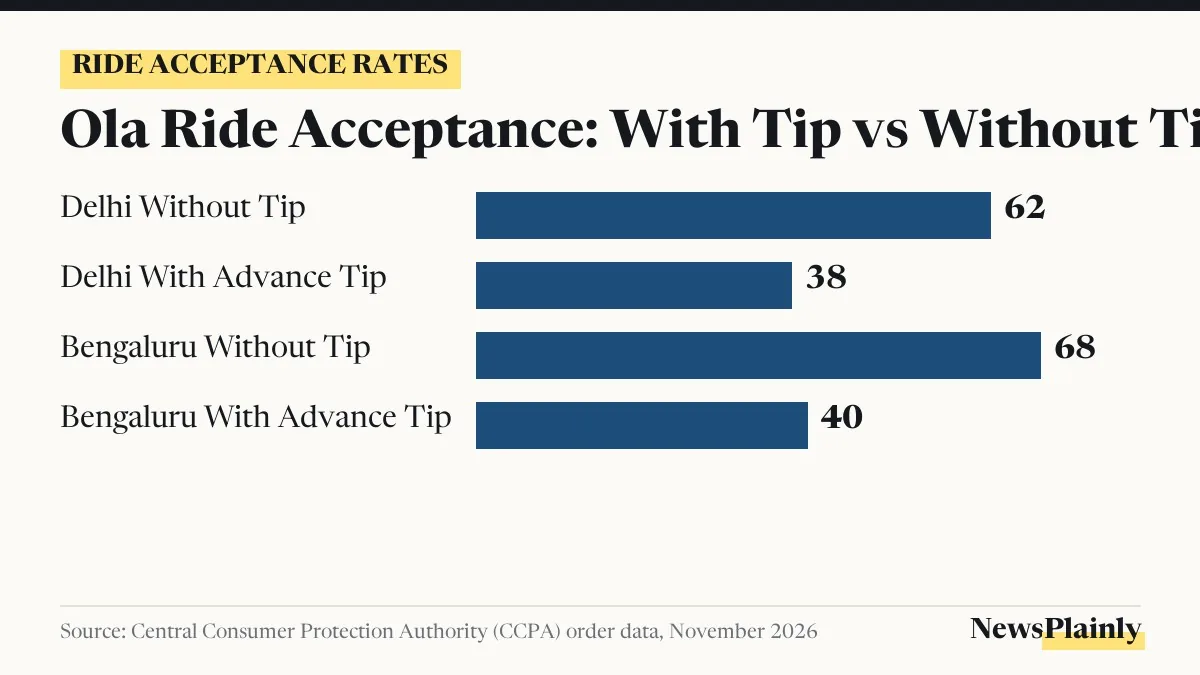
The table below summarizes the official city-level acceptance statistics and regulatory findings documented in the landmark ccpa ola order.
| Metropolitan City | Acceptance Rate With Tip | Acceptance Rate Without Tip | Regulatory Finding |
|---|---|---|---|
| Delhi NCR | 38% | 62% | Misleading speed representation; higher acceptance without tip |
| Bengaluru | 40% | 68% | Contradicts platform claim of enhanced booking probability |
| Pricing Ceiling Examined | Up to Rs 499 add-on | Base fare displayed | Unregulated escalation with no objective baseline disclosed |
| Legal Assessment | Dark pattern violation | Standard consumer right | Violates 2019 Consumer Protection Act dark pattern rules |
Dark patterns and fair commercial rules under Consumer Protection Act
The ola tipping feature fine represents an important enforcement milestone under India’s Guidelines for Prevention and Regulation of Dark Patterns. The CCPA observed that the interface design created an artificial sense of urgency and scarcity, nudging passengers into paying amounts above the initial quoted fare. By allowing drivers to view tip offers before accepting rides, the feature incentivised drivers to ignore standard bookings in anticipation of higher bids, effectively operating an informal reverse auction on public transport services.
In analyzing the consumer protection act dark pattern violations, the authority highlighted that digital platforms cannot disguise mandatory fare adjustments as voluntary gratuities. Legal counsel appearing for the cab aggregator argued that the pre-ride tipping option was an opt-in feature rather than an opt-out mandate, asserting that the entire additional sum was credited directly to driver bank accounts without any commission deduction by the platform. The company contended that the phrase “might help increase the chances” represented a probability rather than a contractual guarantee.
However, the CCPA firmly dismissed these arguments, stating that an unfair practice does not become permissible simply because some consumers decline to pay. The commission ruled that allowing uncalibrated surcharges undermines transparent metered tariffs across metropolitan transport corridors. Commercial enterprises can also study earlier commercial policy decisions to understand broader corporate compliance standards established by statutory regulatory bodies.
What happens next as the 15-day compliance window begins
Under the terms of the operative order accompanying the ola ccpa tipping penalty, the cab aggregator must deposit the penalty amount of Rs 10 lakh with the central authority and immediately remove all pre-booking prompts, pop-up dialog boxes and interface add-ons across its application ecosystem. The company has been directed to submit a comprehensive compliance affidavit within 15 days of the order date, confirming that passengers are quoted a single transparent fare without pre-acceptance solicitations.
The CCPA emphasized that consumer protection guidelines apply uniformly across all digital aggregators operating in India. Following the ola ccpa tipping penalty, regulators noted that voluntary gratuities remain permissible only after a ride has concluded, ensuring that customer appreciation reflects actual service quality rather than desperate attempts to secure basic mobility during peak traffic hours.