Representative image. Arunvrparavur, CC BY-SA 3.0, Wikimedia Commons

Why it matters
The sale moves control of IDBI Bank from the government and LIC to a private foreign owner, and the two sellers are to receive about ₹52,878 crore between them. The row is over whether that price was fairly set. The bank's 19,108 employees, as counted by their representatives, would work for a privately controlled bank.
The IDBI Bank sale turned into an open political row on 30 October 2026. Finance Minister Nirmala Sitharaman said on X that “all due process has been followed”, hours after Leader of the Opposition Rahul Gandhi backed the bank’s employees and questioned how the price was fixed. A night earlier, on 29 October, the Finance Ministry had put out a long clarification saying the second bidding round lifted the deal’s value by ₹3,917 crore without any change to the reserve price.
The deal itself is not new. On 14 October the Cabinet Committee on Economic Affairs (CCEA), the Cabinet panel that clears big economic decisions, approved selling a combined 60.72% stake in IDBI Bank to a subsidiary of Canada’s Fairfax Financial Holdings, the group led by Prem Watsa. Reports put the value at ₹52,878 crore, at ₹81 a share. What changed this week is the argument over how that price was reached.
What Rahul Gandhi said about the IDBI Bank sale
Gandhi wrote a letter to IDBI Bank employees, dated 29 October according to Livemint, and shared it on X. In the post, quoted by the Times of India and Moneycontrol, he said that in Modi’s time “first the bidding was seen, then the price was set”, and contrasted the Congress years, when banks were created, with the present, when he said they are being sold. “I stand with the employees of IDBI Bank,” he wrote, according to the Indian Express.
The letter, as reported by Livemint, made three further points. Gandhi said reservation for Scheduled Caste (SC), Scheduled Tribe (ST) and Other Backward Class (OBC) candidates would go once the bank is privately owned. He said the bank made losses seven years ago and earned a profit of more than ₹9,000 crore last year. And he recalled a 2003 promise to Parliament by the then Finance Minister Jaswant Singh that the government’s holding in IDBI would not fall below 51%.
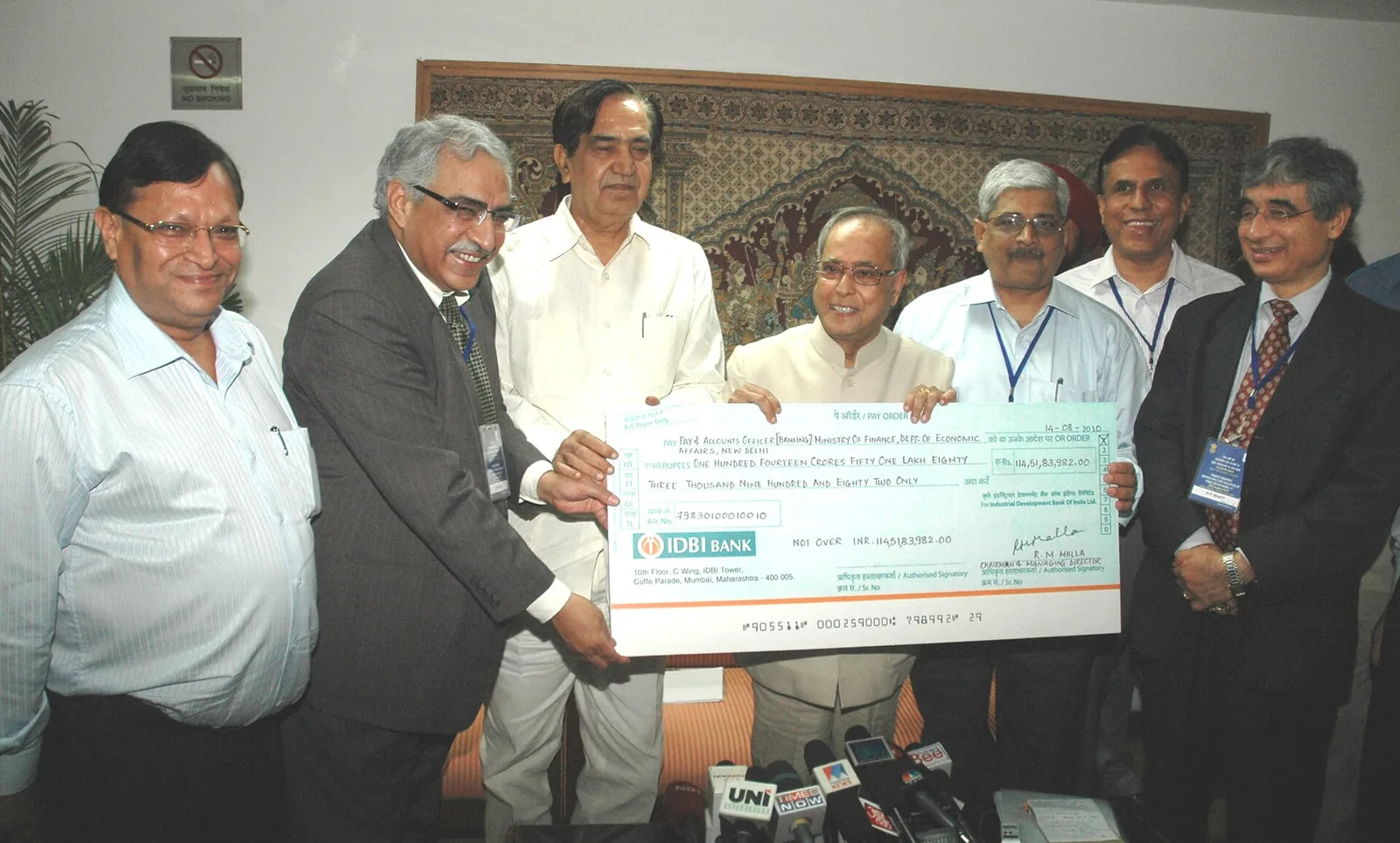
The United Forum of IDBI Officers and Employees has asked for the deal to be suspended and reviewed under parliamentary scrutiny, Livemint reported. Its convener, Devidas Tuljapurkar, wants the valuation method, its assumptions and the treatment of the bank’s property made public. Employee representatives put the bank’s staff at 19,108, including about 9,500 from SC, ST and OBC communities.
How Sitharaman answered
Sitharaman’s reply on X, reproduced by Moneycontrol, went after the Congress record rather than the deal terms. She said IDBI Bank was “handed over to us in poor shape” because it had been pushed to lend to business groups close to Congress leaders, naming Videocon, Winsome, ABG Shipyard and Kingfisher, and that those loans turned bad. She said the NDA government revived the bank with recapitalisation of more than ₹25,000 crore and that the ministry had already explained the process a day earlier.
She also listed older episodes she said showed Congress governments pressuring banks, from the 1957 Mundra affair to the removal of State Bank of India chairman R.K. Talwar in 1976. Her post ended with a line that has since been widely quoted: Congress-era banking, she said, had “a phonebook for the powerful and a rulebook for the common citizens”. The reports read up to 1.15 pm IST on 30 October did not include a response from Gandhi to her post.
It is the second exchange between the two in a week. They had already traded posts over the boardroom dispute in the Tata Group, the Indian Express noted, a fight that also touches the question of whether Tata Sons must list on the stock market.
What the Finance Ministry clarification says about the price
The ministry’s statement of 29 October, published by the Press Information Bureau, is the government’s full account of the bidding. Moneycontrol reported that it followed a BW Businessworld article of the same day which alleged that valuers were told to set aside IDBI’s market price and leave private banks out of the comparison, producing a benchmark of ₹75.99 a share. NewsPlainly has not read that article and relies on Moneycontrol’s description of it.
The ministry’s main points, in plain terms:
- The first round lapsed. The Department of Investment and Public Asset Management (DIPAM) ran the first round in 2025-26. The bids were not approved, and that round ended. The Times of India reported that those bids were well below the reserve price.
- The rules allowed a second round. Clause 5.3.6(iii) of the request for proposal says that if the top bid is below the reserve price, the government decides what happens next. A CCEA decision of 16 August 2017 lets the Core Group of Secretaries on Disinvestment (CGD) approve departures from the usual procedure. The CGD set the “best offer” round itself.
- The reserve price stayed the same. The ministry said it was neither lowered nor raised.
- Valuations were redone. The CGD reviewed the method in April 2026, and two independent advisers began fresh valuations in May, after the bank’s accounts for the year to 31 March 2026 came out. Bidders did not see the valuations and valuers did not see the bids.
- Public sector banks were the yardstick. With no suitable past deals to compare, the advisers compared IDBI with listed public sector banks. The ministry said the RBI treats IDBI as a private bank only for regulatory purposes since the Life Insurance Corporation of India (LIC) took majority control in 2019, while investors still value it like a public sector lender.
The ₹3,917 crore figure, worked out
Bidders asked to be protected against disputed tax demands on the bank, and the government agreed. The ministry put the possible cost of this indemnity at ₹627 crore and said the discovered price rose by ₹3,917 crore. It called the payout a low-probability event, payable only if extra tax is actually paid.
NewsPlainly’s calculation from the ministry’s own numbers: the ₹3,917 crore rise is about 6.2 times the ₹627 crore it says the indemnity could cost. And using the ₹75.99 benchmark described in Moneycontrol’s report, Fairfax’s ₹81 a share is about 6.6% higher. Neither figure settles the dispute: critics question how the benchmark was built, not the arithmetic.
| Who | What they said |
|---|---|
| Rahul Gandhi | Bids were seen before the price was set; reservation and job protections will go after privatisation |
| Nirmala Sitharaman | Due process followed; IDBI was weakened by lending under Congress and revived with over ₹25,000 crore |
| Finance Ministry | Reserve price unchanged; second round added ₹3,917 crore against a ₹627 crore indemnity |
| Employees’ forum | Suspend the deal; publish the valuation method and review it in Parliament |
Who sells in the IDBI Bank sale, and who stays
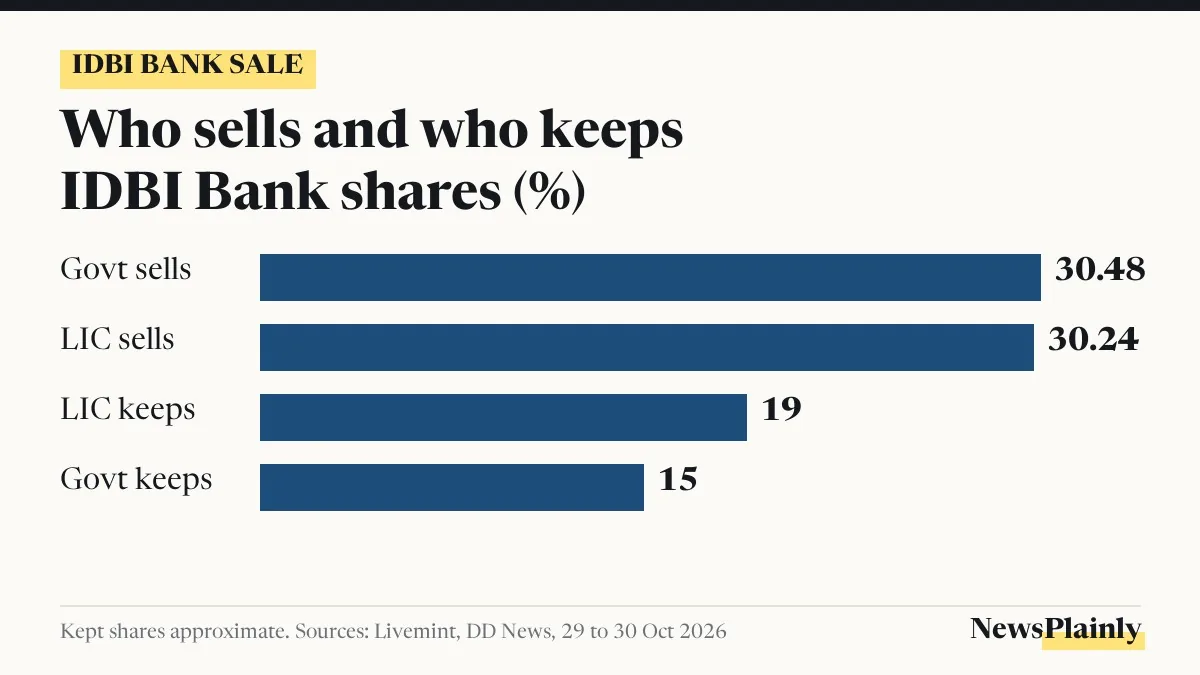
According to Livemint, the government sells 30.48% of the bank, worth about ₹26,620 crore, and LIC sells 30.24%, worth about ₹26,440 crore. Sitharaman has called the deal a “strategic restructuring” rather than a disinvestment, because the government and LIC keep about 15% and 19% respectively, DD News reported. The ministry said both are holding on to those shares to gain if the bank’s value rises after the change of control.
A short timeline of the sale:
- 2003: Jaswant Singh tells Parliament the government will keep at least 51% of IDBI (as cited by Gandhi and the employees’ forum).
- 16 August 2017: CCEA gives the secretaries’ panel power to approve changes in disinvestment procedure.
- 2019: LIC takes majority control of IDBI Bank.
- 2025-26: First bidding round; bids not approved.
- April to May 2026: Valuation method reviewed; fresh valuations begin.
- 14 October 2026: CCEA approves the 60.72% sale to Fairfax.
- 29 to 30 October 2026: Ministry clarification, Gandhi’s letter and Sitharaman’s reply.
The material read does not say when the sale will be completed. The employees’ forum’s demands for disclosure and a parliamentary review are pending, and the ministry has pointed back to its 14 October press note for why IDBI’s thinly traded share price was not used as the benchmark.
Frequently asked questions
Who is buying IDBI Bank?
A subsidiary of Canada's Fairfax Financial Holdings, led by Prem Watsa. The CCEA approved the purchase of a combined 60.72% stake on 14 October 2026 at ₹81 a share.
Was the IDBI Bank reserve price changed?
No, according to the Finance Ministry's 29 October statement. It said the reserve price was neither cut nor raised, and the first round lapsed after its bids were not approved.
Will the government still own part of IDBI Bank?
Yes. The government and LIC keep about 15% and 19% after the sale, DD News reported, which is why Sitharaman calls it a strategic restructuring.
Why does Rahul Gandhi oppose the IDBI Bank sale?
In a letter to employees he said reservation for SC, ST and OBC candidates would go with private ownership, and recalled a 2003 promise to keep 51% with the government.