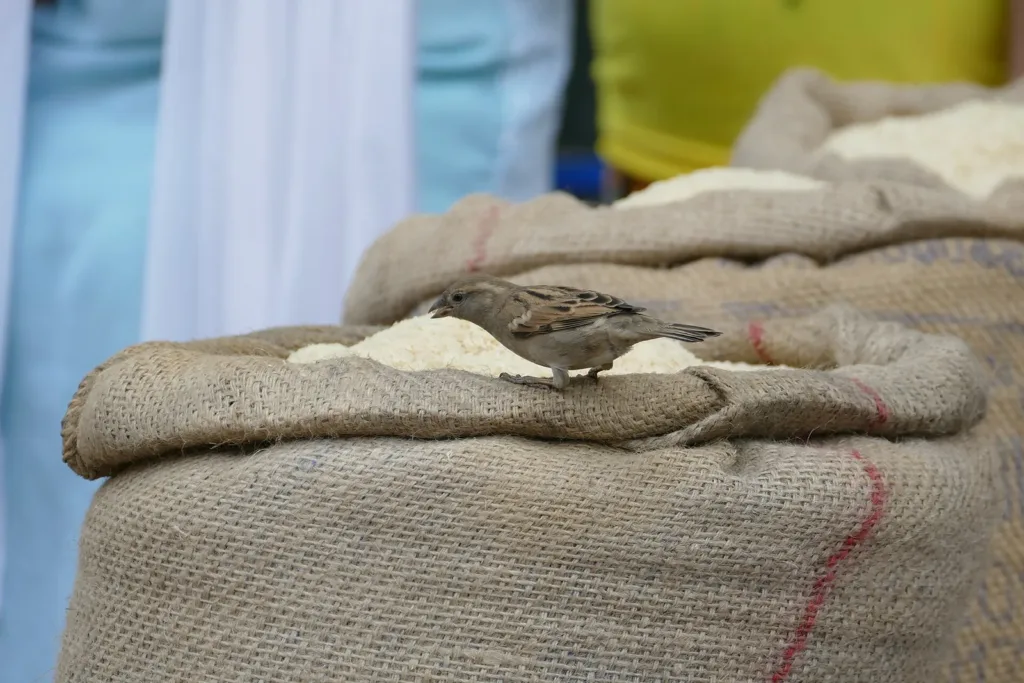
Representative image. Kritzolina, CC BY-SA 4.0, Wikimedia Commons

Why it matters
Weekly stock figures let the government see where rice is being held and act against hoarding, while the government expects more e-auction and Bharat Rice supply to help moderate retail prices, especially in the South. Businesses that miss registration or exceed limits face action under the Essential Commodities Act.
Rice stock disclosure is now compulsory for every trader, wholesaler, retailer, big chain retailer and miller holding rice or paddy anywhere in India. They must post their stock every Friday on a government portal, under an order dated 6 November 2026, the Ministry of Consumer Affairs, Food and Public Distribution said in a release that day.
The same release doubled the amount of government rice to be sold in the open market this year, from 25 lakh tonnes to 50 lakh tonnes, cleared five southern states to cap how much rice and paddy traders can hold, and sent more “Bharat Rice” to three state-run agencies: the National Agricultural Cooperative Marketing Federation (NAFED), the National Cooperative Consumers’ Federation (NCCF) and Kendriya Bhandar. The government said it was acting to keep rice supplies up, prices steady and hoarding down.
Rice stock disclosure: who must declare and how
The order covers four kinds of businesses in all states and Union Territories: traders and wholesalers, retailers, big chain retailers, and processors or millers. Each must declare its stock under six heads, the ministry’s release said: basmati rice, non-basmati premium rice, non-basmati rice, parboiled rice, broken rice and paddy.
The figures go on the Food Stock Portal, foodstock.dfpd.gov.in, and must be updated every Friday. Entities must keep the information accurate. Any business found not registered on the portal, or holding more than a stock limit, faces action under Sections 6 and 7 of the Essential Commodities Act, 1955, the law that lets the government control the supply of essential goods, the ministry said.
The release did not set a size threshold, so on its wording the order applies to every business of those four kinds that stocks rice or paddy.
Stock limits in five southern states until 31 January 2027
The Centre has given its consent to Andhra Pradesh, Karnataka, Kerala, Tamil Nadu and Telangana to impose stock limits on paddy and rice through their own control orders, wherever they consider it necessary. A rice stock limit caps how much of a commodity a business may hold at one time. These limits can stay in force until 31 January 2027, the release said.
The release did not give the limits themselves; each state will set them in its own order. It said the Centre and the states will watch how the measures work to keep rice available and prevent hoarding and black marketing.
OMSS rice target doubled to 50 lakh tonnes
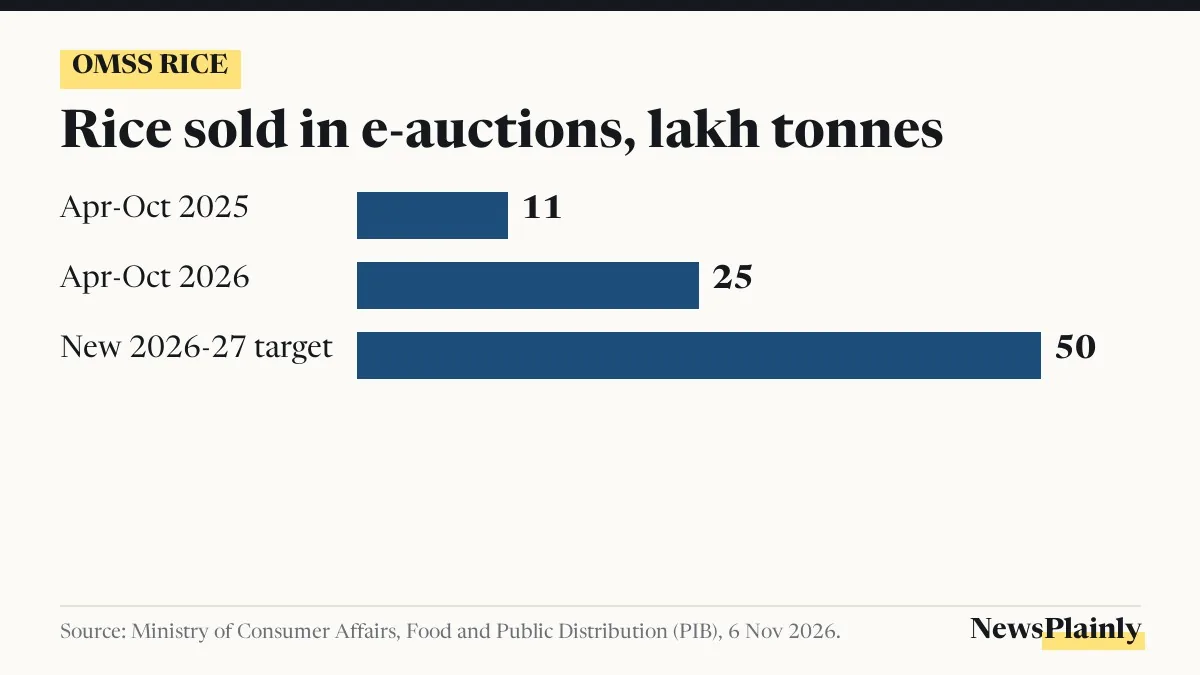
The Open Market Sale Scheme (Domestic), or OMSS (D), is how the government sells grain from central stocks to private buyers through e-auctions, to add to market supply. For 2026-27, the rice target under the scheme has been raised from 25 LMT (lakh metric tonnes) to 50 LMT.
Sales have already run fast. Up to 31 October 2026, 25 LMT of rice had been sold to private parties through OMSS (D) e-auctions, against 11 LMT in the same period of the previous financial year, the ministry said. By NewsPlainly’s reading, the original target was used up in the first seven months of the financial year, April to October.
| Measure | Who it applies to | Key detail |
|---|---|---|
| Weekly stock disclosure | Traders, wholesalers, retailers, big chain retailers, millers in all states and UTs | Every Friday on foodstock.dfpd.gov.in, six categories |
| Stock limits | Andhra Pradesh, Karnataka, Kerala, Tamil Nadu, Telangana | States may impose them until 31 January 2027 |
| More Bharat Rice | NAFED, NCCF, Kendriya Bhandar | Wider sale, especially in southern states |
| OMSS (D) rice target | Private buyers in e-auctions | 25 LMT to 50 LMT for 2026-27 |
Bharat Rice and what it means for buyers
Bharat Rice is the government’s own branded rice, sold through state-run agencies. Extra quantities are going to NAFED, NCCF and Kendriya Bhandar. They have been told to use every channel they can to make it widely and easily available, particularly in the southern states, the ministry said.
The government expects the steps to add to market supplies, make rice more affordable and help moderate retail prices, according to the release. It did not give current rice prices or say how much they have risen, so the size of the problem the measures target is not clear from the release itself.
NewsPlainly’s calculation: the 25 LMT sold by the end of October is about 2.3 times the 11 LMT sold in the same months last year. The new target of 50 LMT equals 50 lakh tonnes, or 5 million tonnes, of rice for the full year to March 2027.
Rice stock limit and Friday deadlines: what comes next
Declarations are now due every Friday, and the release says businesses found unregistered on the Food Stock Portal are liable to action. In the five southern states, stock limits will apply only once each state issues its control order. The release did not say when the extra Bharat Rice will reach shops. More farm and food news is on NewsPlainly’s agriculture page.
Frequently asked questions
Who must declare rice stock every Friday?
Traders and wholesalers, retailers, big chain retailers, and processors or millers in all states and Union Territories, under the order of 6 November 2026.
Where do rice stocks have to be declared?
On the Food Stock Portal, foodstock.dfpd.gov.in, in six categories from basmati rice to paddy, updated every Friday.
What is the new OMSS rice target for 2026-27?
50 LMT (lakh metric tonnes), double the earlier 25 LMT. 25 LMT had been sold by 31 October 2026.