Representative image. Subhashish Panigrahi, CC BY-SA 4.0, Wikimedia Commons

Why it matters
The bill decides when one-third of Lok Sabha and assembly seats are reserved for women, and how many MPs every state elects after the next delimitation. A two-thirds vote in both Houses is needed, so the stand of a few parties with 8 to 22 MPs can decide whether it passes.
Ahead of the delimitation bill vote in the Lok Sabha, the DMK (Dravida Munnetra Kazhagam) said on Saturday, 28 November 2026, that its 22 MPs will support the Constitution (132nd Amendment) Bill. Hours later, Congress president Mallikarjun Kharge said after a meeting of floor leaders of the INDIA bloc (Indian National Developmental Inclusive Alliance), the opposition group, that the alliance will oppose it. The delimitation bill is due to be introduced on Monday, 30 November.
The bill would raise every state’s and Union territory’s Lok Sabha seats and assembly seats by 50% so that one-third of seats can be reserved for women, and would freeze the new allocation until 2051, according to the text reported by The Hindu and Hindustan Times. A similar amendment fell 54 votes short in April. So the question on Monday is simple: can the government find the two-thirds majority among the MPs who vote?
Why the DMK now backs the amendment
The DMK’s MPs met in Chennai with party president M.K. Stalin in the chair and passed a resolution backing the bill, The Hindu reported. Party MP A. Raja said Tamil Nadu’s 7.18% share of Lok Sabha seats is not being cut. “Tamil Nadu’s share will be 7.21% instead of 7.18%. There is no loss,” he told reporters.
Raja said the DMK’s position had not changed, and called it “politically indecent” to suggest otherwise because the party is no longer allied with the Congress. He said the DMK had found “some problems and shortcomings” in the delimitation bill and would suggest amendments in Parliament and in talks with the government. The DMK did not attend the INDIA bloc meeting in Delhi, though it was invited, according to The Hindu and the Indian Express.
The NCP (Sharadchandra Pawar), which has 8 Lok Sabha MPs and opposed the April bill, has also signalled support for the delimitation bill. The Times of India reported that party leader Jitendra Awhad said on Friday the party had decided to back the delimitation process. A Press Trust of India (PTI) report carried by Hindustan Times quoted unnamed party sources as saying working president Supriya Sule had told district leaders the party would support the bill; Sule herself had said she would first study the draft. Wardha MP Amar Kale said he would vote “as per my conscience”.
What the INDIA bloc wants changed
Leaders of 11 INDIA bloc parties met for about two hours at Kharge’s home in New Delhi. Rahul Gandhi attended. So did leaders of the Samajwadi Party, Trinamool Congress (TMC), Rashtriya Janata Dal, Shiv Sena (UBT), the Left parties, the National Conference, the Indian Union Muslim League and the Jharkhand Mukti Morcha, according to the Indian Express. AAP and the Biju Janata Dal (BJD) were invited but did not come.
The Congress set out three demands in a post on X, as quoted by the Times of India:
- keep the Lok Sabha at its current strength;
- give women their one-third reservation within the current strength;
- keep each state’s present share of Lok Sabha seats for the next 25 years.
Kharge said the bill does not raise the number of seats reserved for Scheduled Castes (SC) and Scheduled Tribes (ST) in line with their population, which he said Article 330 of the Constitution requires. He alleged the government wanted “800 paar” after its “400 paar” slogan and would use the bill to stay in power. “We will oppose this bill,” he said, according to The Hindu.
Prime Minister Narendra Modi, in a video message on X, said the government’s resolve to give women representation “remains unshaken”, the Economic Times reported. On Saturday President Droupadi Murmu also recommended that the Lok Sabha consider the companion Delimitation (Second) Bill under Article 117(3), a step needed for bills that involve spending from the Consolidated Fund of India, Hindustan Times reported.
Outside Parliament, Bahujan Samaj Party (BSP) chief Mayawati welcomed the bills in a post on X and asked for a separate quota for SC and ST women within the women’s reservation, the Indian Express reported. Her party has no MPs in either House.
Who stands where before Monday
| Party | Lok Sabha MPs | Position on 28 Nov |
|---|---|---|
| DMK | 22 | Supports; will seek amendments |
| NCP (Sharadchandra Pawar) | 8 | Has signalled support; one MP says he will vote by conscience |
| INDIA bloc (Congress, SP, TMC, RJD, Left and others) | Not given in reports | Will oppose |
| BSP | 0 | Welcomes bills, wants SC/ST women’s sub-quota |
| AAP, BJD | Not given in reports | Skipped the INDIA meeting; stand not stated in reports read |
Delimitation bill vote: how many MPs must say yes
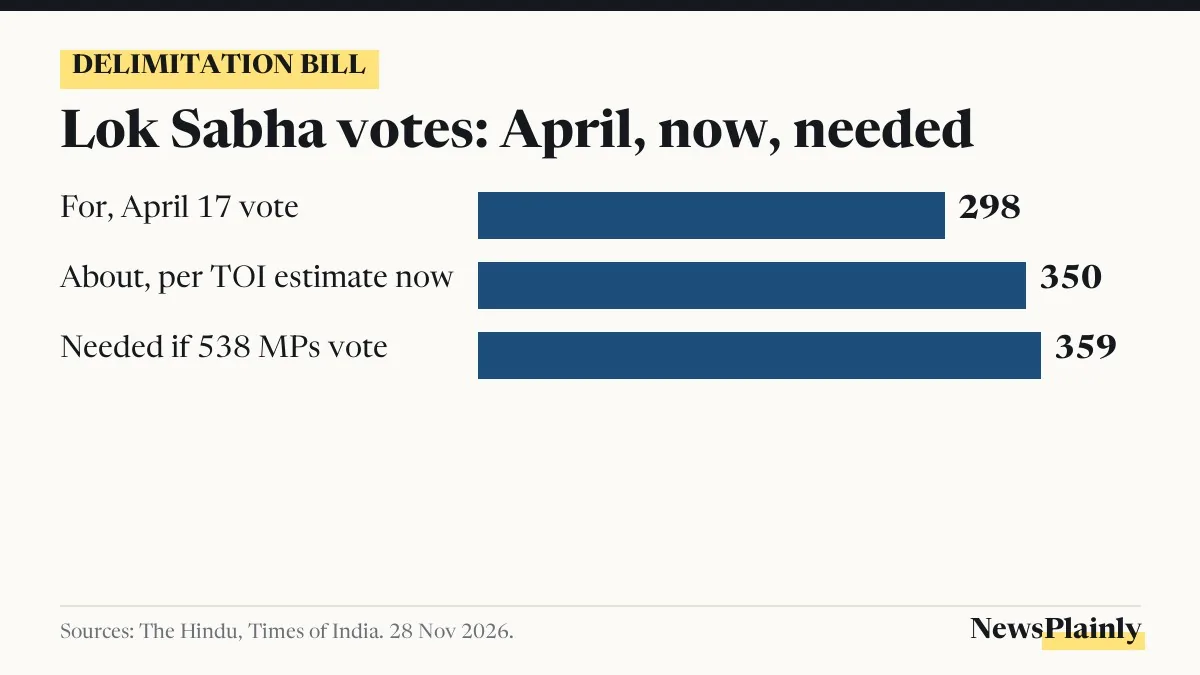
A Constitution amendment needs a special majority under Article 368(2): two-thirds of members present and voting, and a majority of the House’s total membership, as LiveLaw and the Times of India explain. The April bill got 298 votes for and 230 against, The Hindu reported. That was short of the two-thirds majority of 352 it needed.
The Lok Sabha now has 540 sitting members and three vacancies. If Trinamool MP Kalyan Banerjee’s suspension stays, 539 can attend, including the Speaker. If all 538 others vote, the bill needs 359 votes, according to The Hindu and the Times of India. The bar falls when MPs stay away, because only those present and voting count.
| MPs present and voting | Votes needed (two-thirds) |
|---|---|
| 538 | 359 |
| 530 | 354 |
| 520 | 347 |
| 510 | 340 |
The Times of India estimated that the DMK and NCP (Sharadchandra Pawar) together could take the ruling alliance from about 320 votes to about 350. Set against 359, that is about 9 short if every MP votes. That is NewsPlainly’s comparison, and it rests on the newspaper’s estimate, not a vote count. The Hindu reported that the BJP is also counting on 20 MPs who left the Trinamool Congress in June and merged with the NDA-backing Nationalist Citizens Party of India. Disqualification proceedings against them are pending before Speaker Om Birla.
What else the bill changes
The delimitation bill would raise the maximum size of the Lok Sabha from 550 to 850, with up to 815 members from states and 35 from Union territories, and lift the ceiling on a state assembly from 500 to 650 seats, The Hindu reported. Because every state gets the same 50% rise, each state’s share would stay roughly where it is. That is the main change from the April bill, which would have let Parliament pick the census used to share out seats, LiveLaw reported.
For a state like Uttar Pradesh, the rise would take its Lok Sabha seats from 80 to 120, and West Bengal’s from 42 to 63. Our earlier report on the 50% rise in Lok Sabha seats has the state-by-state numbers.
The Lok Sabha sits from 30 November and the Rajya Sabha from 2 December. Both are due to rise on 3 December. The bill must pass both Houses with the special majority.
Frequently asked questions
How many votes does the delimitation bill need?
Two-thirds of MPs present and voting plus a majority of the total membership. If all 538 eligible MPs vote, that is 359 votes; fewer voters lower the bar.
Why did the DMK support the delimitation bill?
A. Raja said Tamil Nadu's 7.18% share of Lok Sabha seats is kept, so the state loses nothing. The party says it will still seek amendments.
What does the INDIA bloc want instead?
Keep the Lok Sabha at its current size, give women one-third of seats within it, and keep each state's share of seats for 25 years.