
Representative image. Ravi Dwivedi, CC BY-SA 4.0, Wikimedia Commons

Why it matters
Retail inflation is already above the RBI's 6% upper limit, and the ministry's own review says the next readings could be pushed higher by seasonal demand, weather and oil. For a family, that means food and some non-food bills may keep rising faster than the 4% the RBI aims for. The review also lists what could soften the pressure, so the outcome depends on crude prices, the rupee and the weather.
The Finance Ministry’s Monthly Economic Review for November, released on 28 November 2026, says inflation may face more upward pressure in the coming months even as growth holds firm. It names festive and wedding-season demand, a possible strong El Nino and the conflict in West Asia as the main inflation risks, after retail inflation rose to 6.09% in October.
The review is prepared by the ministry’s Department of Economic Affairs. For a household budget its message is mixed: indicators such as e-way bills, GST collections, electricity use and freight pointed to an economy still expanding in October, Zee Business and The Times of India reported, but food and some non-food items are costing more. NewsPlainly could not open the review’s PDF on the department’s website at the time of writing. The ministry’s statements below are taken from reports in The Indian Express, Hindustan Times, The Times of India and Zee Business; the price figures come from the official consumer and wholesale price releases.
What the Finance Ministry says may push prices up
The review lists four pressures. Each one works on a different part of the price index:
- Festive and wedding demand. The festive season stretched into November and the wedding season has started. The review said this could lift demand for both food and non-food items, Hindustan Times and The Indian Express reported.
- The base effect. Retail inflation compares prices with the same month a year earlier. When prices were unusually low a year ago, the yearly rate looks higher. The review said this unfavourable base effect may stretch slightly into November.
- El Nino. El Nino is a warming of the Pacific Ocean that can upset weather around the world. The review cited the World Meteorological Organisation’s warning of an exceptionally strong El Nino towards the end of 2026 and counted it among weather-related uncertainties for prices.
- West Asia. Continued conflict, and risks to shipping through the Strait of Hormuz, may keep India’s oil import bill and sea freight rates volatile. The review said such supply shocks threaten to feed into wholesale and retail prices in the coming months, according to The Indian Express and The Times of India.
The ministry also said geopolitical tensions, AI-related demand and festive buying had pushed up the prices of some non-food items, Hindustan Times reported. On the weather risk, the review added a possible counterweight: the Indian Ocean Dipole index, a measure of the temperature gap across the Indian Ocean, is in the positive zone at 0.8°C and could offset El Nino conditions if it lasts.

The inflation figures behind the warning
The review’s 6.09% figure matches the October consumer price index (CPI) release from the Ministry of Statistics and Programme Implementation (MoSPI). That took retail inflation above 6%, the upper limit of the Reserve Bank of India’s tolerance band, for the first time since October 2024, Hindustan Times reported. The RBI’s target is 4%.
The table sets the latest month against the one before, from the two official releases. Wholesale prices, tracked by the wholesale price index (WPI), measure what traders and producers pay before goods reach shops.
| Price measure | September 2026 | October 2026 |
|---|---|---|
| Retail inflation (CPI, all India) | 5.54% | 6.09% |
| Rural CPI | 6.08% | 6.63% |
| Urban CPI | 4.88% | 5.41% |
| Retail food inflation (CFPI) | 7.74% | 8.94% |
| Wholesale inflation (WPI) | 11.39% | 12.29% |
| WPI food index | 8.66% | 8.58% |
| WPI fuel and power | 25.85% | 32.84% |
Two things stand out in the official numbers. Retail food inflation, measured by the consumer food price index (CFPI), rose by 1.2 percentage points in a month, while food inflation at the wholesale level eased slightly. And fuel and power inflation at the wholesale level rose by about 7 points; the review links the West Asia conflict to oil import bills. Inflation was also higher in villages than in cities: 6.63% rural against 5.41% urban.
There is a softer side. About 52% of the CPI basket still had inflation below the RBI’s 4% target, the ministry said, according to Hindustan Times and Zee Business. Core inflation, which leaves out food and fuel, rose for a third month to 4.5% in October, Hindustan Times reported. NewsPlainly covered the October retail inflation data and the 12.29% wholesale reading when they came out.
What is already costing more in the kitchen
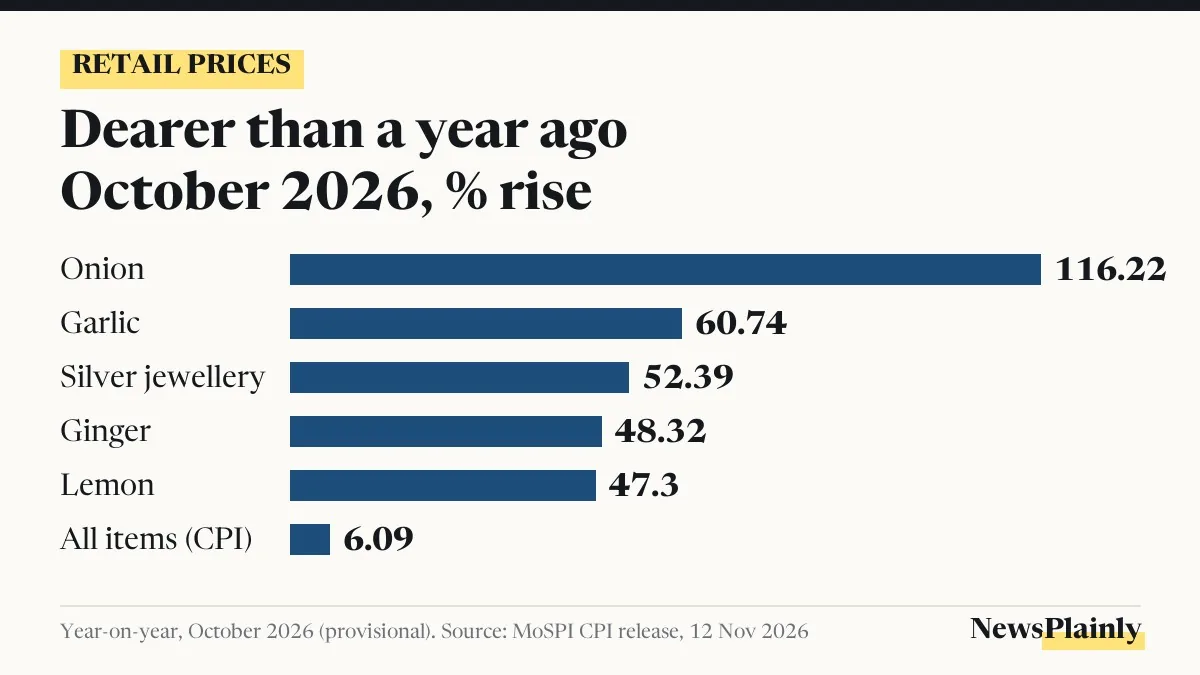
The review speaks of inflation risks ahead, but the CPI release shows where prices have already moved. Onion prices were 116.22% higher in October than a year earlier, up from 108.13% in September. Garlic rose 60.74%, ginger 48.32% and lemon 47.30%. Among non-food items, silver jewellery was up 52.39%.
Not everything is dearer. Potato was 14.24% cheaper than a year ago, cauliflower 10.57% and coconut 5.60%, the same release shows. By spending group, restaurants and accommodation rose 10.06% and personal care and related goods 10.14%, while health rose 2.05% and housing, water, electricity and gas 2.90%.
What 6.09% means for a household, as a rough guide: on average, a basket of goods and services that cost ₹1,000 in October 2025 cost about ₹1,061 in October 2026. At 8.94% food inflation, food that cost ₹1,000 in October 2025 cost about ₹1,089 a year later. This is NewsPlainly’s calculation from the official averages; each family’s own rise depends on what it buys.
What the Monthly Economic Review says could ease prices
The ministry pointed to two things working the other way. Global crude benchmarks fell below $100 a barrel in early November, and the rupee strengthened on strong capital inflows. Together they may give some relief from imported inflation, the review said, but only if the trends last, The Times of India and The Indian Express reported. The rupee touched an eight-month high in the week before the review, The Indian Express said.
For food supply, the review said fertiliser stocks are comfortable for the rabi (winter) crop. It also noted that sowing is at an early stage and water stored in reservoirs is below last year’s level. For businesses, it said input cost pressures are easing and new orders are picking up.
Growth numbers and the dates to watch
On growth, the review sounds confident. The index of eight core industries grew 10.9% in October (provisional), and industrial output rose 6.7% in September, Zee Business reported from the review. Merchandise exports rose 45% from a year earlier to $49.5 billion in October, the highest monthly value on record, and foreign exchange reserves stood at $705.3 billion on 13 November, enough for about 10 months of imports. The economy grew 7.8% in April to June, The Indian Express noted.
The government releases July to September GDP data on Monday, 30 November. The RBI’s monetary policy committee, which raised its policy rate by 25 basis points in October according to Hindustan Times and The Indian Express, announces its next decision on 4 December. MoSPI will publish November’s CPI on 14 December, the first official test of the risks the review lists.
Frequently asked questions
What did the Finance Ministry's Monthly Economic Review for November 2026 say about inflation?
It said inflation may face upside pressure from festive and wedding demand, a base effect stretching into November, a possible strong El Nino and the West Asia conflict, according to reports of the review.
What was India's retail inflation in October 2026?
6.09%, up from 5.54% in September, according to MoSPI. Food inflation was 8.94%, with rural inflation at 6.63% and urban at 5.41%.
Which food items rose most in price in October 2026?
Onion (116.22% higher than a year earlier), garlic (60.74%), ginger (48.32%) and lemon (47.30%), the CPI release shows. Potato was 14.24% cheaper.
What could bring inflation down, according to the review?
Crude oil benchmarks falling below $100 a barrel in early November and a stronger rupee, if both trends last.