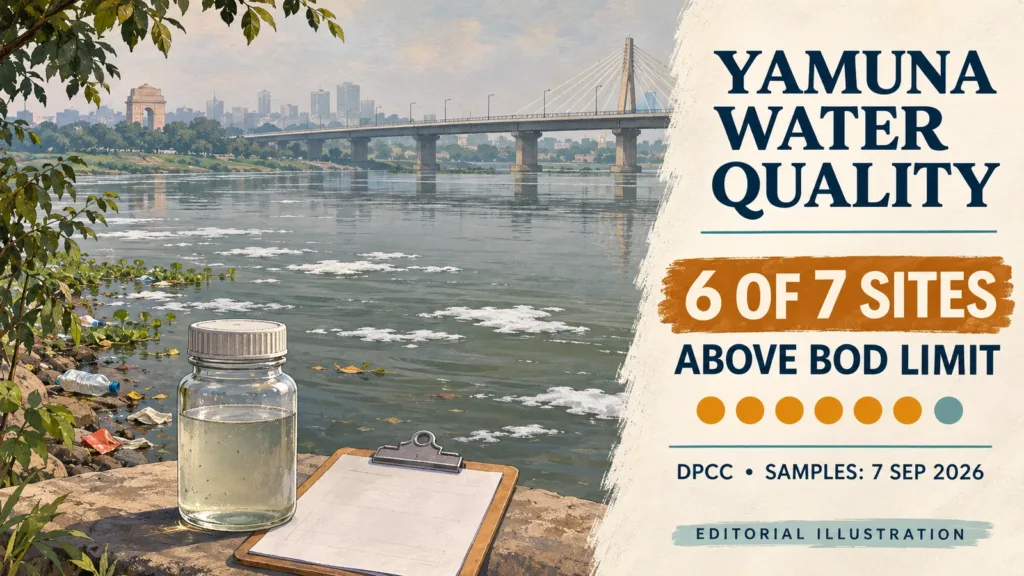
AI-generated editorial illustration by NewsPlainly; symbolic river scene, not a photograph of the sampling or current conditions. Six of seven sites exceeded the BOD limit in DPCC samples collected on 7 September 2026; count by NewsPlainly from the report table.
हिन्दी में सारांश Summary in Hindi
- दिल्ली के पर्यावरण मंत्री मंजिंदर सिंह सिरसा ने 23 नवंबर को कहा कि यमुना का 60% हिस्सा इतना साफ है कि उसका पानी पिया जा सकता है।
- डीपीसीसी की सितंबर की रिपोर्ट (7 सितंबर के नमूने) में 7 में से 6 जगह बीओडी सीमा से ऊपर है; केवल पल्ला सीमा के भीतर है।
- सी श्रेणी का पानी सिर्फ उपचार के बाद पीने लायक माना जाता है।
বাংলায় সারাংশ Summary in Bangla
- দিল্লির পরিবেশমন্ত্রী মনজিন্দর সিং সিরসা ২৩ নভেম্বর বলেন, যমুনার ৬০ শতাংশ এতটাই পরিষ্কার যে তার জল পান করা যায়।
- ডিপিসিসির সেপ্টেম্বরের রিপোর্টে (৭ সেপ্টেম্বরের নমুনা) ৭টির মধ্যে ৬টি জায়গায় বিওডি সীমার উপরে; শুধু পাল্লা সীমার মধ্যে।
- সি শ্রেণির জল শোধনের পরেই কেবল পানযোগ্য ধরা হয়।
Why it matters
A claim that river water is drinkable can lead people to bathe in it or use it at ghats without a second thought. The DPCC table is the checkable record, and it is the only measured data in this story.
Delhi Environment Minister Manjinder Singh Sirsa said on Monday, 23 November 2026, that 60% of the Yamuna is clean and its water is safe to drink, The Hindu reported. The latest Yamuna water quality report we could find from the Delhi Pollution Control Committee (DPCC), on water sampled on 7 September 2026, tells a different story at five of its seven Yamuna sites. This article sets the minister’s claim and the measured Yamuna water quality side by side, and says what each can and cannot show.
Sirsa’s claim that the Yamuna is safe to drink
Sirsa was speaking at the launch of Uber’s “One Less Car” report in New Delhi. “60% of Yamuna jii is totally clean… Clean means so clean that even you can drink that water,” he said, urging people to visit the river and see for themselves. He said cleaning began at one end of the river and moves to the other, which is why 60% is done, and that the whole river will be cleaned by 2029 or 2030. He credited Chief Minister Rekha Gupta and the Union government, and said sewage reaches the river through drains, so treatment plants matter.
The Hindu’s report does not say what “60%” measures: length of the river, number of drains tapped or a water-quality test. It also names no figure or report behind the claim.
What DPCC’s Yamuna water quality report for September shows
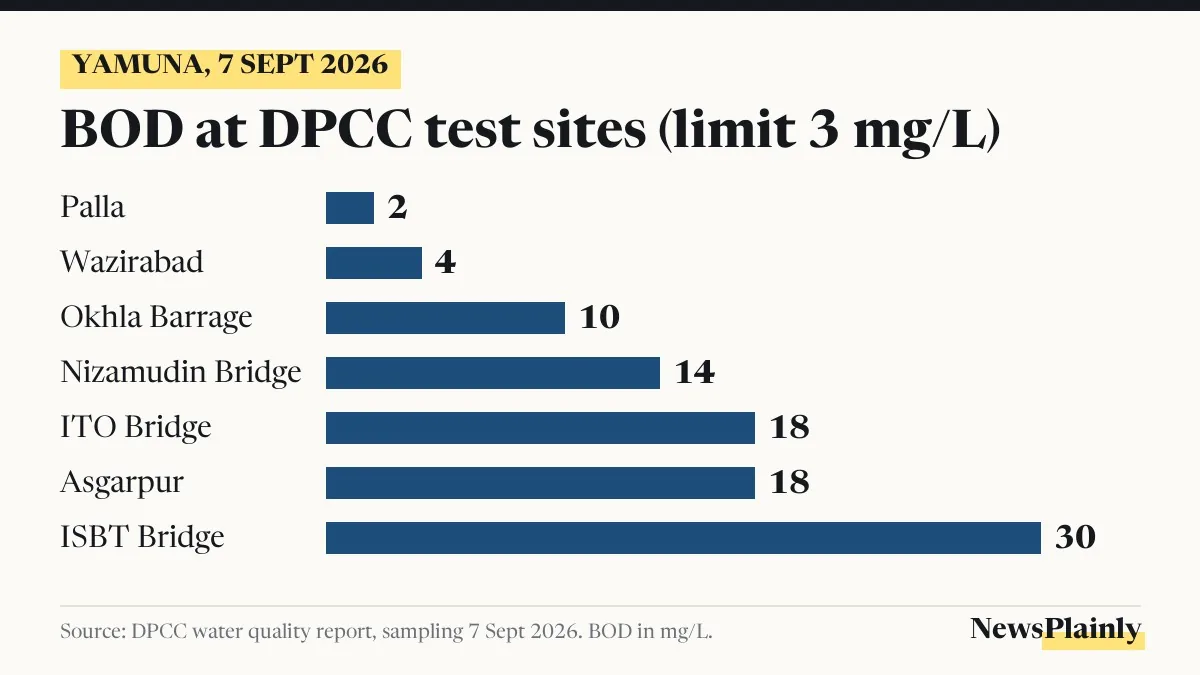
DPCC tests the river at seven points each month, six in Delhi and one at Asgarpur, in Haryana. Its September table, dated 30 September 2026, measures each against the limits for “C class” water. Under the Central Pollution Control Board’s scheme, class C water is a source for drinking after conventional treatment and disinfection, not water to drink straight from the river. The limits in the table are biochemical oxygen demand (BOD, a measure of organic pollution) of 3 mg/L or less, dissolved oxygen (DO) of 5 mg/L or more, and faecal coliform bacteria of 500 desirable and 2,500 at most.
| Site | BOD (mg/L) | DO (mg/L) | Faecal coliform |
|---|---|---|---|
| Palla | 2.0 | 6.5 | 1,100 |
| Wazirabad | 4.0 | 5.2 | 1,300 |
| ISBT Bridge | 30.0 | 2.9 | 35,000 |
| ITO Bridge | 18.0 | 4.2 | 17,000 |
| Nizamudin Bridge | 14.0 | 3.8 | 15,000 |
| Okhla Barrage | 10.0 | 4.0 | 21,000 |
| Asgarpur (Haryana) | 18.0 | NIL (none recorded) | 38,000 |
How to read the three measures: BOD is the oxygen that bacteria use up breaking down waste in the water, so a high number means heavy sewage load. DO is the oxygen left in the water for fish; a low number means the river is struggling. Faecal coliform counts bacteria from human and animal waste. Lower is better for BOD and coliform, higher is better for DO.
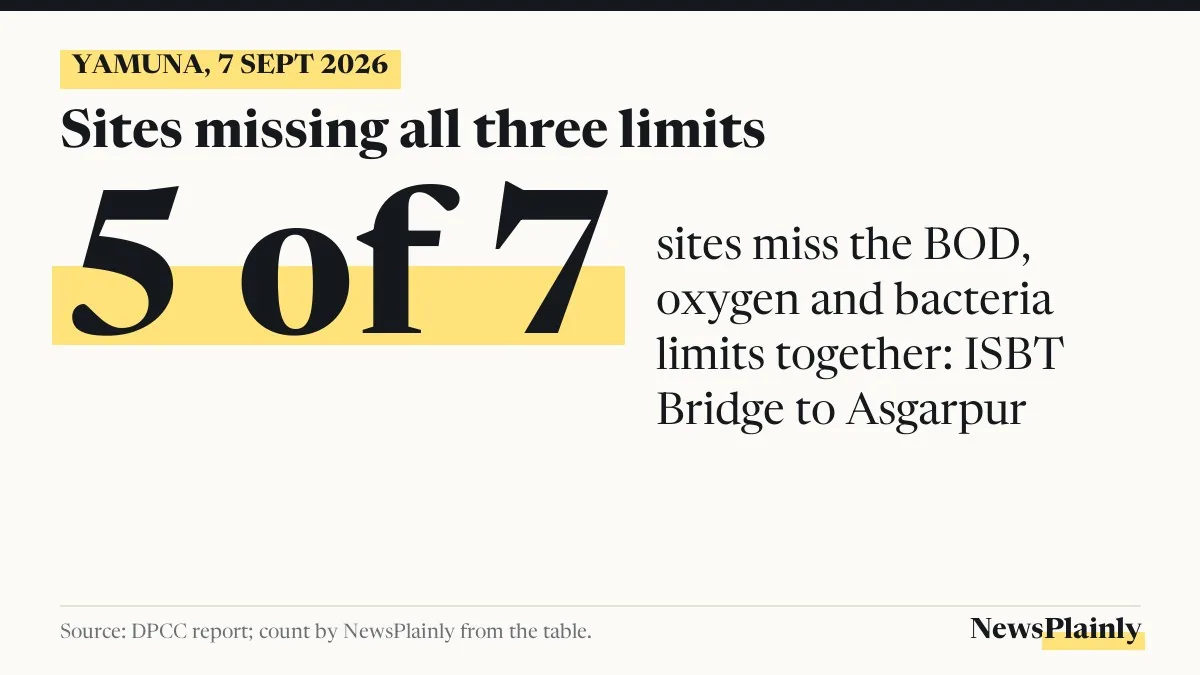
Palla, where the Yamuna enters Delhi, is the only site within the BOD and DO limits, and its bacteria count is under 2,500 but above the desirable 500. Wazirabad meets the oxygen and bacteria limits but not BOD. The five sites downstream, from ISBT Bridge to Asgarpur, miss all three limits. The Pioneer’s report on the same September data gives the BOD range as 2 to 30 mg/L with ISBT Bridge highest at 30, against a limit of 3. Our counts of sites come from reading the DPCC table.
One caution on the DPCC Yamuna report’s units: the table’s column header prints the faecal coliform unit as most probable number (MPN) per 200 ml, while the Pioneer uses 100 ml, so we give the numbers as printed. “NIL” for Asgarpur is the report’s own entry for dissolved oxygen. ISBT Bridge is near the Inter State Bus Terminal, and ITO Bridge is near the Income Tax Office.
What the comparison can and cannot show
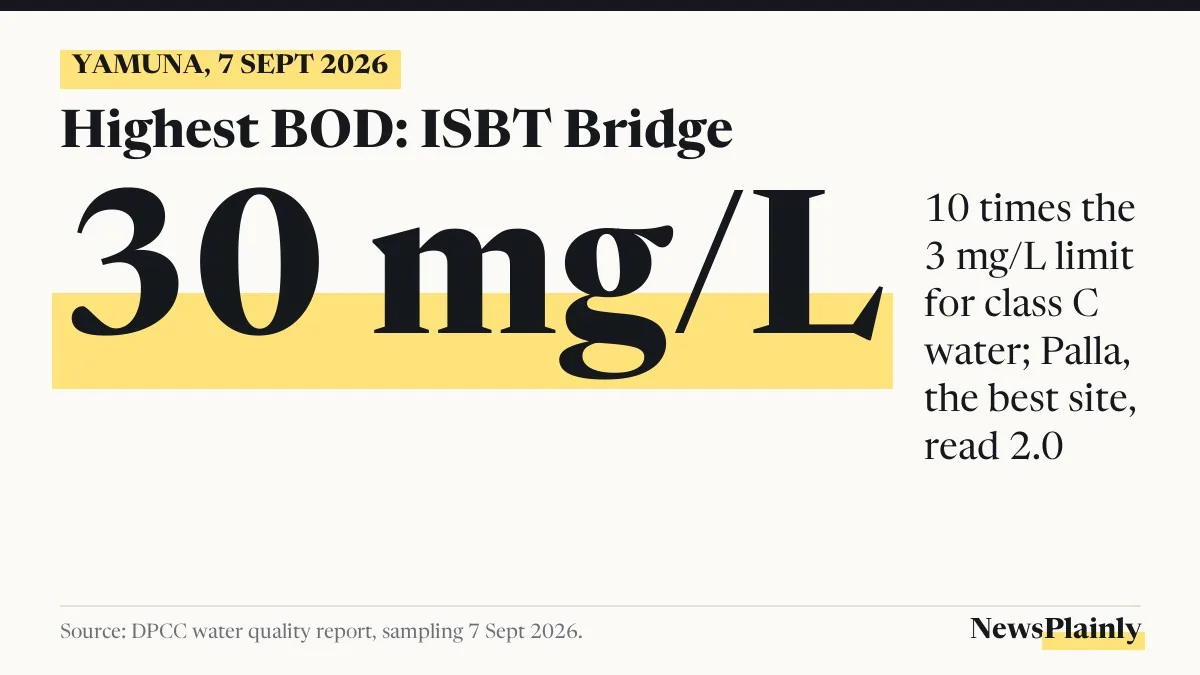
On Yamuna pollution, the minister spoke in November and the table is from sampling on 7 September, so they are not the same dates. The newest DPCC report listed on its analysis page when we checked was September. A cleaner river in October or November would not show up here. The minister’s 60% also has no definition, so it cannot be set against DPCC’s seven points. What the table does show is that on 7 September, at six of seven sites, the Yamuna’s water quality did not meet the BOD limit for class C water, and the water at the worst sites was far above it.
The DPCC report is a Delhi government body’s own data, and The Hindu’s report of the minister’s speech does not mention it. For more on the river, see our reports on the Supreme Court’s order for fines on states and flow meters and on the Delhi Police FIR over dead fish.
What it means for readers
Under the criteria DPCC itself uses, even water that meets class C limits is meant for drinking only after treatment. Anyone who uses the river at the ghats can check the monthly DPCC Yamuna report on its website, which lists each site’s figures, to judge whether the Yamuna is safe to drink or to use. The next report will show whether Yamuna water quality has moved at the downstream sites since 7 September. No publication date for it has been announced in the reports we saw.
Frequently asked questions
Is the Yamuna water safe to drink?
Delhi's environment minister said so on 23 November. DPCC's September table finds 6 of 7 sites above the BOD limit for class C water, which needs treatment before drinking.
What does class C water mean?
The Central Pollution Control Board's class C is a drinking water source after conventional treatment and disinfection.
Which site is best and worst?
On 7 September Palla had BOD of 2.0 mg/L, the only site within the limit; ISBT Bridge had the highest, at 30.0.