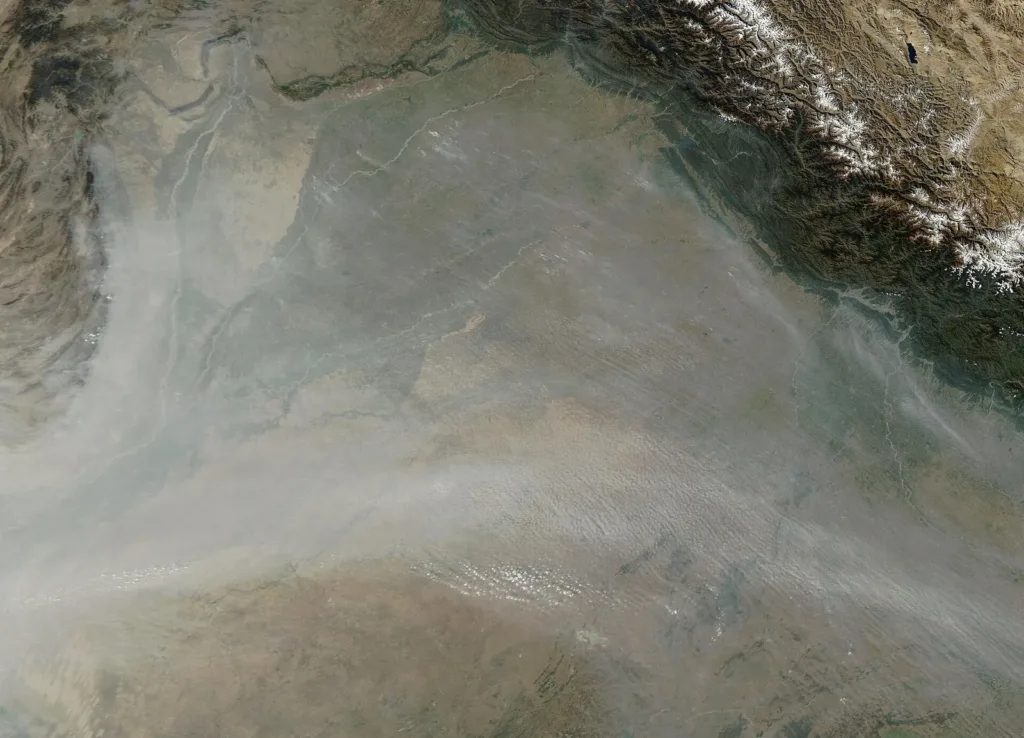
Representative image. MODIS Land Rapid Response Team, NASA GSFC, Public domain, Wikimedia Commons

हिन्दी में सारांश Summary in Hindi
- वायु गुणवत्ता प्रबंधन आयोग (CAQM) ने दिल्ली और NCR राज्यों से 2027 की कार्य योजनाएं बनाने को कहा है, जिनमें पहली बार जिला-स्तर की योजनाएं शामिल होंगी।
- 2027 में सालाना औसत प्रदूषण (AQI, PM2.5, PM10) को 2026 के मुकाबले 15 से 20 प्रतिशत घटाने की दिशा में काम करना है।
- धिकारी तय होगा; योजनाएं 5 दिसंबर तक CAQM के पोर्टल पर जमा करनी हैं।
বাংলায় সারাংশ Summary in Bangla
- বায়ু গুণমান ব্যবস্থাপনা কমিশন (CAQM) দিল্লি ও NCR-এর রাজ্যগুলিকে 2027 সালের কর্মপরিকল্পনা তৈরি করতে বলেছে, যাতে এই প্রথম জেলা-স্তরের পরিকল্পনাও থাকবে।
- 2027 সালে বার্ষিক গড় দূষণ (AQI, PM2.5, PM10) 2026-এর তুলনায় 15 থেকে 20 শতাংশ কমানোর লক্ষ্যে কাজ করতে হবে।
- ফিসার ঠিক করতে হবে; পরিকল্পনা 5 ডিসেম্বরের মধ্যে CAQM-এর পোর্টালে জমা দিতে হবে।
Why it matters
State and municipal plans already exist; the new plans add a named officer, a target and a date at district level. If they are made public, residents and reporters can check an action against a person and a deadline. The reports read do not say they will be.
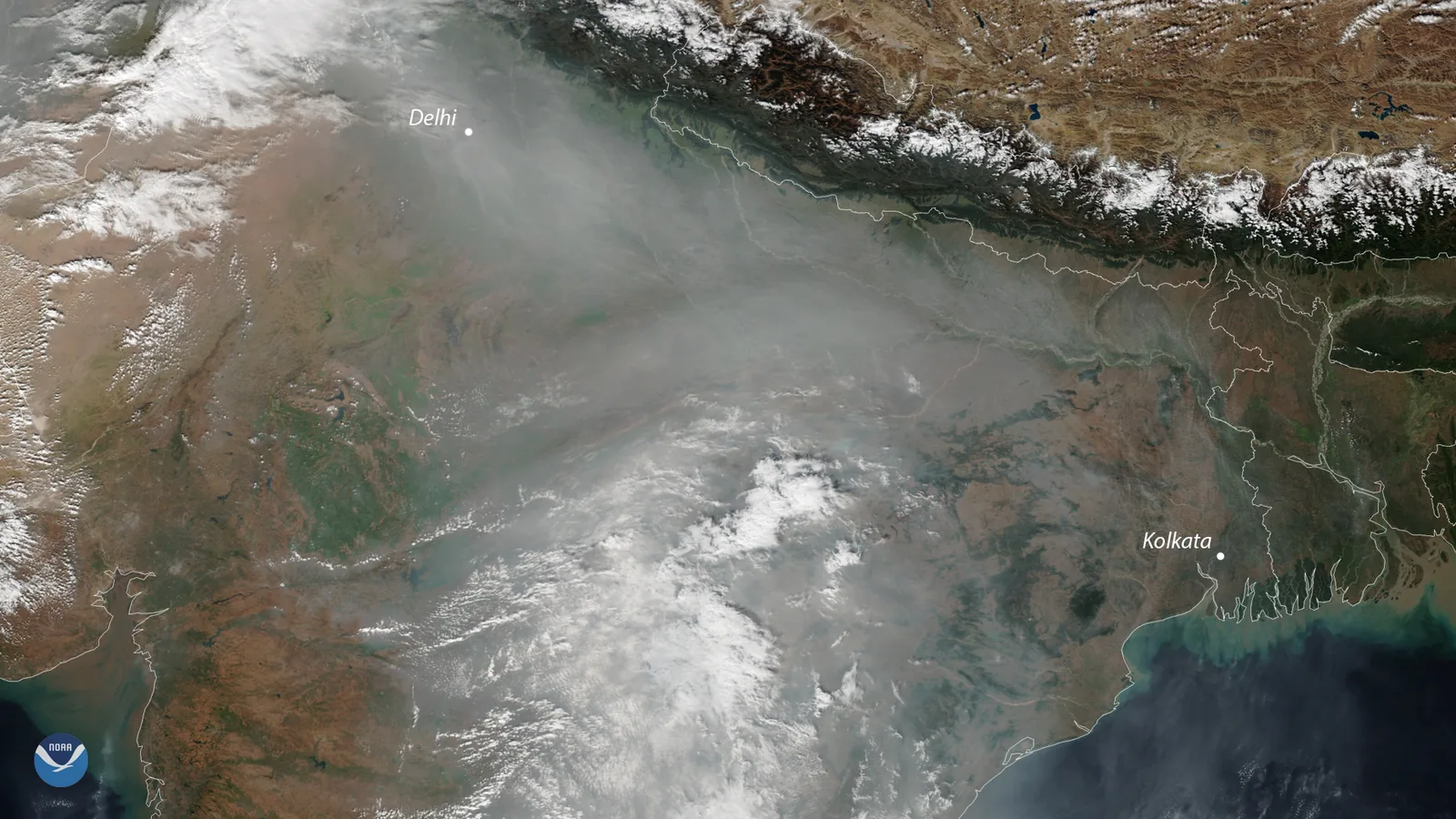
CAQM district plans are the new part of anti-pollution rules for Delhi and the rest of the National Capital Region (NCR) in 2027. The Commission for Air Quality Management in National Capital Region and Adjoining Areas (CAQM) has asked Delhi and the NCR states to prepare 2027 action plans that include plans for each district, with measures meant to cut annual average pollution by 15 to 20% compared with 2026. In a statement on Saturday, 21 November 2026, the commission said it is the first time district-level plans will form part of the State Action Plans, The Hindu reported.
What CAQM has asked the states to do
The plans must list actions sector by sector, with measurable targets, timelines and monitoring parameters. The CAQM statement names the sources to be tackled: vehicles, road dust, industry, construction and demolition work, municipal solid waste, crop residue, diesel generator sets, crematoria and other local sources. The Delhi NCR pollution target is a reduction of 15% to 20% in annual average AQI (the air quality index), PM2.5 and PM10, the fine and coarse particles, against 2026.
Economic Times described 15% as the minimum and 20% as the aspirational figure. The CAQM statement quoted by The Hindu gives only the 15% to 20% range, so this article uses that.
The Indian Express reported more detail from the directions, which it said were issued on Friday, 20 November. Every action point must name the department or agency responsible, plus a nodal officer with name, designation and contact details. State governments are to ask municipal corporations, district commissioners and district magistrates to start at once, and the plans must reach CAQM’s online portal by 5 December. CAQM will also specify extra measures that must go into the plans, according to The Hindu.
Why CAQM wants district plans now
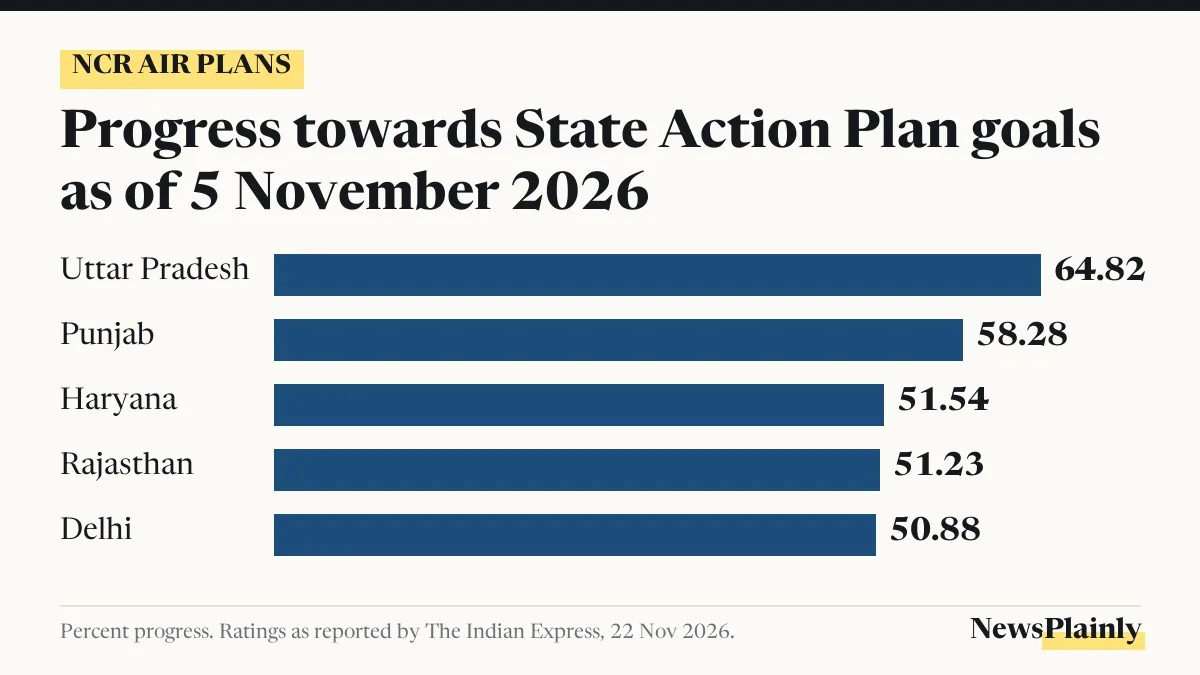
According to the Indian Express, which gave the ratings as of 5 November, nearly half the action points in the NCR states’ current plans were rated unsatisfactory. That record is the background to the CAQM district plans. Of 165 action points, 76 were unsatisfactory, 18 needed improvement and 37 were satisfactory, while 34 were marked not required. Delhi had 32 action points: 8 satisfactory, 18 unsatisfactory, 2 needing improvement and 4 not required.
| State | Progress towards plan goals |
|---|---|
| Uttar Pradesh | 64.82% |
| Punjab | 58.28% |
| Haryana | 51.54% |
| Rajasthan | 51.23% |
| Delhi | 50.88% |
Delhi’s 50.88% was the lowest of the five states assessed, the Indian Express reported. In September, The Hindu had reported, citing sources, that only about 40% to 60% of the measures promised in the 2026 plans had been completed. Those plans were sent to CAQM in January and finalised in February.
Who is responsible under the CAQM district plans
State and municipal action plans already exist. The CAQM district plans add a layer below them: a district-level plan with a named officer for each action. The CAQM statement says this is meant to bring planned, focused action to the grassroots, show gaps early and allow timely corrective steps, with clearly defined accountability.
Sunil Dahiya, founder and lead analyst at the Delhi-based think tank Envirocatalysts, told the Indian Express that the exercise will work only if districts have up-to-date emission inventories (lists of pollution sources and how much each emits) and the skills to update them every quarter. He also said district-wise emission data should be made public so that steps are carried out on the ground. The reports read do not say whether the district plans will be published, or whether CAQM district plans from the four states will use one common format.
What happens next with the Delhi NCR pollution target
Delhi and the NCR states have until 5 December to file the district plans, by the Indian Express account. The 2026 action plan stays in force until then and CAQM is still monitoring it, The Hindu reported. For the winter curbs that came before, see our earlier reports on stage 3 of the Graded Response Action Plan (GRAP) being revoked and on the 30 November deadline for automatic number plate recognition (ANPR) cameras.
The Federal, which cited a Hindustan Times report, and The Economic Times carried the same announcement. None of the four reports read says what happens to a state that misses the 5 December date, or how progress on the Delhi NCR pollution target will be reported to the public.
Frequently asked questions
What are CAQM district plans?
District-level action plans that Delhi and the NCR states must now include in their 2027 State Action Plans, each with sector-wise actions, targets, timelines and a named nodal officer, according to the CAQM statement.
What pollution target has CAQM set for 2027?
The actions should contribute to a 15% to 20% reduction in annual average AQI, PM2.5 and PM10 compared with 2026, the statement said.
When are the district plans due?
By 5 December on CAQM's online portal, according to the Indian Express.
How well are the current plans going?
As of 5 November, 76 of 165 action points were rated unsatisfactory and 37 satisfactory; Delhi's progress was the lowest of five states at 50.88%, the Indian Express reported.