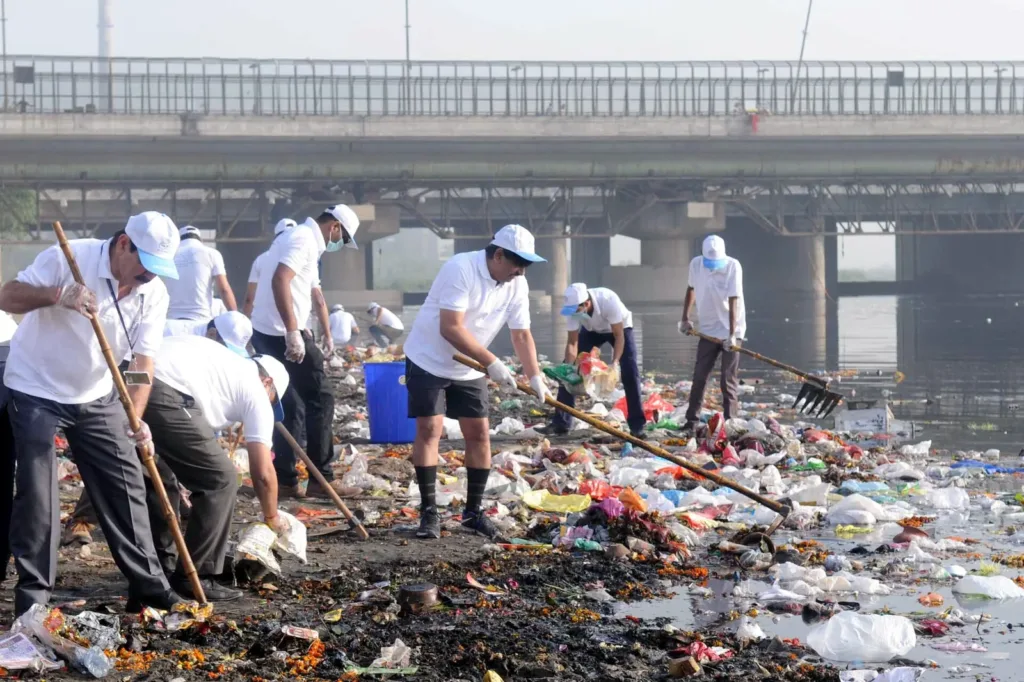
Representative image. Ministry of Water Resources, River Development and Ganga Rejuvenation, GODL-India, Wikimedia Commons

हिन्दी में सारांश Summary in Hindi
- सुप्रीम कोर्ट ने कहा है कि जिस राज्य या ज़िले से गुज़रते हुए यमुना का पानी और खराब होगा, उस पर जुर्माना लगेगा।
- हर सीवेज ट्रीटमेंट प्लांट को एक महीने के भीतर टैम्पर-प्रूफ स्मार्ट मीटर लगाने होंगे।
- गली सुनवाई 13 जनवरी 2027 को होगी।
বাংলায় সারাংশ Summary in Bangla
- সুপ্রিম কোর্ট বলেছে, কোনও রাজ্য বা জেলার মধ্য দিয়ে যাওয়ার সময় যমুনার জল আরও খারাপ হলে সেখানে জরিমানা হবে।
- প্রতিটি পয়ঃশোধনাগারকে এক মাসের মধ্যে ট্যাম্পার-প্রুফ স্মার্ট মিটার বসাতে হবে।
- আদেশটি ২০২৬ সালের ৪ নভেম্বরের এবং পরবর্তী শুনানি ২০২৭ সালের ১৩ জানুয়ারি।
Why it matters
The court wants to end the practice of states passing the buck, The Indian Express reported. With a reading at every boundary, a worse result has a state or district name against it. The fine goes to the court's registry. Live plant data on public websites also lets residents see whether the plant near them is running.
On Yamuna pollution, the Supreme Court has ordered that any state, Union Territory or district, Delhi included, that makes the river’s water worse will be fined. The money goes into the court’s registry. The order is dated 4 November and was reported on 16 November by The Indian Express and Hindustan Times. The Central Pollution Control Board (CPCB) has been asked to propose how the fine is calculated.
Who pays if the Yamuna’s water gets worse
A bench of Justices Manoj Misra and Manmohan said a state, Union Territory or district is accountable if water quality drops on any parameter while the river flows through it or leaves it. States may recover the amount from the polluters and from officials who failed in their duties, after an inquiry.
To make that measurable, CPCB must give the court water-quality data from the points where the Yamuna and its major drains enter and leave every state, Union Territory and district. The tests are BOD (biochemical oxygen demand, which shows how much oxygen the waste in the water will use up), COD (the chemical version of the same test), faecal coliform bacteria from human and animal waste, and total suspended solids. HT reported that the court suggested simultaneous samples be checked by institutions such as the IITs.
The river flows through Uttarakhand, Himachal Pradesh, Haryana, Delhi and Uttar Pradesh. HT noted that Delhi’s stretch, 22 km between Wazirabad and Okhla, is about 2% of the river’s length but adds the most to its pollution load. CPCB must also report the cause of any fish deaths, white foam, algal bloom or sudden spike in pollution. That follows the Delhi Police case over dead fish we covered on 15 November.
Why the court says spending has not worked
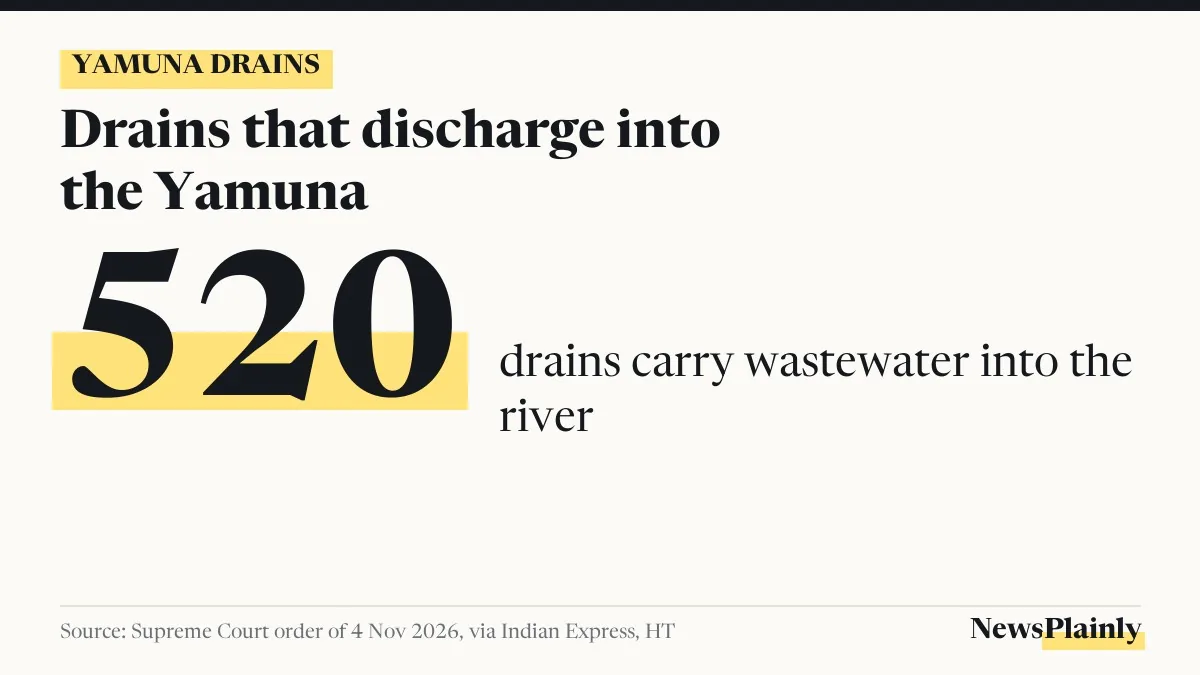
The court said pollution in the Yamuna has only increased despite huge sums spent on cleaning it. It tied this to 520 drains that discharge wastewater into the river. It was examining the Yamuna Action Plan, drawn up by a committee headed by the Union Home Secretary. The court called the plan a step forward because it names household sewage as the largest source of pollution.
The Yamuna Action Plan proposes 125 new sewage treatment plants (STPs) with a combined capacity of 4,401.30 million litres a day (MLD). It also covers upgrades to 20 existing sewage treatment plants, 12 common effluent treatment plants (CETPs, which treat waste water from clusters of factories) in Haryana, 10 municipal solid waste plants and 23 biogas plants. HT reported that the 520 drains currently carry about 9,666.81 MLD.
NewsPlainly’s calculation from those two figures: the 125 new plants would handle about 46% of what the drains carry today (4,401.30 divided by 9,666.81). Each would average about 35 MLD. The upgrades and the 12 CETPs would add to that, but the reports do not give their capacity.
The court also pointed to gaps in the plan, as reported by The Indian Express. The plan said the water bodies and wetlands in Zone ‘O’, the Yamuna riverfront zone in Delhi, were free of encroachment. An annexure from the Delhi government marked all 35 of them as encroached. The plan said 28 of Delhi’s 38 treatment plants meet the standards. CPCB’s report says none meets all of them and only five meet the bacteriological limit.
What the Yamuna pollution order asks of plants and officials
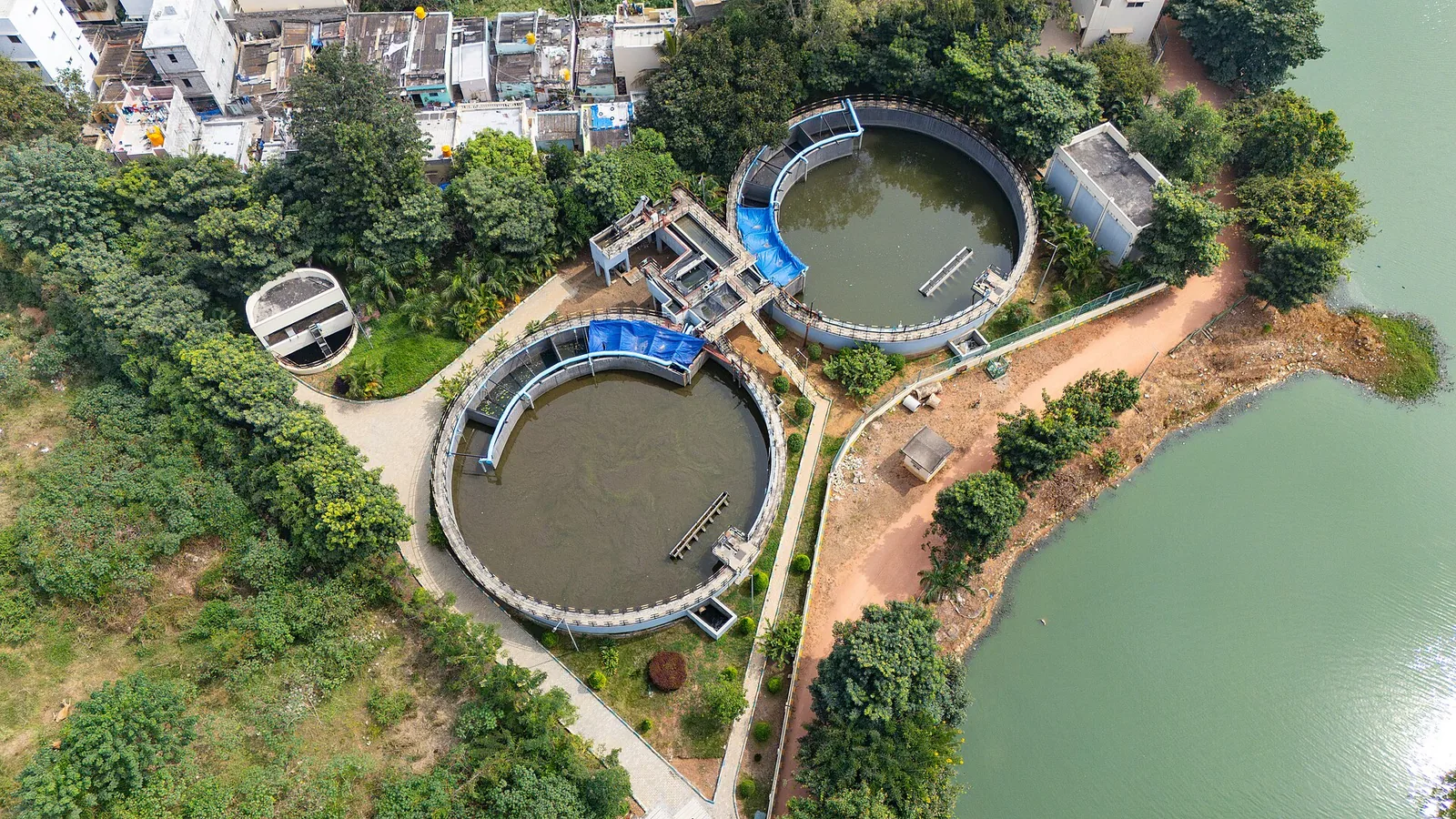
The Supreme Court Yamuna order sets duties for sewage treatment plants and for the officials who run them. The reports give time limits for some and not for others.
| Duty | Time limit | Who |
|---|---|---|
| Tamper-proof smart energy meters | Within a month | Every STP, CETP and government-commissioned biogas plant |
| Inlet and outlet meters with continuous sensors for pH, BOD, COD, solids and ammoniacal nitrogen | Not given in the reports | STPs and CETPs |
| Faecal coliform tested in accredited laboratories | Every week | STPs and CETPs |
| Live plant-wise data on CPCB and state pollution board websites | Continuous; a gap over 24 hours is presumed to mean the plant is not running | Plant operators |
| Unannounced inspections and sampling by IITs, NITs or accredited labs | At least once a quarter; results within 30 days | STPs of 5 MLD or more, and CETPs |
| Nodal officers of at least special secretary rank | Within two weeks | Chief secretaries of Yamuna states and Union Territories, and secretaries of central ministries |
| Monthly compliance affidavit to the court | Every month | Officer in charge of each plant and major drain, named on a public portal |
Environmental compensation is to be recovered from operators of sewage treatment plants for each day of non-compliance. The reports do not say from which date the one-month and two-week limits count.
Floodplain, unauthorised colonies and dairies
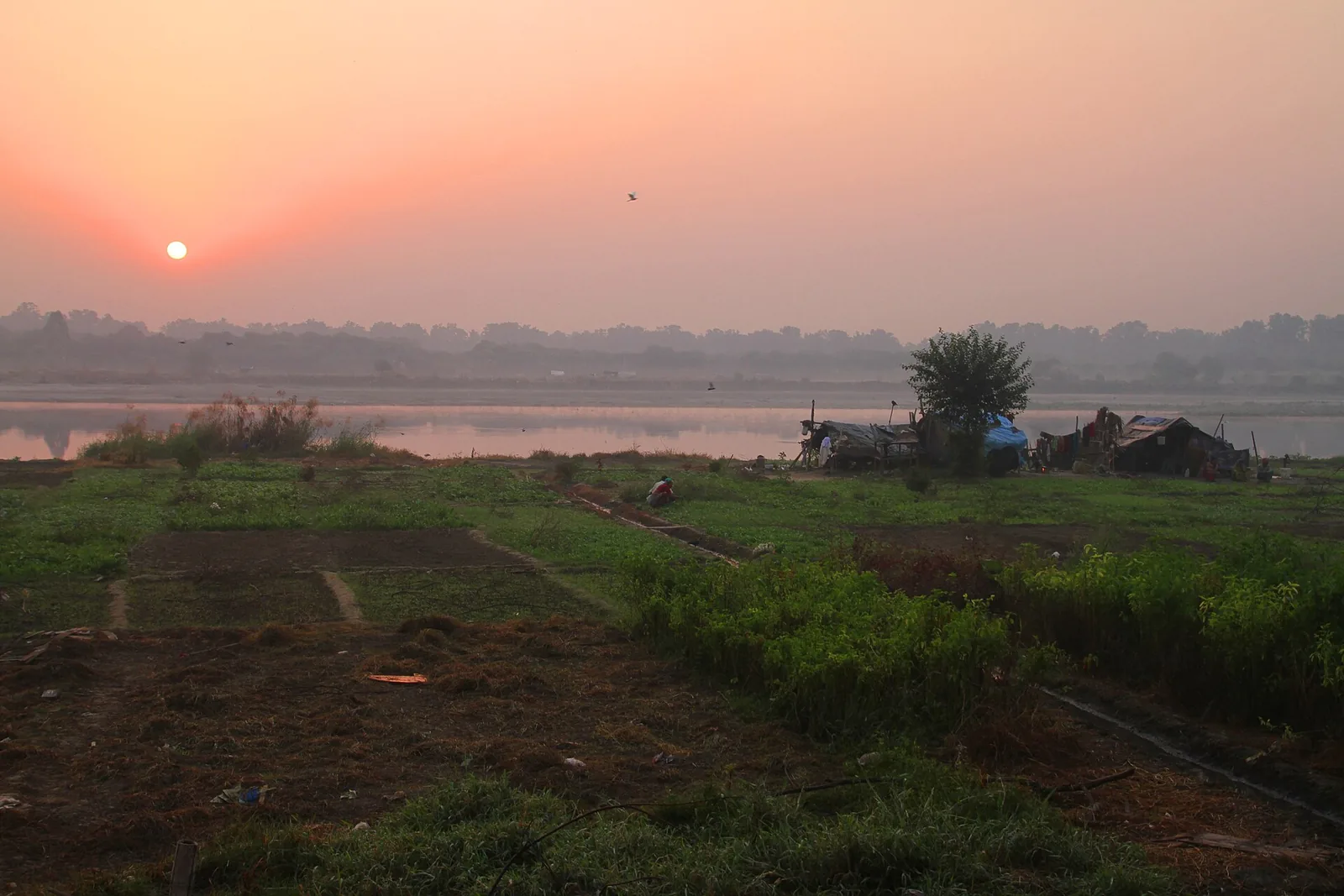
The court said Zone ‘O’, which is a green zone under Delhi’s Master Plan 2047, should be protected and, if feasible, extended along the river from its source to its meeting with the Ganga. No permanent structures should be allowed there except green parks and essential public infrastructure, and recreation should be limited to semi-permanent facilities such as cycling and walking tracks. Existing structures should be removed in accordance with law, after those entitled to rehabilitation get alternative accommodation.
The bench said sewage from unauthorised colonies and jhuggi clusters on drains and on the riverbed will keep polluting the river unless those settlements are removed after their occupants are rehabilitated. It acknowledged that laying sewers in such colonies is hard because they were built without a grid layout. HT also reported that the court flagged illegal dairies, particularly in Delhi, saying planned biogas plants would not handle the waste of dairies outside the authorised network. Urban local bodies must register septage tankers (vehicles that carry waste from household tanks), fit them with global positioning system (GPS) trackers and build portals to track septage.
What comes next in the Supreme Court’s Yamuna order
The Supreme Court will hear the matter again on 13 January 2027. CPCB has to put its penalty formula and the entry and exit data before the court. The reports do not give a date for either.
Frequently asked questions
Who can be fined under the Supreme Court's Yamuna order?
A state, Union Territory or district where the river's water quality gets worse on any parameter while flowing through or leaving it. CPCB has been asked to propose the formula for the amount.
Can a state get the fine back?
Yes. The court said states and Union Territories may recover it from the polluter and from officials who failed in their duties, after an inquiry.
What are sewage treatment plants and common effluent plants?
Sewage treatment plants clean household waste water. Common effluent treatment plants clean waste water from clusters of factories. The Supreme Court Yamuna order sets metering and inspection rules for both.
When is the next hearing?
The Supreme Court will hear the matter again on 13 January 2027.