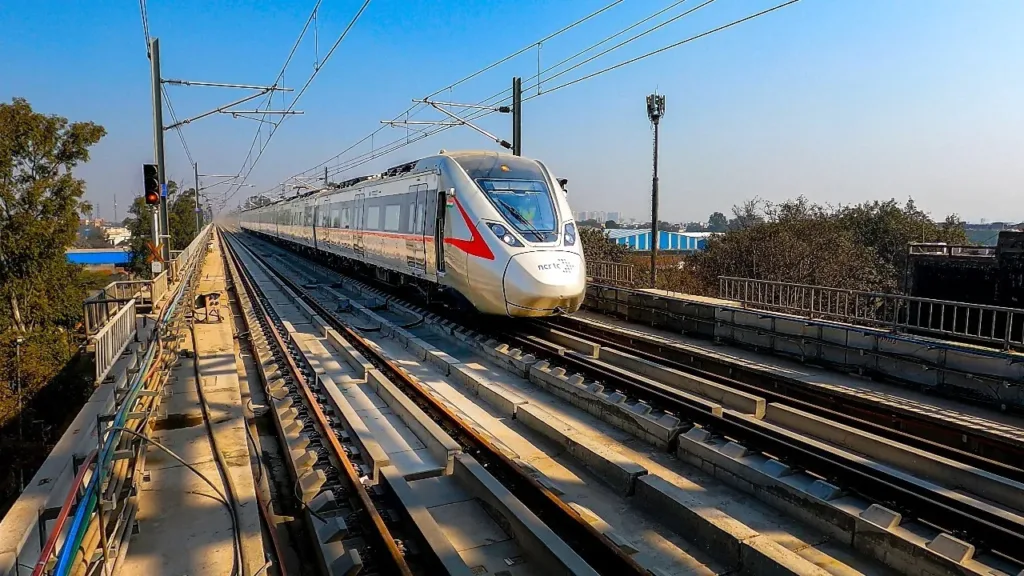
Representative image. Government of India, GODL-India, Wikimedia Commons

हिन्दी में सारांश Summary in Hindi
- 16 नवंबर 2026 से दिल्ली-मेरठ नमो भारत कॉरिडोर पर 8 फास्ट ट्रेनें चलेंगी।
- ये सिर्फ सराय काले खां, आनंद विहार, गाजियाबाद, बेगमपुल और मोदीपुरम पर रुकेंगी।
- दोनों छोर से सुबह 8 और 8.30 बजे, शाम 6 और 6.30 बजे चलेंगी।
বাংলায় সারাংশ Summary in Bangla
- ১৬ নভেম্বর ২০২৬ থেকে দিল্লি-মীরাট নমো ভারত করিডরে ৮টি ফাস্ট ট্রেন চলবে।
- ট্রেনগুলি থামবে শুধু সরাই কালে খাঁ, আনন্দ বিহার, গাজিয়াবাদ, বেগমপুল ও মোদীপুরমে।
- দুই প্রান্ত থেকে সকাল ৮টা ও ৮টা ৩০, সন্ধ্যা ৬টা ও ৬টা ৩০-এ ছাড়বে।
Why it matters
For a Delhi to Meerut commuter on the full stretch, the fast train cuts more than 10 minutes off a trip that takes about an hour. The catch is that only five stations get it, and only four departures in each peak.
Eight Namo Bharat fast trains will start running on the Delhi to Meerut corridor on Monday, 16 November 2026, stopping at only five stations during the morning and evening rush. The National Capital Region Transport Corporation (NCRTC), which runs the line, said the limited-stop trains will take Anand Vihar to Ghaziabad in eight minutes and cover the full corridor in under 50 minutes, the news agency PTI and the Indian Express reported on Saturday.
The line is the Delhi Meerut RRTS (Regional Rapid Transit System), which links Delhi with Ghaziabad and Meerut in the National Capital Region (NCR). The new services come on top of its regular trains, which will keep running every 10 minutes and stopping at every open station.
Namo Bharat fast trains: stations and departure times
The fast trains halt only at Sarai Kale Khan in Delhi, Anand Vihar, Ghaziabad, Begumpul in Meerut, and Modipuram at the Meerut end. Every other station is skipped.
Under the new Namo Bharat timings, each peak gets four trains. In the morning, one train leaves each end, Sarai Kale Khan and Modipuram, at 8 am, and another at 8.30 am. The evening pattern is the same at 6 pm and 6.30 pm. That is 2 departures from 2 terminals in 2 peaks, which adds up to the 8 services NCRTC announced.
| Peak | From Sarai Kale Khan | From Modipuram |
|---|---|---|
| Morning | 8 am, 8.30 am | 8 am, 8.30 am |
| Evening | 6 pm, 6.30 pm | 6 pm, 6.30 pm |
Because the fast and regular trains share the same platforms, NCRTC has asked passengers to check the station display boards and listen to announcements before boarding, PTI reported.
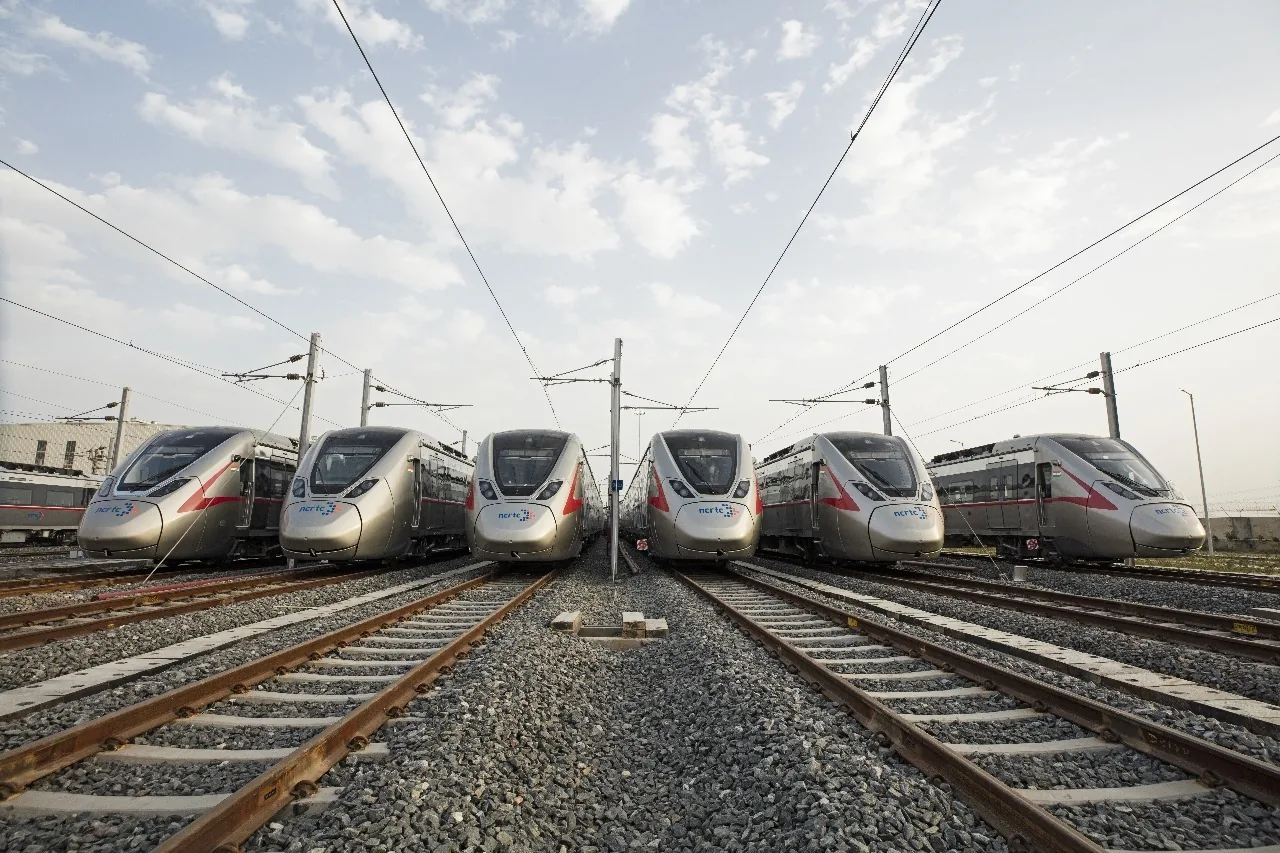
How much time the fast service saves
NCRTC gave three point-to-point times for the Namo Bharat fast trains. They fit together: 8 minutes from Anand Vihar to Ghaziabad plus 28 minutes from Ghaziabad to Begumpul makes the 36 minutes quoted for Anand Vihar to Begumpul.
| Journey | Fast train time |
|---|---|
| Anand Vihar to Ghaziabad | 8 minutes |
| Ghaziabad to Begumpul | 28 minutes |
| Anand Vihar to Begumpul | 36 minutes |
| Full corridor, Sarai Kale Khan to Modipuram | under 50 minutes |
The Delhi Meerut RRTS corridor is 82 km long, and a regular train usually takes about an hour to cover it, the Indian Express reported. So the end-to-end saving is more than 10 minutes. By NewsPlainly’s calculation, under 50 minutes for 82 km means an average speed above 98 km/h, against about 82 km/h for a regular train taking an hour.
The reports did not give a regular-train time for the shorter pairs, so the saving between Anand Vihar and Ghaziabad cannot be worked out from them. They also did not mention any change in fares for the fast trains.
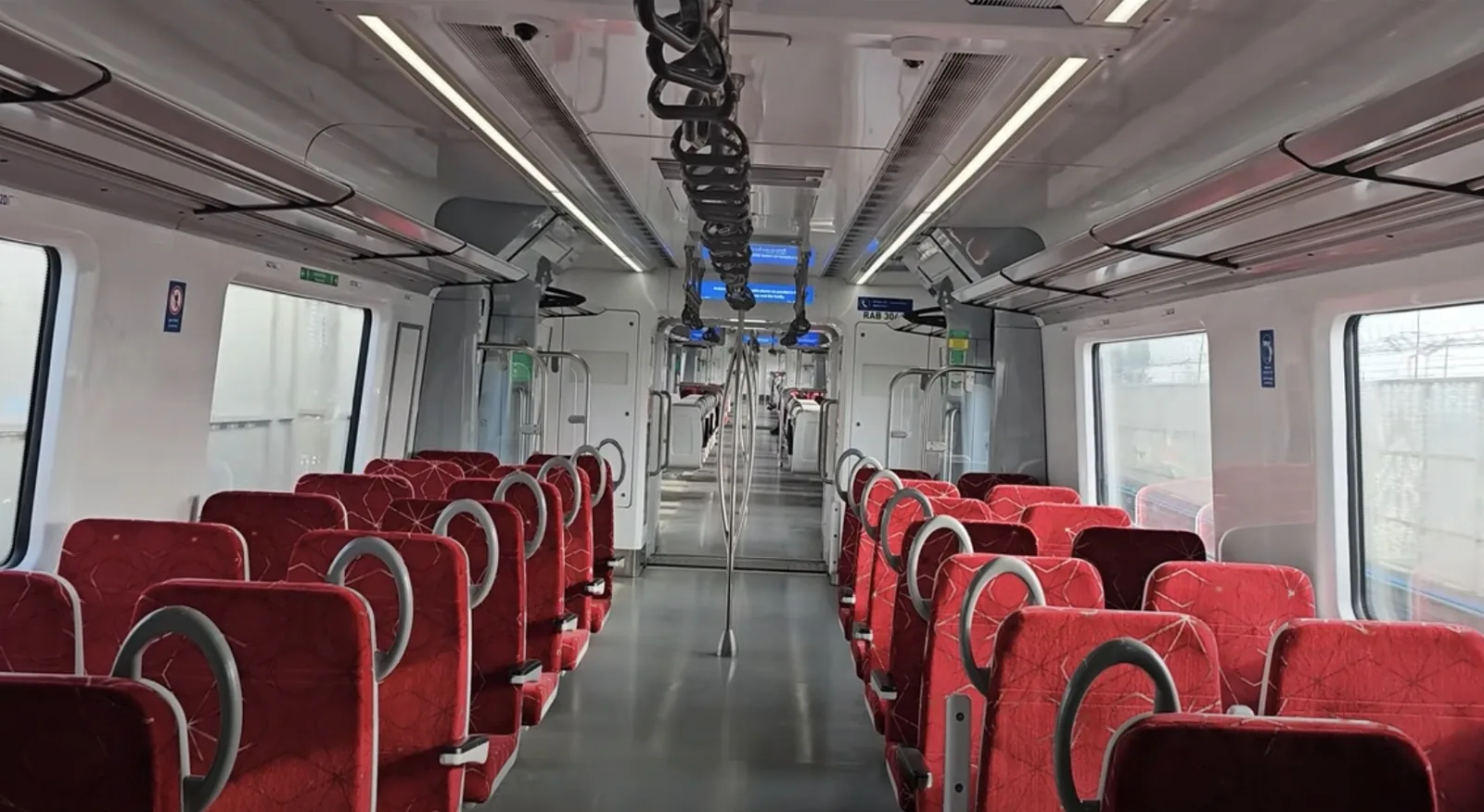
Why NCRTC is adding trains now
NCRTC said the fast trains are meant for office-goers and students, and to get more people onto public transport while air pollution is rising and roads are congested.
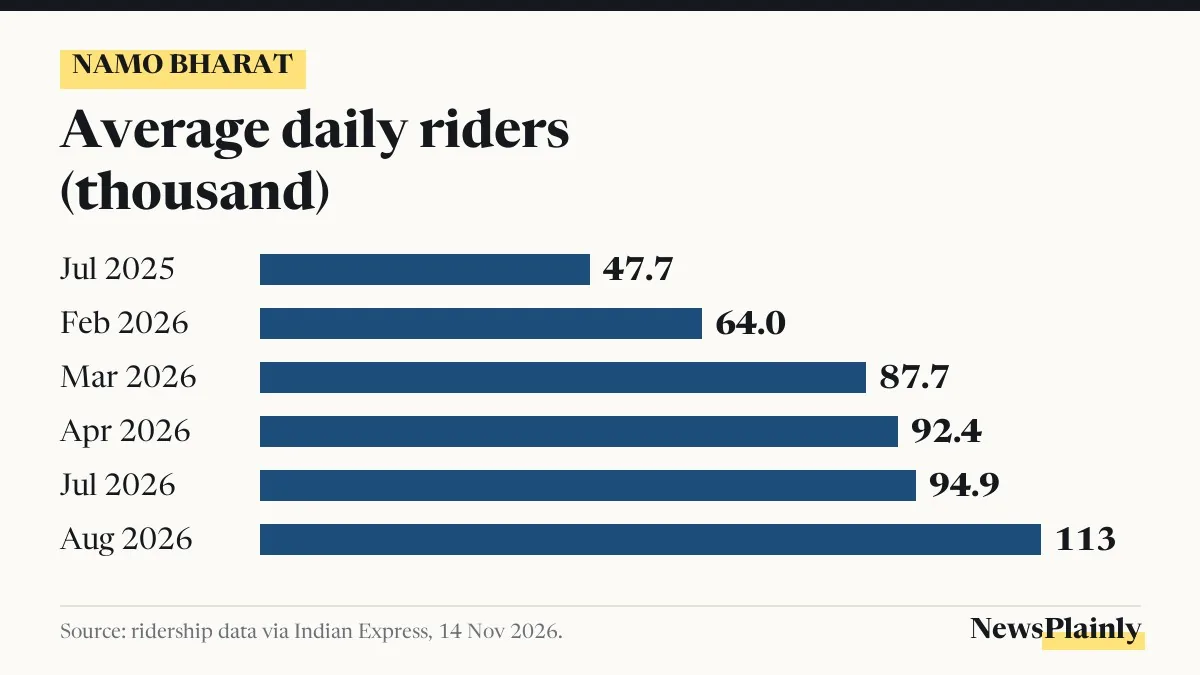
The line is busier than a year ago. About 1.1 lakh people use it every day, and it has crossed 5 crore passenger journeys, NCRTC said. Average monthly ridership over the past three months was above 32 lakh. Divided by 30 days, that is about 1.07 lakh a day, close to the daily figure.
The Indian Express, citing ridership data, said average daily footfall rose from 47,745 in July 2025 to 94,936 in July 2026. By NewsPlainly’s calculation that is a rise of 98.8%, just short of double. Daily use passed 1 lakh in June 2026 (1.02 lakh) and reached 1.13 lakh in August. The busiest single day so far was 28 August, with 1,68,510 riders.
How the Delhi Meerut RRTS grew, stretch by stretch
The jump in riders followed the opening of the whole corridor. The Indian Express listed the stages:
- October 2023: the first 17 km, Sahibabad to Duhai Depot, opened.
- March 2024: services reached Modinagar North.
- August 2024: the line reached Meerut South.
- February 2026: the full corridor from Sarai Kale Khan to Modipuram became operational. Daily footfall that month averaged 63,999, then 87,682 in March and 92,364 in April.
- 16 November 2026: the eight peak-hour fast trains are due to begin.
NCRTC has added extra runs before for festival rush; earlier this month it scheduled 32 extra trips for Bhai Dooj. Those were extra stopping trains. The new services are the first limited-stop trains described in the reports read.
What commuters in Delhi, Ghaziabad and Meerut should check
A passenger going from Anand Vihar or Ghaziabad to Meerut in the morning can use the morning Namo Bharat timings, 8 am or 8.30 am, only if their station is one of the five stops. Someone heading to a skipped station, such as Modinagar North, still needs a regular train, which keeps its 10-minute frequency.
The reports did not say how long the fast-train timetable will run or whether NCRTC plans more of them after the first week. More stories from the region are on our Delhi NCR page.
Frequently asked questions
When do Namo Bharat fast trains start?
On Monday, 16 November 2026, NCRTC said. Eight limited-stop trains will run in the morning and evening peaks.
Where do the Namo Bharat fast trains stop?
Only at Sarai Kale Khan, Anand Vihar, Ghaziabad, Begumpul and Modipuram.
What are the Namo Bharat fast train timings?
From both Sarai Kale Khan and Modipuram at 8 am and 8.30 am, and at 6 pm and 6.30 pm.
Will regular Namo Bharat trains change?
No. Regular trains will keep running every 10 minutes and stop at all open stations, NCRTC said.