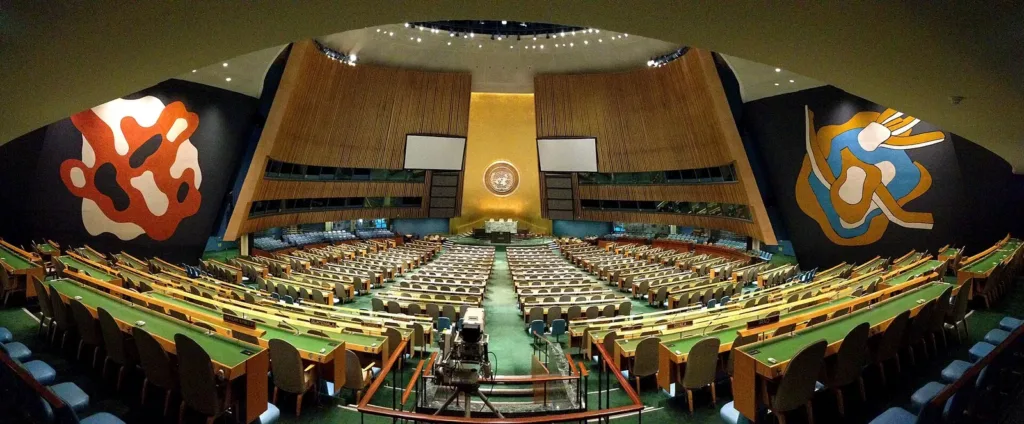
Representative image. Spiff, CC BY-SA 3.0, Wikimedia Commons

Why it matters
The vote sets out India's formal position abroad on a punishment its courts still use in the rarest of rare cases. A General Assembly resolution would not bind India, so Indian law does not change, but the statement shows how India answers UN bodies that link the death penalty to torture.
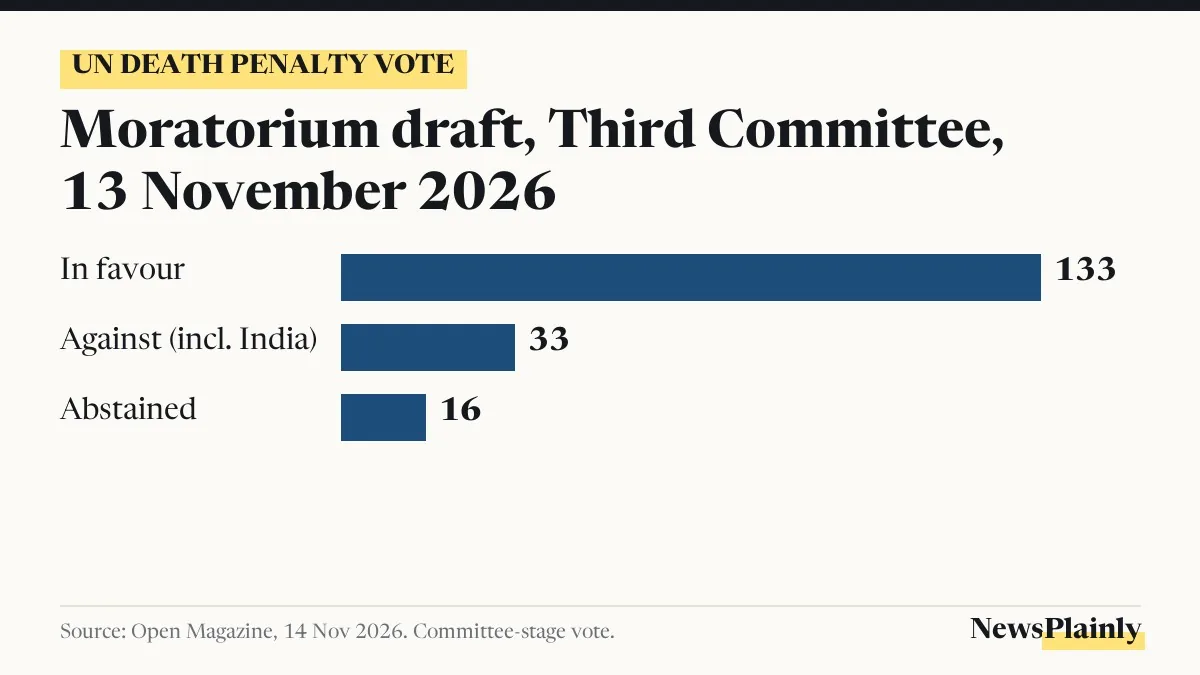
India voted against a United Nations call for a death penalty moratorium, a pause in executions, at a meeting of the General Assembly’s human rights committee in New York on 13 November 2026. The draft still passed by 133 votes to 33, with 16 abstentions, Open Magazine reported. India’s diplomat told the meeting there is no international consensus against capital punishment and that each country may set its own penalties.
At the same session, India backed a second draft that condemns unlawful killings by states, but formally distanced itself from one paragraph that, in its view, puts court-ordered executions in the same category as torture. The statements were made at the 43rd plenary meeting of the Third Committee, the Assembly committee that handles social and human rights questions, news agency Asian News International (ANI) reported.
What India said on the death penalty moratorium
A moratorium, in this case, is a pause: the draft (numbered A/C.3/81/L.43) asks countries to stop carrying out executions as a step towards ending capital punishment. Mexico introduced it, according to Open Magazine. India voted no.
Bhavika Mangalanandan, a first secretary at India’s Permanent Mission to the UN, explained the stand. “There is no international consensus against capital punishment, and article six of the ICCPR permits its use with restrictions,” she said, according to ANI. The ICCPR is the International Covenant on Civil and Political Rights, a 1966 UN treaty India has ratified.
She described the Indian system in some detail. The death sentence is a statutory punishment used only in the “rarest of rare” cases, she said, and every such sentence must be confirmed by a higher court, with the presumption of innocence and mitigation heard along the way.
The no vote is not new. ANI’s report says India took the same position on the death penalty moratorium in 2016, 2018 and 2024, when the draft last came up.
Why India objected to paragraph 6 of the second draft
The second draft (A/C.3/81/L.37) is about extrajudicial, summary or arbitrary executions: killings carried out outside any lawful court process. India supported it. “Extrajudicial, summary or arbitrary executions are unlawful and a clear violation of human rights,” Mangalanandan said, according to ANI.
The dispute was over operational paragraph 6. It refers to a report that the UN’s Special Rapporteur on such executions presented to the Human Rights Council at its 62nd session, and asks states to take its recommendations into account. Open Magazine names the rapporteur as Morris Tidball-Binz and says his report argues that the suffering a death sentence causes, including the wait for execution, amounts to torture or ill-treatment.
India rejected that link. A sentence passed after “rigorous and due legal process” cannot be called “state-inflicted death”, Mangalanandan said, calling it “a travesty” to describe it that way. She also called it “disingenuous and mischievous” to discuss capital punishment under a resolution on unlawful killings. India then disassociated itself from paragraph 6, which means it supported the text but recorded that it does not accept that one part.
How the 2026 vote compares with 2024
Open Magazine gives the figures for both votes. In 2024 the full General Assembly adopted the moratorium text by 130 votes to 32, with 22 abstentions; China, Pakistan, Singapore and the United States voted against, along with India. This year the United States again opposed the draft at the committee stage.
| Vote | In favour | Against | Abstained |
|---|---|---|---|
| 2024, full General Assembly | 130 | 32 | 22 |
| 13 Nov 2026, Third Committee | 133 | 33 | 16 |
| Change (NewsPlainly’s calculation) | +3 | +1 | minus 6 |
On those figures, 182 countries took part in this year’s committee vote, against 184 in the 2024 plenary vote. Most of the movement came from abstentions, six fewer than in 2024. The number voting no rose by one.
One more change came before the UN death penalty vote. The committee accepted an amendment moved by Singapore that reaffirms the right of countries to set their own penalties in line with international law, Open Magazine reported. That is close to the argument India made in its statement.
What happens next to the UN draft
The UN death penalty vote in committee is not the last step. The draft now goes to the full General Assembly, where a vote is expected in December, according to Open Magazine. Even if it is adopted there, a General Assembly resolution of this kind is a recommendation and does not bind any country.
So nothing changes in Indian law because of the vote, and capital punishment stays on the books. Courts in India can still award the death sentence for offences where the law allows it, under the same “rarest of rare” test the diplomat described. Readers who want the background on how UN bodies have handled India’s positions before can see our report on India’s reply in the Pannun lawsuit, or follow more India news.
The full ANI account of the statement is in Hindustan Times’ report, and Open Magazine’s explainer gives the vote counts.
Frequently asked questions
Did India vote against the UN death penalty moratorium?
Yes. India voted against draft A/C.3/81/L.43 at the General Assembly's Third Committee on 13 November 2026. The draft passed 133 to 33 with 16 abstentions, Open Magazine reported.
Does the UN vote change the death penalty in India?
No. A General Assembly resolution of this kind is a recommendation. Indian courts can still award the death sentence where the law allows it.
Which other countries voted against?
Open Magazine reported that the United States also opposed the 2026 draft. In 2024, China, Pakistan, Singapore and the US voted against along with India.