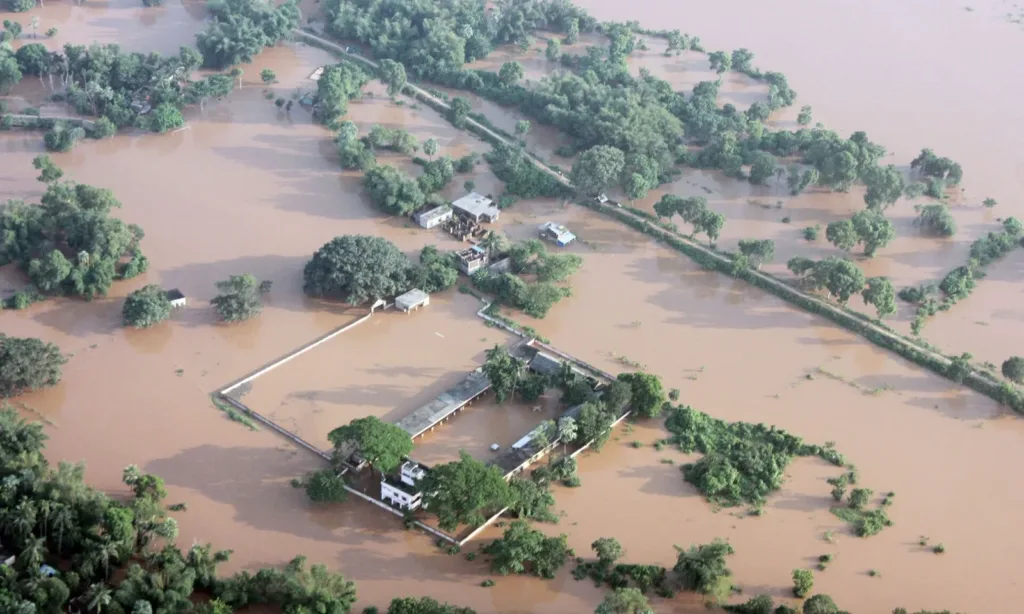
File photo: flooded villages in Balasore, Odisha, October 2013, not Ganjam. Photo: Ministry of Defence, GODL-India, Wikimedia Commons, edited by NewsPlainly.

Why it matters
Tens of thousands of people in south Odisha are cut off or in relief camps after rain far heavier than officials planned for, with roads, bridges and embankments damaged. Schools are shut and food is reaching some villages only by air. The damage count will shape how much central help Odisha receives after the 2 November assessment.
Four Navy and Coast Guard helicopters began dropping food packets over flooded villages in Odisha’s Ganjam district on 30 October 2026, as the Ganjam floods left thousands of people cut off for more than a day after heavy rain from Cyclone Arnab. Disaster Management Minister Suresh Pujari said about 50,000 people in the district had been severely affected, the Press Trust of India (PTI) news agency reported.
The rain fell two days after the cyclone crossed the Andhra Pradesh coast near Narsapur on 28 October. Odisha had expected the worst of it in Malkangiri, in the state’s southwest. Instead, Chief Minister Mohan Charan Majhi said, the heaviest rain came down on Ganjam and neighbouring Gajapati, and nobody had expected that much water there.
How bad the Ganjam floods are
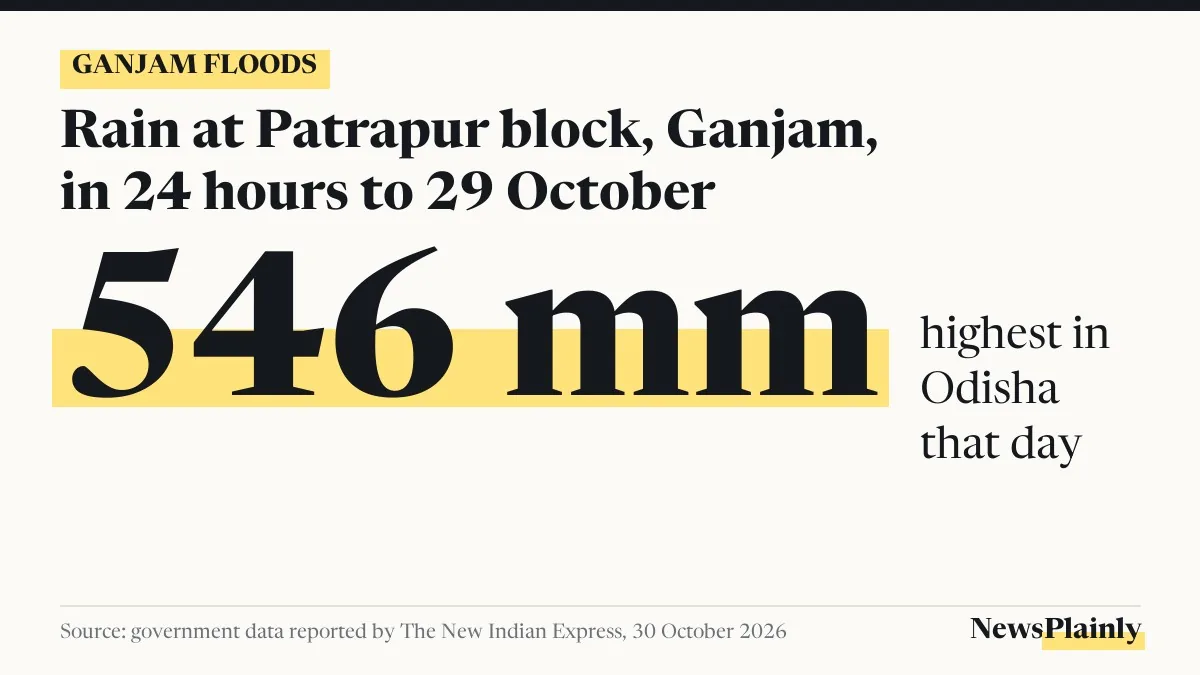
Patrapur block in Ganjam recorded 546 mm of rain in the 24 hours to Thursday, 29 October, The New Indian Express reported from government data, the highest in the state. G Udayagiri in Kandhamal district came next with 462.4 mm. Chief Secretary Anu Garg said the rain that fell on Ganjam in one day was more than the area normally gets in a whole year, according to PTI.
The Rushikulya river, the main river of Ganjam, overflowed. PTI reported floodwater inside Sorada, Aska, Bhanjanagar and Purushottampur, and said Dasamaili village in Dharakote block was under nearly 10 feet of water. An official told the agency a 30-foot breach had opened in the river embankment near Achhuli and a bridge near Patashala had been washed away. The New Indian Express separately reported an embankment breach near Goba.
Roads linking Aska, Berhampur and Sorada were cut, and about five feet of water was running over the Tankachhai to Hinjilicut road, according to PTI.
How many people the Odisha flood has hit
Official counts of people hit by the Ganjam floods have grown as teams reach more villages, and they come from different moments, so they do not match exactly.
- The New Indian Express reported on the morning of 30 October that about 42,500 people in Ganjam were affected, across 208 gram panchayats in 22 blocks and 56 wards in 18 urban local bodies, with 22 villages marooned.
- On Friday, Mr Pujari put it at around 50,000 people severely affected in Ganjam. He said more than 23,000 were in relief camps and that the number still marooned was much higher, PTI reported.
- Government data cited by The New Indian Express showed 299 villages hit in 22 blocks of Ganjam and 711 villages in seven blocks of Gajapati. That is 1,010 villages across the two districts, by NewsPlainly’s count.
- More than 59,000 people had been moved to safety across Odisha in the 72 hours to Thursday, the same newspaper reported.
Mr Pujari said the government had received no report of anyone killed so far. Ganjam is the worst hit, he said, with damage in Gajapati and Kandhamal too.
River levels against the danger mark
The New Indian Express reported these readings on Thursday. The difference column is NewsPlainly’s calculation from those figures.
| River | Gauge | Level | Danger mark | Above danger |
|---|---|---|---|---|
| Rushikulya | Purushottampur, Ganjam | 19 m | 17 m | 2 m |
| Vamsadhara | Kashinagar, Gajapati (7 am) | 55.58 m | 54.60 m | 0.98 m |
Downstream on the Vamsadhara, all 22 gates of the Gotta barrage in Andhra had been opened to let the floodwater through, the paper said. In Gajapati, the Mahendratanaya river also entered villages in Gosani and Rayagada blocks.
Odisha flood relief: airdrops, boats and ₹20 crore
Special Relief Commissioner Rajesh P. Patil said the four helicopters were dropping food at 21 marked locations, where staff on the ground would hand it out, PTI reported. The flights covered parts of Hinjilicut, Purushottampur, Seragada, Dharakote, Aska, Belaguntha, Bhanjanagar and Chikiti. Mr Pujari said the packets carried up to 4,500 kg of grain, while rescue teams were taking cooked food by boat to other stranded families.
The state asked the Indian Coast Guard on 29 October to lift people out and drop food where boats could not reach, because the current was too strong for rescue teams, the Chief Secretary said. A Coast Guard helicopter flew six stranded people out of Dharakote that day, The New Indian Express reported. Boats had found it easier to move on Friday, Mr Pujari said.
Of the 313 rescue teams working across Odisha, more than 100 are in Ganjam and Gajapati, according to the minister. In Ganjam alone, The New Indian Express counted 52 Odisha Disaster Rapid Action Force (ODRAF) teams, five National Disaster Response Force (NDRF) teams, 45 fire service teams, plus 16 government and 25 private boats. Forty more NDRF and ODRAF personnel were being sent in with cooked food, PTI reported.
The Special Relief Commissioner’s office also said an extra ₹20 crore had been released to Ganjam for relief and rescue work, Pragativadi reported. Mr Majhi and Mr Pujari left on Friday afternoon to see the two districts from the air. Union Home Minister Amit Shah said on X that he had spoken to the Chief Ministers of Odisha, Andhra Pradesh, Chhattisgarh and Puducherry and that central teams would assess the damage, The New Indian Express reported.

What happens next after Cyclone Arnab
Schools, colleges and anganwadi centres in Ganjam and Gajapati are closed until 31 October, the district administrations said, according to The New Indian Express. A central team is due in Odisha on 2 November to assess the flood damage, Mr Pujari said.
The Ganjam floods figures above are those officials gave on 29 and 30 October. They may change as water recedes and teams reach villages that are still cut off. NewsPlainly covered the cyclone’s landfall in our earlier report on Cyclone Arnab.
Key dates
- 28 October: Cyclone Arnab crosses the Andhra Pradesh coast near Narsapur.
- 29 October: Patrapur records 546 mm in 24 hours; the Rushikulya and Vamsadhara run above their danger marks; Odisha asks the Coast Guard for help.
- 30 October: Food airdrops begin at 21 points in Ganjam; ₹20 crore released; the Chief Minister surveys the area from the air.
- 31 October: Schools in Ganjam and Gajapati stay shut.
- 2 November: Central team due to assess damage.
Frequently asked questions
How much rain fell in Ganjam?
Patrapur block recorded 546 mm in the 24 hours to 29 October 2026, The New Indian Express reported. The Chief Secretary said Ganjam's one-day rain was more than its annual average.
How many people are affected by the Ganjam floods?
Minister Suresh Pujari said on 30 October that about 50,000 people were severely affected and more than 23,000 were in relief camps, PTI reported.
Are schools closed in Ganjam?
Yes. Schools, colleges and anganwadi centres in Ganjam and Gajapati are closed until 31 October, The New Indian Express reported.