Illustration by NewsPlainly. Jio is worth about 7% more than Airtel on the stock market (30 October close), while Airtel's revenue is 45% higher (Airtel April to June, Jio July to September 2026). The bars are decorative, not a chart of the figures.
Why it matters
Market value shows what investors will pay for a company's future, not how much it sells or earns today. Jio's lead over Airtel rests on expectations about growth and pricing rather than on a larger business, and the two companies' latest quarters cover different months. Airtel's results on 5 November will allow the first like-for-like comparison.
In the Jio vs Airtel comparison, the stock market now puts Jio ahead. At the close on Friday, 30 October 2026, Jio Platforms was worth about ₹13.18 lakh crore, roughly ₹86,000 crore more than Bharti Airtel, NewsPlainly’s calculation shows. Yet Airtel’s latest reported quarter brought in 45% more revenue than Jio’s, and the two companies’ quarterly profits are within 5% of each other.
Jio, the telecom and digital arm of Reliance Industries, listed on 28 October. Reliance’s results release two days later described it as India’s second most valuable company, behind only Reliance itself. That puts it ahead of Airtel. But being worth more is not the same as being bigger.
How the Jio market cap moved ahead of the Airtel market cap
Market capitalisation, or market cap, is the share price multiplied by the number of shares. Jio’s abridged prospectus puts its equity capital before the IPO at ₹89,390 million in ₹10 shares, which is 893.90 crore shares. The IPO added 27 crore new shares, according to Reliance’s release, taking the total to 920.90 crore. At Friday’s closing price of ₹1,431.30 on the National Stock Exchange (NSE), the Jio market cap comes to ₹13,18,089 crore.
Airtel’s quarterly investor report lists 624.1 crore shares outstanding on 30 June 2026, including about 10 lakh partly paid shares that Airtel itself values at the full price. At its 30 October close of ₹1,973.70, the Airtel market cap works out to ₹12,31,786 crore. The gap is ₹86,302 crore, with Jio about 7% ahead. Airtel’s share count may have changed slightly since June; closing a ₹86,302 crore gap at that price would take about 44 crore more Airtel shares.
The Jio market cap lead has widened since the debut. At the listing price of ₹1,358, INDmoney calculated Jio’s value at ₹12,51,982 crore against Airtel’s ₹12,18,675 crore, a gap of about 2.7%. The Press Trust of India (PTI) also reported on listing day that Jio had become the second most valuable Indian company in early trade. Our earlier report covered the 21% jump on Jio’s debut.
Jio vs Airtel side by side: which is the bigger business?
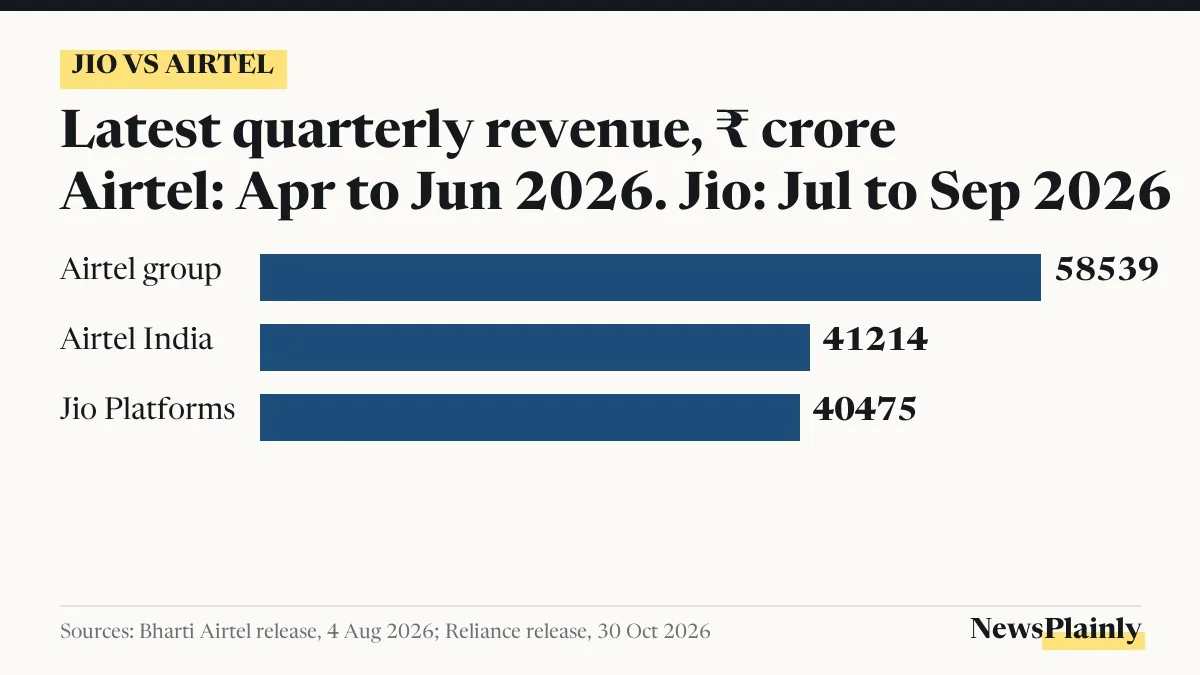
A fair comparison needs the same quarter for both companies, and that is not yet possible. Airtel has not reported July to September 2026: its board meets on 5 November to approve those results. The table therefore sets Jio’s July to September quarter, from the Reliance release of 30 October, against Airtel’s April to June quarter, from Airtel’s release of 4 August and its investor report. EBITDA (earnings before interest, tax, depreciation and amortisation) measures operating profit, and ARPU (average revenue per user) is what a typical customer pays in a month.
| Measure | Jio Platforms (Jul to Sep 2026) | Airtel group (Apr to Jun 2026) | Airtel India only (Apr to Jun 2026) |
|---|---|---|---|
| Revenue from operations | ₹40,475 cr | ₹58,539 cr | ₹41,214 cr |
| EBITDA (margin) | ₹21,879 cr (54.1%) | ₹33,599 cr (57.4%) | ₹24,781 cr (60.1%) |
| Net profit | ₹8,387 cr | ₹8,057 cr before one-off items (₹8,167 cr after) | ₹6,872 cr before one-off items (₹7,262 cr after) |
| Monthly ARPU | ₹218.8 (all customers) | Not given as one figure | ₹264 (mobile) |
| Customers | 542.4 million | 680.9 million in 15 countries | 491.9 million, of which 376.5 million mobile |
| Net debt | ₹8,822 cr on 30 Sep, before IPO money (as reported) | ₹81,852 cr excluding leases; ₹1,57,240 cr including them | ₹69,315 cr excluding leases |
| Market value, 30 Oct close | ₹13,18,089 cr | ₹12,31,786 cr | Not listed separately |
So which is bigger in the Jio vs Airtel match-up? It depends on what you count.
Revenue: Airtel is clearly bigger as a group, at ₹58,539 crore against Jio’s ₹40,475 crore. Much of the difference is Africa, where Airtel had 189 million customers and grew revenue 21.1% in constant currency. Its India business alone, at ₹41,214 crore, is only about 2% larger than Jio, and that India figure also includes the tower business of Indus Towers.
Profit: Jio’s ₹8,387 crore is about 4% more than Airtel’s ₹8,057 crore before one-off items. Airtel runs at higher margins, though: 57.4% for the group and 60.1% in India, against Jio’s 54.1%.
Customers and pricing: Jio has more customers in India, 542.4 million against Airtel India’s 491.9 million. Airtel gets more from each mobile user, ₹264 a month against Jio’s ₹218.8. The two companies count customers and ARPU differently, so treat those rows as close, not exact, comparisons.
What investors are paying for each rupee of profit
Dividing market value by yearly profit gives a figure like the price to earnings (P/E) ratio. Here, NewsPlainly multiplied each company’s latest quarterly profit by four as a rough yearly figure. The Jio market cap of ₹13,18,089 crore divided by ₹33,548 crore gives about 39. The Airtel market cap of ₹12,31,786 crore divided by ₹32,228 crore gives about 38 (37.7 using its profit after one-off items).
On profit, then, the market is paying almost the same multiple in the Jio vs Airtel comparison. The difference shows up on revenue. Jio’s market value is about 8.1 times its annualised revenue; Airtel’s is about 5.3 times. In plain terms, investors are paying more for each rupee of sales at Jio than at Airtel. This is arithmetic on mismatched quarters, not a valuation or a recommendation.

Why the Jio market cap is higher, according to analysts and reports
INDmoney’s comparison on listing day said the market appeared to be pricing in Jio’s growth potential more than its current numbers, and noted that Jio carries less debt. Before trading began on 28 October, Business Upturn reported that Nomura started coverage with a Buy rating and a ₹1,340 target, arguing that the listing makes Jio the price setter whose tariff increases rivals can follow. Motilal Oswal started at Buy with a ₹1,350 target, modelling profit growth of about 20% a year over the three financial years to March 2029. The stock closed on 30 October above both targets.
BusinessToday reported that Geojit, Religare Broking and Canara Bank Securities pointed to higher ARPU, broadband growth, AI and enterprise services as longer-term drivers. Reliance’s own analyst presentation says several ways of earning more per customer will drive “sustainable high-teen growth” for Jio, which is the company’s expectation, not a result.
Debt is the other big difference between Jio and Airtel. BusinessToday reported Jio’s net debt at ₹8,822 crore on 30 September, down about 79% from a year earlier and before the IPO money arrived; Reliance’s presentation gives the matching ratio of 0.10 times yearly EBITDA. Airtel’s ratio was 1.17 times on 30 June. The definitions differ: Jio’s prospectus counts borrowings minus cash, while Airtel’s figure includes lease liabilities. INDmoney also noted that Jio had about ₹1.04 lakh crore of deferred spectrum payments on 30 June.
Two limits apply to any Jio vs Airtel ranking. Market cap is what investors are willing to pay for a company’s shares, not a measure of its sales or profit, and it moves every trading day. And Reliance still owns about two-thirds of Jio, PTI reported; the 27 crore shares sold in the IPO are about 2.9% of the total.
What to watch next in the Jio vs Airtel race
Airtel’s board meets on 5 November to approve its July to September results, and its earnings webinar is set for 6 November. That will allow the first same-quarter comparison with Jio’s Q2 results, which showed profit up 13.7% to ₹8,387 crore. Jio’s 30 September debt figures came before the IPO money, BusinessToday reported; Reliance’s release says ₹27,500 crore of it has since been used to prepay foreign loans of Reliance Jio Infocomm, Jio’s main telecom subsidiary.
Frequently asked questions
Is Jio bigger than Airtel?
By market value, yes: at the 30 October close Jio was worth about ₹13.18 lakh crore and Airtel about ₹12.32 lakh crore. By revenue, Airtel's group is bigger (₹58,539 crore in April to June against Jio's ₹40,475 crore in July to September), though Airtel's India business alone is about Jio's size.
What is the Jio Platforms market cap?
About ₹13,18,089 crore at the 30 October closing price of ₹1,431.30 on the NSE, using 920.90 crore shares (893.90 crore before the IPO plus 27 crore new shares).
When will Airtel announce its Q2 FY27 results?
Airtel's board meets on 5 November 2026 to approve results for July to September, and its earnings webinar is on 6 November.
Does Airtel earn more per customer than Jio?
Yes. Airtel's India mobile ARPU was ₹264 a month in April to June 2026; Jio's ARPU was ₹218.8 in July to September. The two companies calculate ARPU differently.