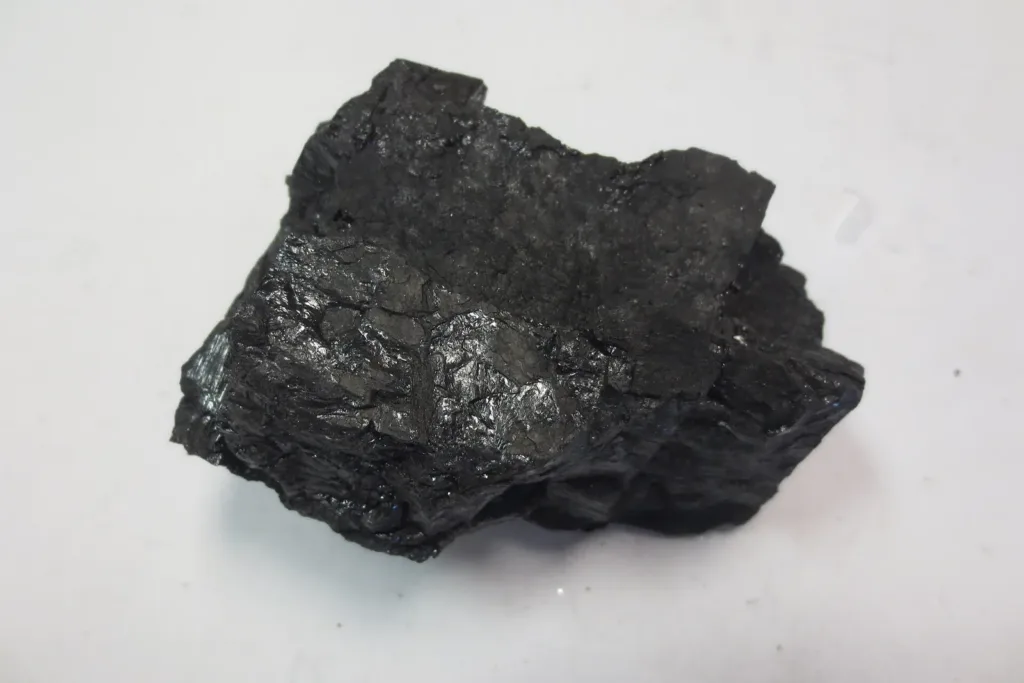
File photo, 7 January 2015: a bituminous coal sample, not a Round 3 project. Representative image. Amcyrus2012, CC BY 4.0, Wikimedia Commons

Why it matters
Industrial applicants must plan around both the early clarification window and the later submission deadline. Confusing total project cost with eligible machinery cost would overstate the possible incentive.
Coal gasification round 3 opened on 10 November 2026, with the Ministry of Coal listing 11 January 2027 as the application deadline for industrial projects under its ₹37,500 crore scheme. A separate official notice gives the round’s calendar, while the request for proposal sets eligibility, funding limits and submission requirements.
The calendar is tentative and subject to change. It lists a pre-application conference on 20 November, followed by a 25 November deadline for queries. Applicants therefore have an earlier opportunity to seek clarification before preparing their final submissions.
The fresh development is this application round. The scheme’s ₹37,500 crore outlay is the overall programme figure in the proposal, rather than a statement that the entire amount has been newly awarded or paid to projects today.
Coal gasification round 3: the official calendar
The ministry’s 10 November schedule separates applications from selection, the award letter and the project agreement. Its dates run into May 2027; an application deadline is not the date when a plant must start operating.
| Round 3 stage | Tentative date |
|---|---|
| Request for proposal issued | 10 November 2026 |
| Pre-application conference | 20 November 2026 |
| Queries due | 25 November 2026 |
| Ministry responses to queries | 4 December 2026 |
| Applications due | 11 January 2027 |
| Applications opened | 12 January 2027 |
| Selected applicants declared | 23 February 2027 |
| Letters of award issued | 9 March 2027 |
| Project agreements signed | 7 May 2027 |
The notice says changes will be communicated through the ministry website or the MSTC electronic application portal. It does not state a closing hour alongside the 11 January date.
The 20% ceiling uses machinery cost
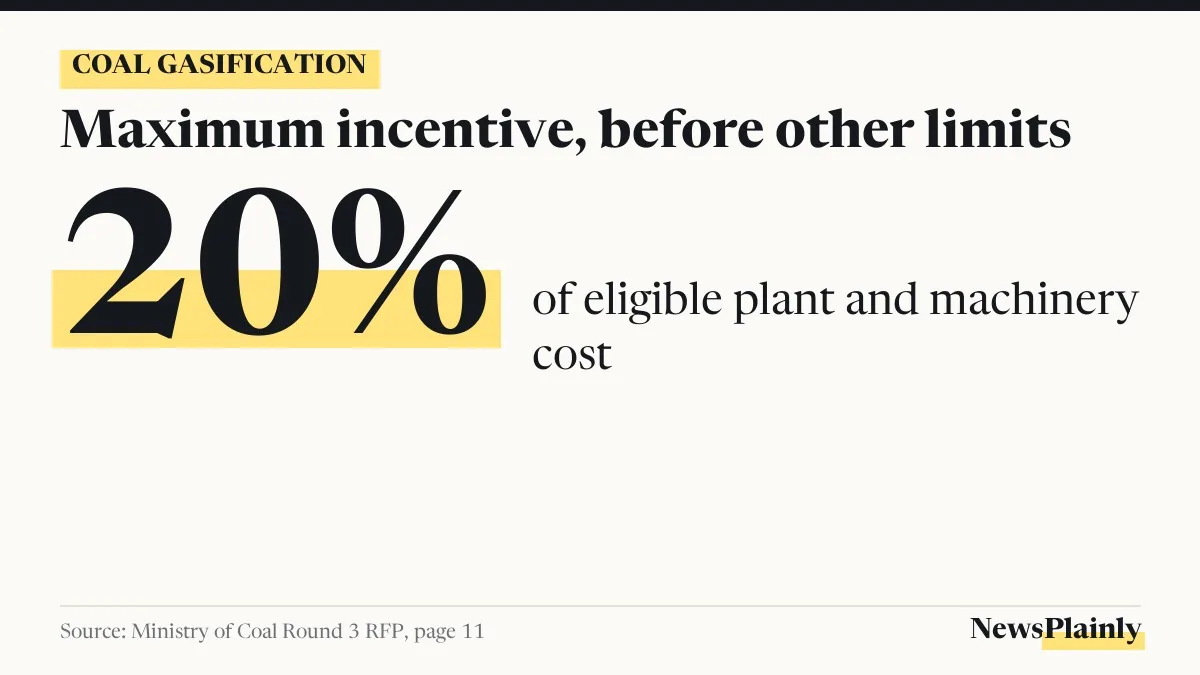
The 73-page proposal sets a maximum financial incentive of 20% of eligible plant and machinery cost. That denominator matters: it is not a promise to reimburse one-fifth of every rupee spent on the whole project.
For a hypothetical project with ₹1,000 crore of eligible plant and machinery cost, NewsPlainly’s calculation puts the 20% ceiling at ₹200 crore. This is an arithmetic illustration, before other limits and assessment. It is not an award to an actual company or a guaranteed rate for every applicant.
The proposal separately caps the incentive at ₹5,000 crore for one project. An applicant and its group companies cannot collectively receive more than ₹12,000 crore across projects under the scheme. These limits sit alongside the cost-based ceiling, rather than replacing it.
The eligible-cost definition excludes items including land, site development, financing charges and used machinery. Applicants need to use that definition when identifying the machinery-cost base. A headline project-cost estimate cannot simply be multiplied by 20% to calculate an entitlement.
Who can apply, and what gasification produces
For coal gasification projects, eligible applicant types include public-sector undertakings, private companies, and joint ventures or consortia of no more than three companies. The project must be a new surface coal or lignite gasification project in India. The proposal places responsibility for arranging coal or lignite with the project developer, including through its own mines or other arrangements.
The minimum plant capacity is 0.5 million tonnes a year of clean syngas. The proposal calculates that using 330 days of annual availability and an average clean-syngas density of 1.1 kilograms per normal cubic metre. Applicant net worth must be more than 20% of project cost, a separate test from the incentive’s machinery-cost ceiling.
Gasification converts coal or lignite into synthesis gas through partial oxidation at high temperature and pressure. The proposal lists possible downstream products including synthetic natural gas, urea, methanol and dimethyl ether. These explain the industrial purpose of the application process; the round is not a direct cash application for households or farmers.
Submission involves originals as well as the portal
The proposal requires an application on the electronic portal and specified documents in physical original form. The records must agree. Its document list includes authorisations, a board-approved pre-feasibility or detailed project report, and the prescribed declarations and financial material.
It also requires ₹50 lakh in application security through a bank guarantee from a scheduled commercial bank. This is security under the proposal, rather than an application fee. The prescribed format and validity conditions form part of the submission rules.
Selection and payment are separate. The incentive is released in four equal instalments tied to verified milestones. These include preparatory requirements, expenditure, commissioning and, for the last instalment, achieving at least 50% of peak annual production capacity during the preceding 365 days.
For prospective industrial applicants, the next step is checking the full proposal and any subsequent clarifications before the conference and query deadlines. NewsPlainly’s business coverage follows confirmed policy and company developments. Filing in this round does not establish that a project has been selected, financed or commissioned.
Frequently asked questions
Is the whole ₹37,500 crore newly paid out in this round?
The proposal states the overall scheme outlay. The new development is the Round 3 application process, with selection and milestone-based payment separate.
Does the scheme pay 20% of total project cost?
The proposal sets a maximum of 20% of eligible plant and machinery cost, subject to other caps and assessment.
Is the application entirely online?
The proposal requires an electronic application and specified original documents in physical form. Applicants should use its document list and submission instructions.