Representative image. Fredericknoronha, CC BY-SA 4.0, Wikimedia Commons

Why it matters
Most secondary students already use chatbots and AI apps, often without knowing when to trust them. The module sets out, for the first time in an NCERT book, how schools are expected to teach checking AI answers, protecting personal data and spotting deepfakes, and it is built to work even in schools without computers.
The NCERT AI module for Classes 9 to 12 is out. The National Council of Educational Research and Training (NCERT), which writes the textbooks used in CBSE schools and many state boards, announced on 23 October 2026 an introductory module on computational thinking and artificial intelligence for the secondary stage. It is built for students with no prior knowledge of AI and is planned for 20 class hours.
The full module, a 108-page PDF on the NCERT website, has five units, an hour-by-hour plan for teachers and a running student portfolio in place of a written exam. NCERT says in its press release that the module keeps “human judgement, creativity, and ethical responsibility” central to learning.
What the NCERT AI module teaches in its five units
Computational thinking, the first half of the title, is not coding. The module describes it as a way of solving problems: spotting patterns, breaking a big problem into parts, picking out what matters and planning clear steps. The AI half then applies those habits to the AI tools students already use.
- Unit 1, AI is already in your life: students list the AI they meet in a day and learn to tell it apart from plain automation. FASTag toll collection is given as fixed-rule automation; Bhashini, the government’s Indian-language translation platform, and the fraud checks banks run on UPI payments are given as systems that learn from data.
- Unit 2, how machines learn from examples: students train a simple image classifier on everyday objects such as a pen or a water bottle, using Google’s free Teachable Machine tool or a paper version, and then try to make it fail.
- Unit 3, when AI gets it wrong: confident but wrong answers, deepfakes (fake videos or images made with AI), and “hallucinations”, the module’s word for invented facts.
- Unit 4, your data: consent, fairness and India’s Digital Personal Data Protection (DPDP) Act, 2023, with each student reading the privacy policy of one app they use.
- Unit 5, working with AI tools: writing and improving prompts, the instructions typed into a chatbot, and using the tool as a helper rather than a replacement for one’s own thinking.
Faculty from the Indian Institutes of Technology (IIT) in Madras and Jodhpur worked on it with NCERT, the Hindustan Times reported; the module’s credits list professors from both.
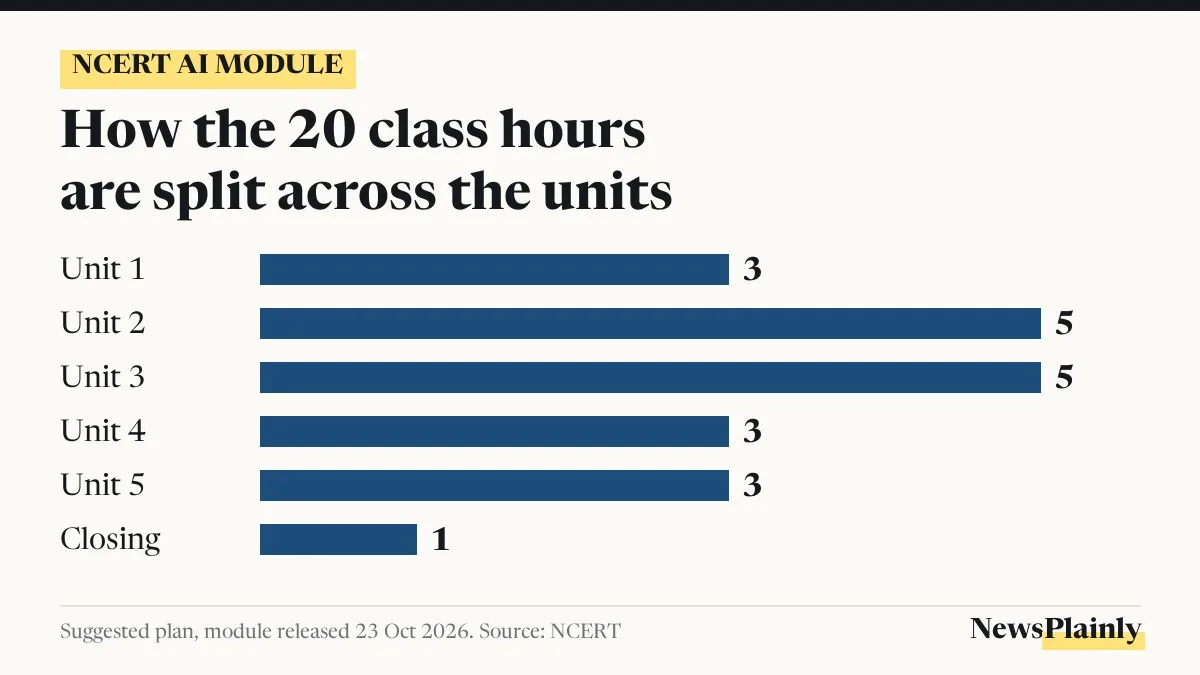
How the 20 class hours are split
The teacher’s note sets out a plan for 20 hours, with the units taught in order. NewsPlainly added up the hours given to each unit in that plan:
| Unit | Hours | Main classroom task | Goes into the Curious Notebook |
|---|---|---|---|
| 1. AI in daily life | 3 | AI scavenger hunt, “AI or not?” sorting | AI Diary |
| 2. Learning from examples | 5 | Train a classifier, then try to break it | Train-and-Break log |
| 3. When AI gets it wrong | 5 | Deepfake gallery walk, Hallucination Hunt | Verification checklist |
| 4. Your data and rights | 3 | Privacy policy dissection | Privacy Policy Dissection |
| 5. Using AI tools | 3 | Build and peer-review prompts | Prompt Library |
| Closing | 1 | Each student presents one piece of work | (review) |
Units 2 and 3 of the NCERT AI module, on how machines learn and how they go wrong, take half of the 20 hours between them. The “Curious Notebook” is a portfolio kept across all five units, and the teacher’s note says it is where assessment should happen. Teachers are told to comment on it from time to time rather than collect it for marks, and not to penalise crossed-out first guesses.
Every hands-on activity comes in three versions: one device per student or pair, a teacher demonstration on one shared screen, or an “unplugged” version with paper and discussion. NCERT says a school with no internet can still complete the core of the module, and asks teachers to change the mode rather than skip Unit 5.
The Five Checks students are taught before trusting AI
Unit 3 gives students a five-step routine to run on any AI output, from a chatbot answer to a translated sentence or a video:
- Source: which tool produced it, when, and was it edited or forwarded on the way?
- Claim type: is it a checkable fact, a harder claim, or an opinion that cannot be checked?
- Compare: open any source the AI cites, since chatbots sometimes invent references, and check important claims against two independent sources.
- Pause: re-read before forwarding or submitting it.
- Confidence: when passing it on, say how sure you are.
The module points out that the first three checks test the AI’s answer while the last two test the student’s own habits. It also tells students who come across a deepfake or harassment to report it on the National Cyber Crime Reporting Portal, cybercrime.gov.in, or the helpline 1930, both run by the Home Ministry’s Indian Cyber Crime Coordination Centre.

What the module tells students about their data
A safety page near the front asks students never to type their Aadhaar or PAN number, passwords, one-time passwords, photos of documents or other people’s details into an AI tool. The classifier exercises use objects rather than faces or ID cards for the same reason, and the module asks students to treat AI tools as helpers that can be wrong.
The data unit also carries a box most coverage left out: the timeline of the DPDP Rules, 2025, the operating rules under the 2023 data protection law. It says the rules on consent managers, registered firms that let a user give and withdraw consent across services in one place, take effect from November 2026, and that the main duties on companies, including breach reporting and most protections for children’s data, apply from May 2027. The module notes the schedule can change and tells students to check the Ministry of Electronics and Information Technology (MeitY) website.
It explains that companies will need a parent’s verifiable consent before processing a child’s personal data, that a company hit by a data breach must tell the people affected, and that a complaint goes first to the company’s grievance officer and then, if unresolved, to the Data Protection Board of India.
Who can use the NCERT AI module now
The NCERT AI module is free to read and download as a PDF from the NCERT website. NCERT describes it as an introductory module that can be taught across Classes 9 to 12 as a common foundation in computational thinking. Neither the press release nor the module says whether schools must teach it this session, how many periods a week it gets or whether it counts towards board marks; the Central Board of Secondary Education (CBSE) had not issued a circular on it in the reports reviewed.
Principals of CBSE schools welcomed the module, the Hindustan Times reported. The foreword, signed by NCERT director Dinesh Prasad Saklani, invites feedback from students, teachers and parents for later editions; this is the first edition, dated October 2026.
For a recent example of why digital trust needs checking, read our report on the eMudhra certificate keys flaw.
Frequently asked questions
Where can I download the NCERT AI module?
It is a free PDF on the NCERT website, titled An Introductory Module on Computational Thinking and Artificial Intelligence for the Secondary Stage (Grades 9 to 12).
Is the NCERT AI module compulsory?
NCERT calls it an introductory module that can be taught across Classes 9 to 12. It has not said whether it is compulsory or counts towards board marks.
Do students need a computer for the module?
No. Every activity has an unplugged version using paper and discussion, and NCERT says a class with no internet can complete the core of it.
What are the Five Checks?
Source, claim type, compare, pause and confidence: five steps students run before trusting or sharing an AI answer.