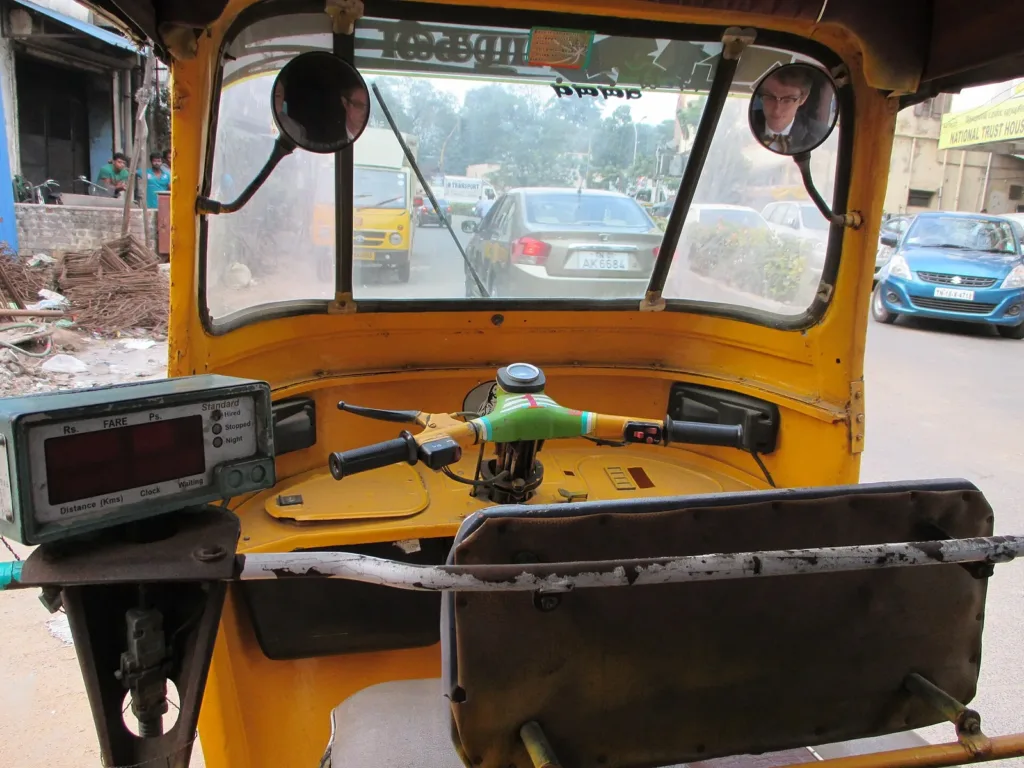
Representative image. ItsZippy, CC BY-SA 3.0, Wikimedia Commons

Why it matters
Autos are an everyday ride in Chennai and other Tamil Nadu towns, and the Chennai meter fare had been set in 2013. At the new rates a typical daytime trip costs about twice as much, and rides between 10 pm and 11 pm now fall in the night slot. Drivers get a revision their unions had sought, though at rates below what the unions asked for, according to DT Next.
A notification dated 27 October 2026 doubles the basic Tamil Nadu auto fare. It sets the minimum fare for an auto rickshaw at ₹50 for the first 1.8 km and ₹25 for every kilometre after that, according to reports by the Chennai daily DT Next and Hindustan Times. In Chennai the old rates, ₹25 and ₹12, had been set in August 2013.
Beyond the basic auto rickshaw fare, the new structure also changes three other charges: the night charge, the waiting charge and the fare on hill roads. It covers autos in the Chennai Metropolitan area and other regions of the state, Hindustan Times reported from the notification.
What the new Tamil Nadu auto fare notification says
The Home (Transport) Department published the order in an extraordinary edition of the Tamil Nadu Government Gazette, DT Next reported. It was issued under Section 67(1) of the Motor Vehicles Act, 1988, the section that lets a state government direct its transport authorities on fares. Hindustan Times, which based its report on a copy of the notification shared by the news agency ANI (Asian News International), said it was signed by A Karthik, Principal Secretary to the Government.
The order does not set the auto fare on the meter directly. It directs the State Transport Authority and the Regional Transport Authorities (the regional bodies that issue permits) to fix these fares for contract carriage autos, meaning autos hired by passengers for a trip.
According to both reports, the rates are:
- Minimum fare: ₹50 for the first 1.8 km.
- Each extra kilometre: ₹25.
- Night travel, 10 pm to 5 am: 1.5 times the regular fare.
- Waiting: ₹1 a minute.
- Ghat (hill) roads: a base fare of ₹60, which is 1.2 times the minimum fare, and ₹30 for each extra kilometre.
Hindustan Times said the notification did not give a date from which the new fares start. NewsPlainly did not see that date in either report, and could not open the 2026 gazette copy itself.
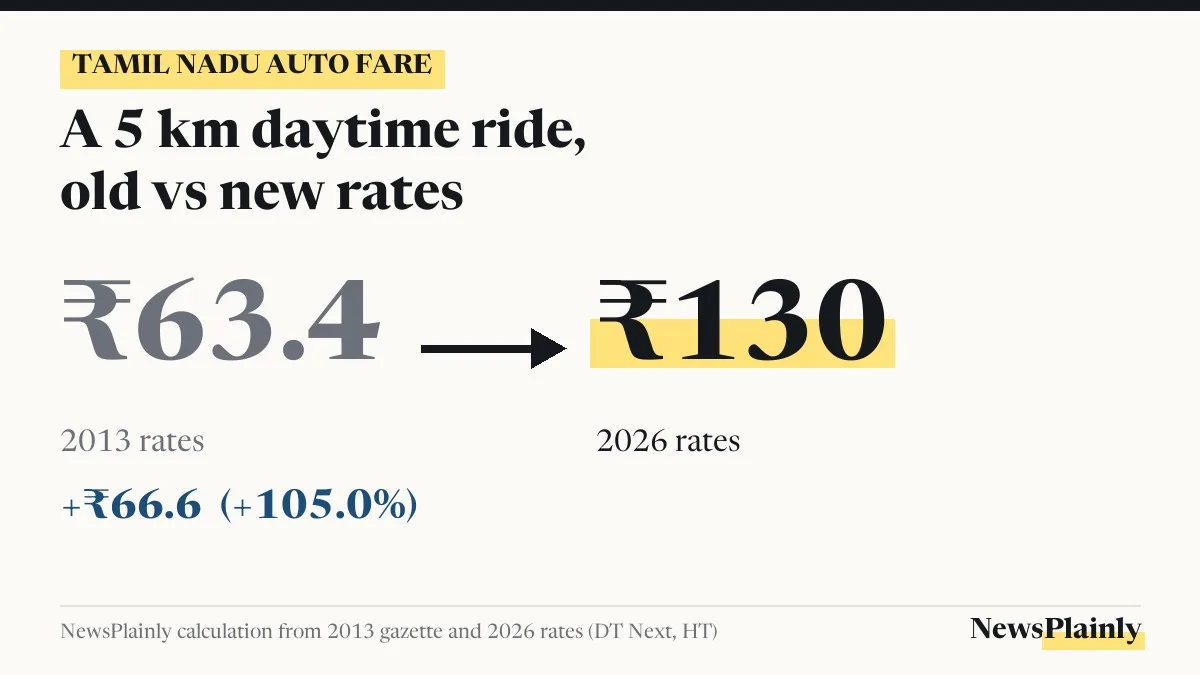
Old vs new auto fares in Tamil Nadu
The 2013 rates are on record in the Tamil Nadu Government Gazette of 25 August 2013, issued as G.O. Ms. No. 611. That order applied to autos in the Chennai Metropolitan area. Rates outside Chennai before this notification were not in the documents read, so the comparison below is for Chennai. Set side by side with the new auto fare, the change looks like this:
| Charge | 2013 order | 27 October 2026 notification |
|---|---|---|
| First 1.8 km | ₹25 | ₹50 |
| Each extra km | ₹12 | ₹25 |
| Waiting | ₹3.50 for every 5 minutes | ₹1 a minute |
| Night charge | 50% extra, 11 pm to 5 am | 1.5 times the fare, 10 pm to 5 am |
| Ghat roads | Not listed | ₹60 base, ₹30 a km |
| Area | Chennai Metropolitan area | Chennai Metropolitan area and other regions |
Two details stand out beyond the doubled minimum fare. The per-kilometre rate has more than doubled, from ₹12 to ₹25, a rise of about 108%. And the night window now opens an hour earlier, at 10 pm instead of 11 pm, so a late evening ride home now attracts the night rate. The multiplier itself is the same: 50% extra is the same as 1.5 times.
Waiting also costs a little more. The old rate of ₹3.50 for five minutes works out to 70 paise a minute; the new rate is ₹1.
The 2026 notification also replaces a second Home department order, dated 16 October 2014, Hindustan Times reported. The reports read did not say what that order covered.
How much a ride costs at the new rates
The table below is NewsPlainly’s calculation, not an official fare chart. It takes the minimum fare and adds the per-kilometre auto rickshaw fare for the distance beyond 1.8 km. It assumes part kilometres are charged in proportion; the rounding rules in the meter settings, which the transport authorities will fix, may differ slightly.
| Trip | Old fare (Chennai, 2013) | New fare | Difference |
|---|---|---|---|
| 3 km, daytime | ₹39.40 | ₹80 | ₹40.60 |
| 5 km, daytime | ₹63.40 | ₹130 | ₹66.60 |
| 10 km, daytime | ₹123.40 | ₹255 | ₹131.60 |
| 5 km, at night | ₹95.10 | ₹195 | ₹99.90 |
| 15 minutes waiting | ₹10.50 | ₹15 | ₹4.50 |
For a 5 km trip, the working is ₹50 plus ₹25 times 3.2 km, which is ₹130. Under the 2013 order the same trip was ₹25 plus ₹12 times 3.2 km, or ₹63.40. That is an increase of ₹66.60, or about 105%. At the revised Tamil Nadu auto fare, a ride of that length costs a little over twice as much on the meter.
A 5 km ride that starts at 10.30 pm shows the effect of the earlier night window. Under the 2013 order it was a day fare, ₹63.40. Under the new rates it falls in the night slot: ₹195.
Why the Tamil Nadu auto fare was revised after 13 years
DT Next reported that fares had stayed unchanged for 13 years. Drivers’ unions had pressed for a revision, pointing to fuel prices, insurance premiums, repairs and the cost of spare parts, DT Next reported. In February 2022, the Madras High Court directed the state government to revise fares in line with rising costs while balancing the interests of drivers and passengers, the paper said.
Consultations took place this year. According to DT Next, unions asked for a higher minimum fare and a higher rate per kilometre than the one notified, while consumer groups pressed for fares that people could still afford. The government weighed the two sets of demands before issuing the notification.
The reports read did not include reactions from unions or consumer groups to the final figures.
For other price changes hitting household budgets in the state this week, see our report on the Aavin price hike for ghee and other dairy products.
When the new fares apply
The notification directs the State Transport Authority and the Regional Transport Authorities to fix the revised auto fare in their areas. Hindustan Times said the notification did not specify when they take effect, so the start date in each district depends on those authorities. Meters will need to be set to the new rates; neither report said how long that will take.
Frequently asked questions
What is the new minimum auto fare in Tamil Nadu?
₹50 for the first 1.8 km, under a notification dated 27 October 2026, as reported by DT Next and Hindustan Times. It was ₹25 in Chennai under the 2013 order.
How much is the auto fare per km in Chennai now?
₹25 for each kilometre after the first 1.8 km, up from ₹12. On ghat roads it is ₹30 a km after a ₹60 base fare.
What are the night and waiting charges?
Between 10 pm and 5 am the fare is 1.5 times the regular fare. Waiting costs ₹1 a minute, against ₹3.50 for every five minutes under the 2013 Chennai order.
From when do the new auto fares apply?
Hindustan Times said the notification did not specify a start date. It directs the State Transport Authority and Regional Transport Authorities to fix the fares.