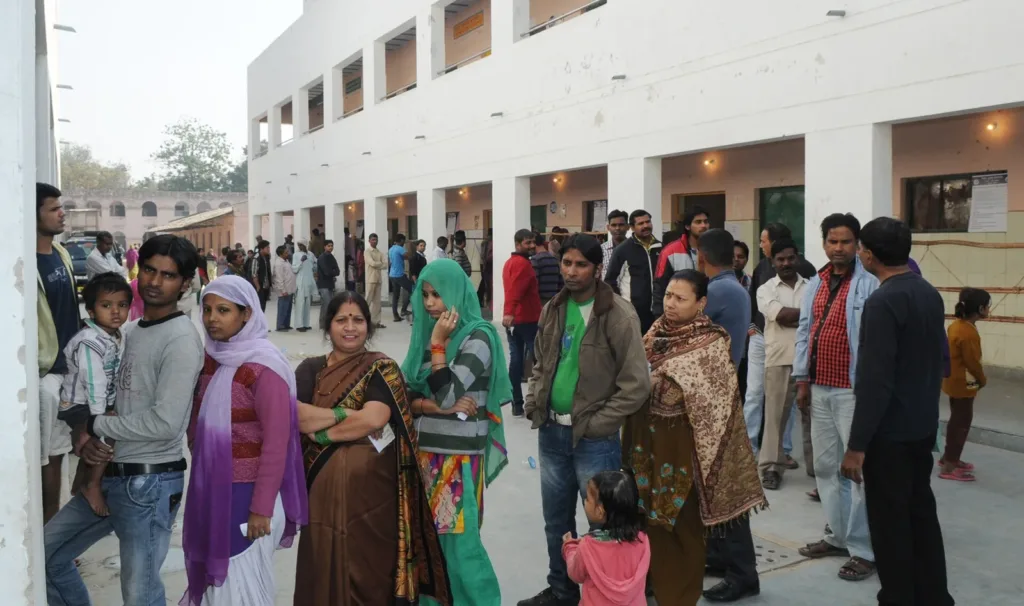
Representative image. Election Commission of India, GODL-India, Wikimedia Commons

Why it matters
Many long-time voters dropped from the draft rolls had hesitated to use Form 6 because its declaration could expose them to a criminal case. The affidavit puts the commission's assurance on record before the Supreme Court, which matters for anyone still trying to get back on the roll before the final lists close.
Voters who were on the rolls before the Special Intensive Revision (SIR) but are missing from the draft roll will not be prosecuted for using SIR Form 6 to apply again, the Election Commission has told the Supreme Court. The condition: they must not already be enrolled in any other constituency, and the rest of their declaration must be lawful, according to the affidavit as reported by the Press Trust of India (PTI).
The commission filed the supplementary affidavit on Saturday, 14 November 2026, The Hindu reported. It also told the court it has asked chief electoral officers to publicise the clarification widely, including in local languages.
Why reapplying looked risky
Form 6 is the application meant for people registering as voters for the first time. During the SIR, people who had voted for years were marked “absent, shifted, dead or duplicate” (ASDD) on the draft roll, and the petitioners in the Supreme Court said such voters were being made to use Form 6 to get back in. That is how SIR Form 6 became a legal worry.
The petitioners in the Supreme Court, activist Anjali Bhardwaj, represented by advocates Prashant Bhushan and Neha Rathi, and Shailendra Mani Tripathi, represented by advocate Chand Qureshi, argued that this pushed old voters into signing a false declaration. Such declarations, they said, could be prosecuted under Section 31 of the Representation of the People Act, 1950, The Hindu reported.
The worry was not only theoretical. On 5 November the Bombay High Court at Goa held that a family who had only moved house should not be made to file Form 6, because it would mean a false declaration; it ordered them restored, as NewsPlainly reported.
What the affidavit says on Form 6 prosecution
The affidavit says the commission had heard of “apprehensions” that previously enrolled voters filing Form 6 could face action under Section 31. To settle that, it states that no prosecution will be launched against anyone for filing Form 6 merely because they were on the rolls before the SIR and did not appear in the draft roll, PTI reported.
Two conditions stay on the Form 6 prosecution assurance. The applicant must not already be registered in another parliamentary or assembly constituency, and the declaration must otherwise be in line with the law. A person enrolled in two places is not covered.
The Hindu reported that voters who had already filed Form 6 do not need to submit anything else. Their applications will be processed under the commission’s 3 November clarification, without fear of prosecution.
The other routes back onto the roll
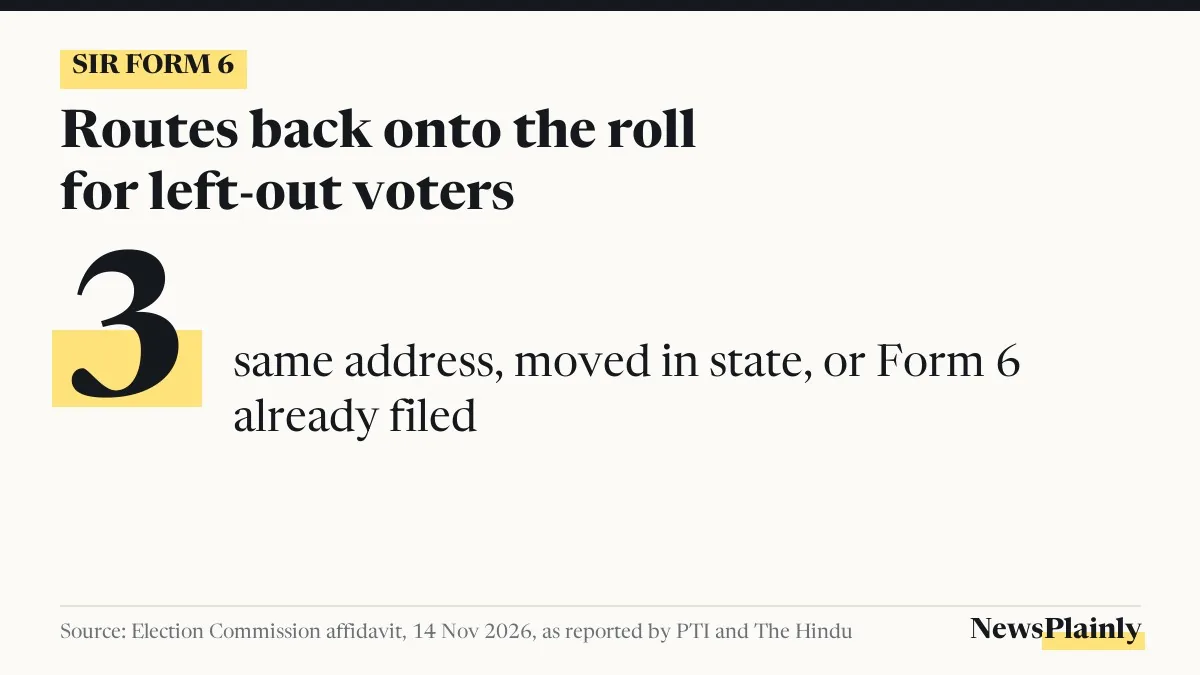
Form 6 is no longer the only way back for left-out voters. By a communication dated 6 November, the commission told chief electoral officers in states and Union territories where the SIR is running to accept the enumeration form (Annexure A) from left-out voters instead, both reports said. It goes to the electoral registration officer (ERO), the assistant ERO (AERO) or the booth level officer (BLO), or online through the commission’s ECINET platform. The route depends on the voter’s situation.
| Your situation | What to submit | Where |
|---|---|---|
| Left out, but still at the same address | Signed enumeration form (Annexure A) with Annexure B, giving the reason it was not submitted earlier | ERO, AERO or BLO, in person or through family; online with e-sign on ECINET |
| Left out after moving within the same state | Annexure A with Annexure C (new address and assembly constituency) and address proof; Form 8 not needed | ERO or AERO of the new constituency; “Book a call with BLO” also available |
| Already applied on Form 6 | Nothing more | Application processed as filed, with no prosecution for the earlier enrolment |
Enumeration forms from left-out voters will be processed under Rule 21(1) of the Registration of Electors Rules, 1960, which covers names left out by mistake, and the voter will get back the same EPIC (voter ID) number, The Hindu reported.
Booth-wise lists of left-out voters are also to be put up again, this time with the “probable reasons” each name was left out, so people can check whether they are on them.
What the Election Commission said about the SIR
The commission told the court that a mechanism has been ordered so that no eligible elector loses the chance to be in the final roll, while avoiding duplicate entries. “The Commission remains alive to the need to ensure that those who are eligible to vote find their names in the voters’ lists,” the affidavit said, according to PTI, adding that inconsistencies in the lists must also be fixed.
It said the large numbers involved and fully digitised data create challenges. In earlier filings, the commission defended the SIR as authorised by law and said no changes had been made to the statutory Form 6, PTI reported.
Deadlines still running for SIR Form 6 applicants
The 6 November direction applied in Delhi, Maharashtra, Haryana, Andhra Pradesh, Jharkhand, Telangana and Nagaland, with final rolls due on 30 November in six of those states and on 22 December in Delhi, according to earlier reports that NewsPlainly covered. The reports on the affidavit did not say whether those dates will change, and did not give the date of the next Supreme Court hearing.
Frequently asked questions
Will I be prosecuted for filing Form 6 after being left out of the SIR draft roll?
No, the Election Commission told the Supreme Court, provided you are not enrolled in another constituency and your declaration is otherwise lawful.
Do I keep my old voter ID number?
If you use the enumeration form route, the same EPIC number is reassigned, The Hindu reported. Form 6 is the form meant for new voters.
I have already filed Form 6. Do I need to do anything else?
No. The affidavit says such applications will be processed under the commission's 3 November clarification, without prosecution.