Representative image. This photograph is created by Sbb1413. All photographs created by him are released under the {{CC-BY 4.0}} license unless otherwise noted. Derived works are released under the same license as original., CC BY 4.0, Wikimedia Commons

हिन्दी में सारांश Summary in Hindi
- पश्चिम बंगाल में ग्राम पंचायत संपत्ति कर संग्रह 168 प्रतिशत बढ़कर 118 करोड़ रुपये तक पहुंच गया है।
- ऑनलाइन टैक्स पोर्टल शुरू होने से करदाताओं की संख्या 11.69 लाख से बढ़कर 28.94 लाख हो गई।
- क्टूबर जीएसटी संग्रह 17 प्रतिशत बढ़कर 6,055 करोड़ रुपये रहा।
বাংলায় সারাংশ Summary in Bangla
- পশ্চিমবঙ্গে গ্রাম পঞ্চায়েত সম্পত্তি কর সংগ্রহ ১৬৮ শতাংশ বৃদ্ধি পেয়ে প্রায় ১১৮ কোটি টাকায় পৌঁছেছে।
- নলাইন কর পোর্টাল চালুর ফলে করদাতার সংখ্যা ১১.৬৯ লাখ থেকে বেড়ে ২৮.৯৪ লাখে দাঁড়িয়েছে।
- ক্টোবরে রাজ্যের জিএসটি সংগ্রহ ১৭ শতাংশ বেড়ে ৬,০৫৫ কোটি টাকা হয়েছে।
Why it matters
Rural panchayats secure independent local development funds for roads, drinking water, and civic drainage without relying entirely on central grants. Property owners receive digital payment records that establish formal proof of land tenure and rural property ownership.
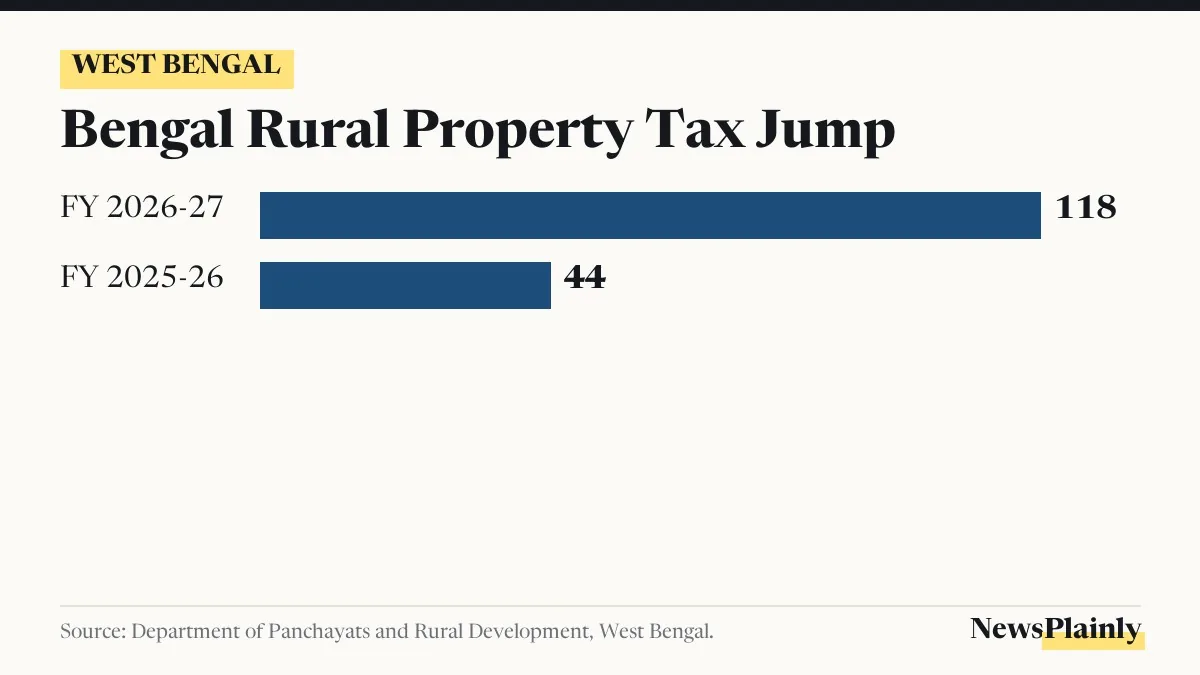
Bengal panchayat tax receipts across rural West Bengal jumped by 168 percent to nearly Rs 118 crore between 1 April and 27 October 2026, marking a major fiscal expansion for village local bodies. Official administrative review data released by the state secretariat, Nabanna, confirms that rural civic authorities collected Rs 117.85 crore during the first seven months of the ongoing financial year (FY), compared to Rs 44.05 crore collected during the corresponding period of the previous financial year. According to Indian Express state reporting, the revenue surge reflects a comprehensive transition toward online tax assessments and expanded door-to-door administrative drives across rural districts.
How Bengal panchayat tax collections reached Rs 118 crore
The state administrative review highlights that the Bengal panchayat tax mechanism underwent a fundamental modernization program over the past year. Previously, rural local bodies relied on manual paper ledgers, fragmented collection receipts, and periodic collection camps that left extensive rural residential and commercial holdings unassessed. The deployment of the centralized digital property tax portal allowed Gram Panchayats to map holdings digitally, verify built-up area measurements, and issue verifiable digital receipts directly to property owners.
This systematic overhaul expanded the active rural tax base substantially. Official records indicate that 28.94 lakh property owners paid rural property tax during the April to late October period, compared to 11.69 lakh taxpayers registered during the same period in 2025. By bringing more than 17 lakh additional property owners into the formal local revenue net, local bodies generated an absolute revenue expansion of Rs 73.80 crore without raising basic residential tax assessment rates. Additional context in NewsPlainly West Bengal coverage outlines how rural civic bodies use own-source revenue to finance local maintenance.
Under the statutory provisions of the West Bengal Panchayat Act, every Gram Panchayat is empowered to levy annual property taxes on lands and residential buildings situated within its jurisdiction. Tax rates are assessed based on the annual commercial value of the property or the total floor area of residential units. In fast-urbanizing peri-urban pockets surrounding Kolkata, Asansol, and Siliguri, small manufacturing workshops, warehousing sheds, and roadside commercial complexes previously operated under informal tax assessments. The standardized digital portal established uniform valuation formulas, eliminating discretion and encouraging voluntary compliance among rural entrepreneurs.
District administrative figures compiled by Nabanna revenue observers indicate that southern Bengal districts accounted for a major share of total collections. North 24 Parganas, South 24 Parganas, Howrah, and Hooghly registered particularly rapid portal adoption due to dense rural commercial corridors along state highways. In these growth belts, village local bodies mapped rural commercial complexes that had expanded over the last decade without updated rural property tax assessments. By bringing these establishments onto the Gram Panchayat tax portal, local bodies achieved steady revenue gains while ensuring equitable contributions between agricultural households and commercial ventures.
Comparing rural property tax and festive GST growth
The financial upswing in rural local bodies coincides with strong commercial revenue collections reported by the West Bengal Directorate of Commercial Taxes. State Goods and Services Tax (GST) receipts for the month of October 2026 reached Rs 6,055 crore, representing a 17 percent increase over the Rs 5,175 crore collected in October 2025. Finance officials attributed the monthly expansion to robust consumer spending, restaurant turnovers, hospitality bookings, and retail sales during the extended Durga Puja festive window across both urban centers and district market towns.
Business activity across wholesale clothing hubs in Burrabazar, retail market centers in Gariahat, and district marketplaces across Howrah, Hooghly, and Burdwan surged during the festive season. The increased commercial turnover generated substantial indirect tax inflows, providing state authorities with broader fiscal flexibility as overall economic growth expanded beyond the capital region into rural commerce.
| Revenue Indicator | 2025-26 Performance | 2026-27 Performance | Growth Rate |
|---|---|---|---|
| Bengal Panchayat Tax | Rs 44.05 crore | Rs 117.85 crore | Plus 168 percent |
| Active Rural Taxpayers | 11.69 lakh owners | 28.94 lakh owners | Plus 147 percent |
| October State GST | Rs 5,175 crore | Rs 6,055 crore | Plus 17 percent |
| Primary Collection Mode | Manual paper receipts | Online digital portal | System transition |
| Reporting Window | April to late October | April to late October | Seven-month cycle |
What rural property owners need to do now
For village residents, shopkeepers, and warehouse operators across West Bengal, the institutionalization of digital tax collection clarifies property assessment rules. Rural property tax applies to residential structures, commercial godowns, rural brick kilns, poultry farms, and small enterprise premises situated within Gram Panchayat borders across all 22 rural districts, including North 24 Parganas, South 24 Parganas, Hooghly, Nadia, Murshidabad, and Paschim Bardhaman.
Residents can verify their annual assessment and make payments through two primary channels. Property owners can visit their designated Gram Panchayat office, where village executive assistants access the state portal to generate computerized challans and immediate digital receipts. Alternatively, taxpayers can log into the West Bengal panchayat tax portal using their registered mobile number, search their property by district, block, gram panchayat, and plot number, and pay dues via UPI, net banking, or debit card. Holding a digital tax receipt provides formal municipal-level documentation required for utility connections and rural bank loan applications.
How panchayats will spend the increased collections
Under the West Bengal Panchayat Act, own-source revenue generated from local land and property taxes remains directly with the collecting Gram Panchayat, rather than transferring to the state consolidated fund. The mobilization of Rs 118 crore provides local bodies with untied capital to execute immediate civic improvements without awaiting seasonal central fund releases under the 15th Finance Commission or state budget grants.
Gram Panchayats have allocated the surplus funds toward priority village works, including concrete drainage paving, rural road patch repairs, solar street light installations, and drinking water tube-well repairs ahead of the dry winter season. Block development officers will continue monitoring district-level tax portals through December to ensure uniform coverage across remote mouzas, maintaining fiscal momentum into the fourth quarter of the financial year.
Frequently asked questions
How much property tax did Bengal panchayats collect this year?
West Bengal panchayat bodies collected nearly Rs 118 crore between 1 April and 27 October 2026, marking a 168 percent rise over the previous year.
Why did rural property tax collections rise so sharply?
The surge was driven by the rollout of the online rural property tax portal and doorstep administrative outreach, which increased active taxpayers from 11.69 lakh to 28.94 lakh.
How much GST did West Bengal generate in October?
West Bengal collected Rs 6,055 crore in Goods and Services Tax during October 2026, representing a 17 percent increase over the Rs 5,175 crore collected in October 2025.
How can rural residents pay their Bengal panchayat tax?
Residents can pay directly through the state panchayat department web portal or at their designated Gram Panchayat office to receive an immediate digital receipt.