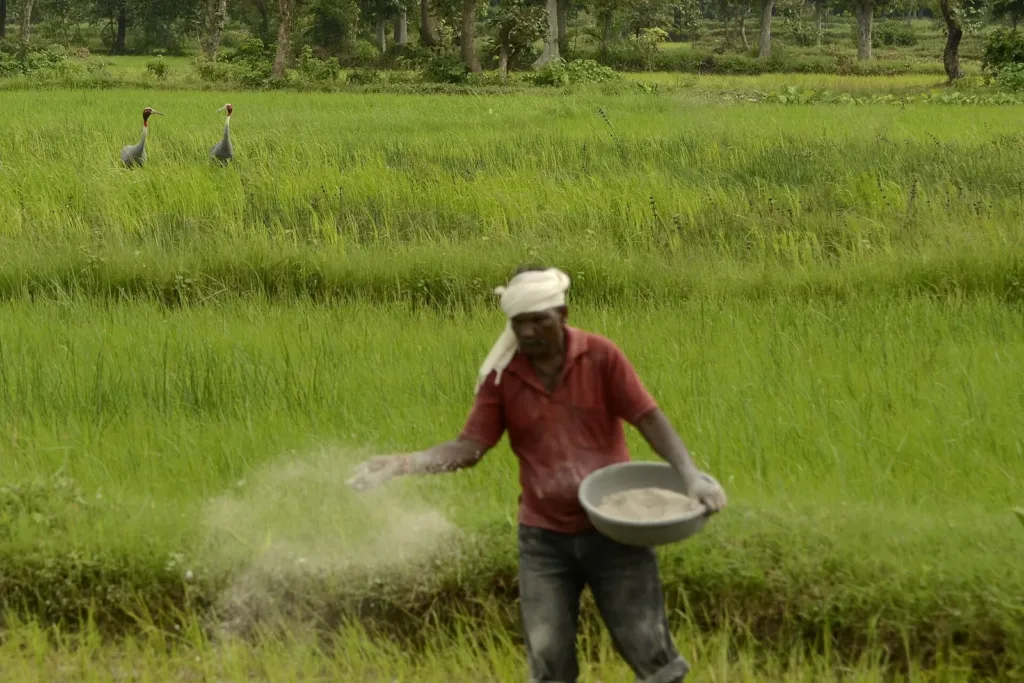
Representative image. PJeganathan, CC BY-SA 4.0, Wikimedia Commons

Why it matters
The fertiliser subsidy is one of the Centre's largest expenses, about ₹1.71 lakh crore this year, and it decides what more than 8 crore farmers pay for urea, DAP and potash. If its design changes, so would input costs on farms and the way soils are fed. For now these are a think tank's proposals, not policy.
India’s fertiliser subsidy should be paid to farmers as cash for each hectare they cultivate, adjusted for crop productivity, instead of keeping urea artificially cheap, the Indian Council for Research on International Economic Relations (ICRIER) has proposed. The Delhi think tank released two policy briefs on 23 October 2026 which find that 11 of India’s 20 major states now put more nitrogen on their fields than crops need, while every state applies far too little potash. The Economic Times and Business Standard reported the recommendations of the ICRIER report.
The briefs are proposals, not government policy. The Centre told Parliament in July that it was not considering direct cash transfer of the subsidy yet.
What the ICRIER report proposes for the fertiliser subsidy
The main brief, written by agricultural economists Ramesh Chand, Purvi Thangaraj, Ritika Juneja and Ashok Gulati, says the biggest fix is to end the special treatment of urea. Under the current system, urea’s retail price is fixed by the government, while other fertilisers such as DAP (diammonium phosphate) and MOP (muriate of potash) get a fixed subsidy per kilogram of nutrient under the nutrient-based subsidy (NBS) scheme and their prices move with the market.
Its preferred route is a direct cash transfer of the fertiliser subsidy: the subsidy would move from the fertiliser bag to the farmer, paid per hectare and revised from time to time for crop productivity. Since the cash would not depend on which product a farmer buys, each nutrient would sell at its market price and urea would lose its price edge. The brief says this needs a farmer database far bigger than what exists, combining satellite land-use data with village land records.
If that is judged too sudden, the brief lists two fallbacks. One is to cap how much subsidised fertiliser a farmer can buy, based on landholding, crops and soil tests. The other is to bring urea under the NBS scheme and cut DAP and MOP prices as urea’s price rises, so farmers are not left worse off overall. It also says support should be equal per kilogram of nitrogen (N), phosphorus (P) and potassium (K), and should not grow with how much fertiliser a crop customarily uses. Money saved, it says, should go to drip irrigation and fertigation, which feeds dissolved fertiliser to plants through the drip lines.
The second brief, by Juneja, Tanmoy Adhikary and Gulati, looks at the digital side. It says AgriStack, the government’s farmer database, should record who actually cultivates each plot, which crop and in which season, before any cash transfer. Close to 11 crore farmer IDs have been created, but only about 60% of land is linked to one and tenant farmers make up under 1% of the registry, the brief says.
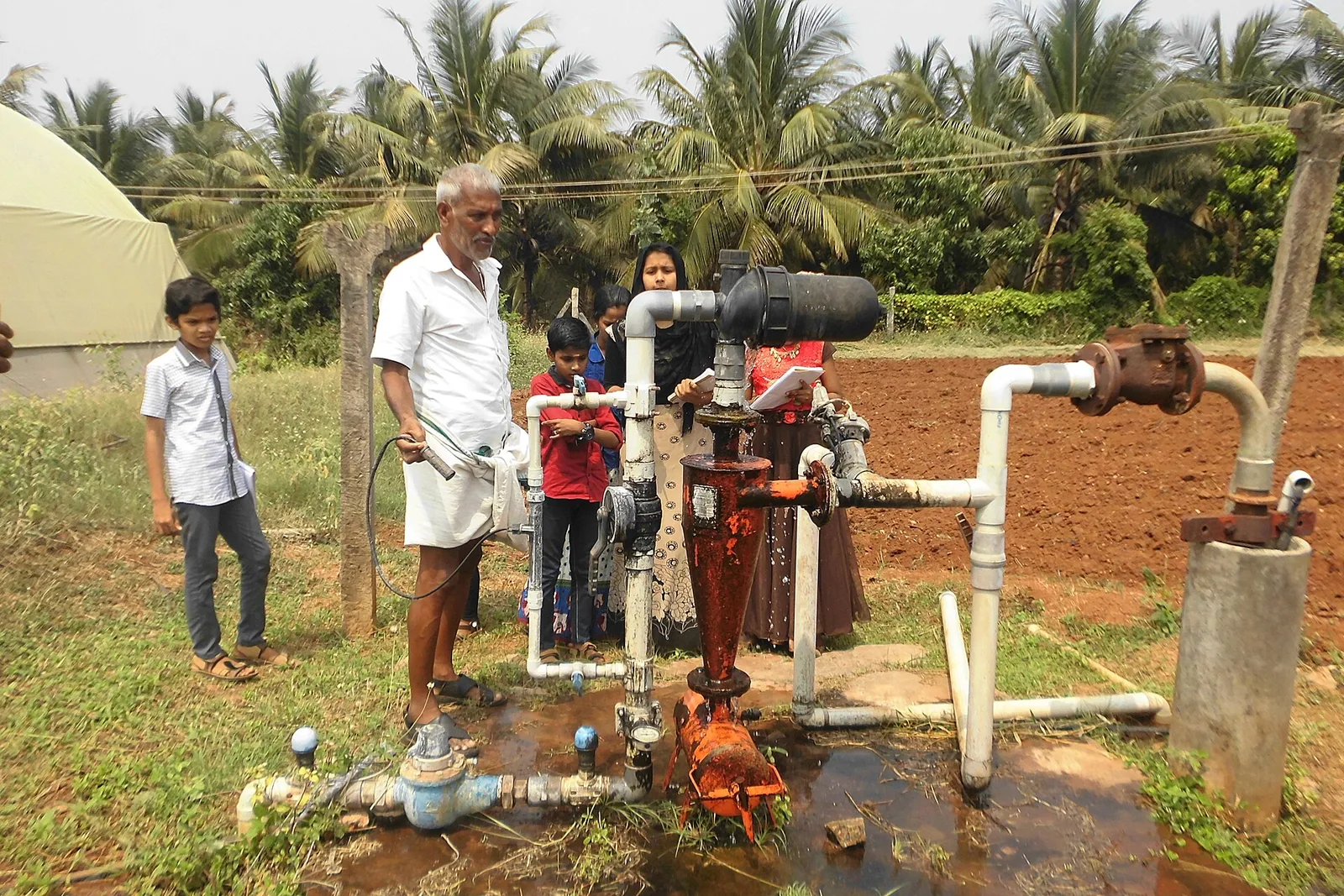
Nitrogen overuse: which states apply too much
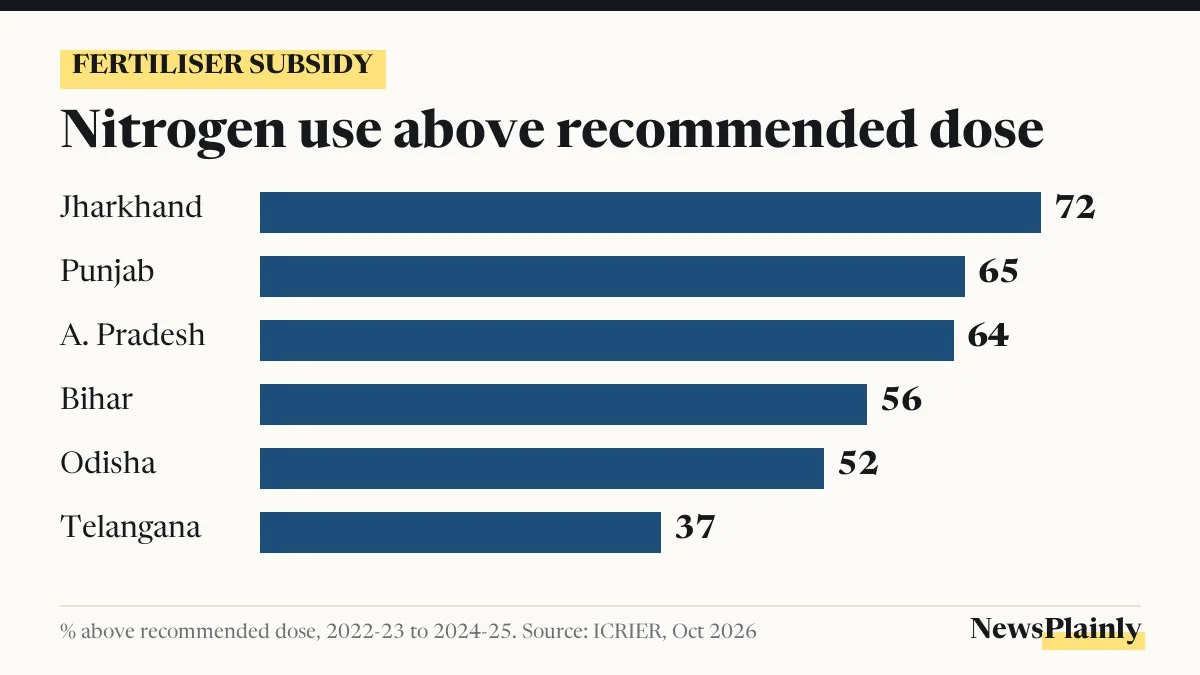
To measure nitrogen overuse, ICRIER compared what each state actually uses per hectare of cropped area with what the recommended doses for its crops add up to, averaged over the three years to 2024-25. Nationally, nitrogen use was 94.7 kg a hectare against a need of 89.2 kg, or 6.2% over. Phosphorus was 22.2% short and potassium 71.8% short.
| State | Nitrogen use vs recommended |
|---|---|
| Jharkhand | +72% |
| Punjab | +65% |
| Andhra Pradesh | +64% |
| Bihar | +56% |
| Odisha | +52% |
| Telangana | +37% |
| Haryana | +22% |
| Maharashtra | -23% |
| Kerala | -65% |
The other overusers are Assam (+35%), Uttarakhand (+28%), Chhattisgarh (+8%) and Uttar Pradesh (+6%). Together the 11 states cover 39% of India’s gross cropped area. In 2009-10 only five states overused nitrogen. The brief notes that the high figures for Jharkhand, Assam and Odisha partly reflect low recommended nitrogen doses for paddy there.
The result is a lopsided NPK ratio, the balance between nitrogen, phosphorus and potassium. India’s actual ratio of nitrogen to phosphorus to potassium is 10.5:4.1:1, against 2.8:1.5:1 that its crops need, the brief calculates. It also calls the old 4:2:1 benchmark, often quoted by officials, outdated and hard to trace.
Why urea is so cheap compared with other fertilisers
Price is the main reason for nitrogen overuse, the ICRIER report argues. Urea supplies about 80% of the nitrogen used in India. A 45 kg bag sells for ₹242, roughly 85 to 90% below its cost, the second brief says. The table shows how far the price of each nutrient moved between 2010-11, when NBS began, and 2024-25.
| Fertiliser | 2010-11 (₹/kg) | 2024-25 (₹/kg) | Change |
|---|---|---|---|
| Nitrogen in urea | 11.54 | 11.65 | +1% |
| DAP | 18.85 | 54.14 | +187% |
| MOP | 8.43 | 51.92 | +516% |
On NewsPlainly’s calculation from those figures, potash now costs more than six times what it did in 2010-11, while urea’s nitrogen costs about the same. Farmers responded as the prices suggest: potassium use per hectare nearly halved, from 16.5 kg to 9 kg, though crops still need about 32 kg, according to the brief.
The fertiliser subsidy also flows unevenly. Punjab got about ₹25,701 of nitrogen subsidy per hectare of net sown area and Haryana ₹21,071, against ₹2,540 in Kerala. In Punjab the subsidy equals 9.9% of the value of crop output, against 1.4 to 1.5% in Kerala and Himachal Pradesh.
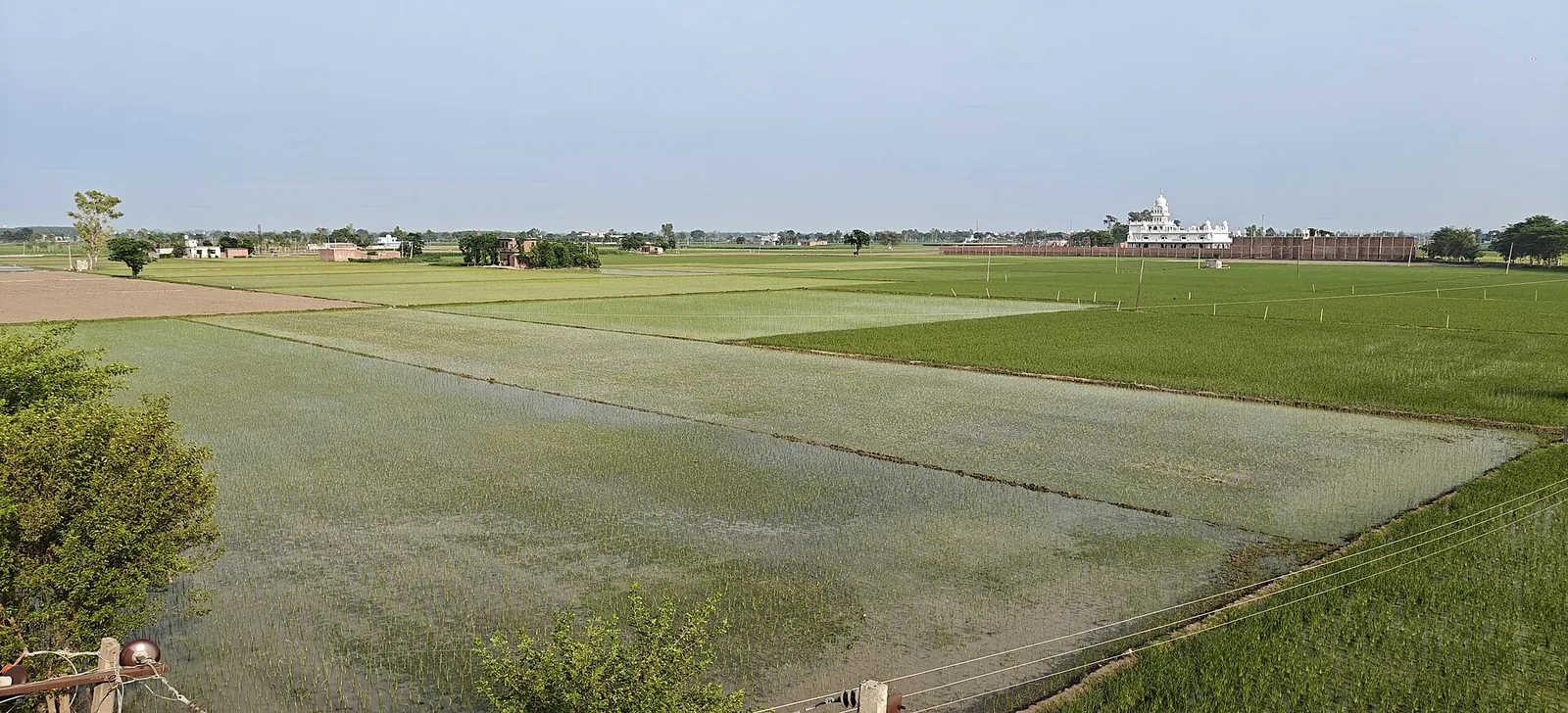
What the coverage skipped: a scheme that paid nothing
The brief’s box on PM-PRANAM, a 2023 scheme that rewards states for cutting chemical fertiliser use, has received little attention. Nine states qualified in its first year, 2023-24, with a combined cut of 14.59 lakh tonnes, led by Karnataka. Only three regions qualified in 2024-25 and five in 2025-26. No incentive has been paid to any state, the brief says, and a parliamentary committee called the scheme a non-starter. ICRIER says officials of the Department of Fertilisers told it on 25 September 2026 that no decision has been taken to continue it beyond 2026-27. It suggests any successor should reward farmers who cut overused products, mainly urea, rather than states.
What the money involved is and what the government has said
The Union government spent ₹1.86 lakh crore on fertiliser subsidy in 2025-26 (revised estimate) and has budgeted ₹1.71 lakh crore for 2026-27, the brief notes, citing budget documents. About two-thirds of this year’s allocation is for urea. ICRIER’s scenario estimates say disruption in the Strait of Hormuz since late February could push the 2026-27 bill to between ₹2.42 lakh crore and ₹3.32 lakh crore.
The government has not responded to the briefs. In a written reply in the Lok Sabha on 24 July 2026, Fertilisers Minister J.P. Nadda said a direct cash transfer was not envisaged because the database of identified farmers was not yet complete, the news agency ANI (Asian News International) reported. The Centre is instead testing a system that ties subsidised fertiliser sales to a farmer’s land and crop in pilot districts. Fertiliser output was already under pressure this year, as NewsPlainly reported when core sector data for September came out.
Subsidy rates for phosphatic and potassic fertilisers for the rabi, or winter, season of 2026-27 have not yet been announced. Last year the Union Cabinet approved them on 28 October.
Frequently asked questions
What has ICRIER proposed on the fertiliser subsidy?
That the subsidy be paid to farmers as direct cash per hectare, adjusted for crop productivity, so urea, DAP and potash sell at market prices. It is a proposal, not government policy.
Which states use too much nitrogen fertiliser?
Jharkhand, Punjab, Andhra Pradesh, Bihar, Odisha, Telangana, Assam, Uttarakhand, Haryana, Chhattisgarh and Uttar Pradesh, according to ICRIER.
Will the government pay fertiliser subsidy as cash?
Not yet. In July 2026 the fertilisers minister told the Lok Sabha that direct cash transfer was not envisaged because the farmer database was incomplete.