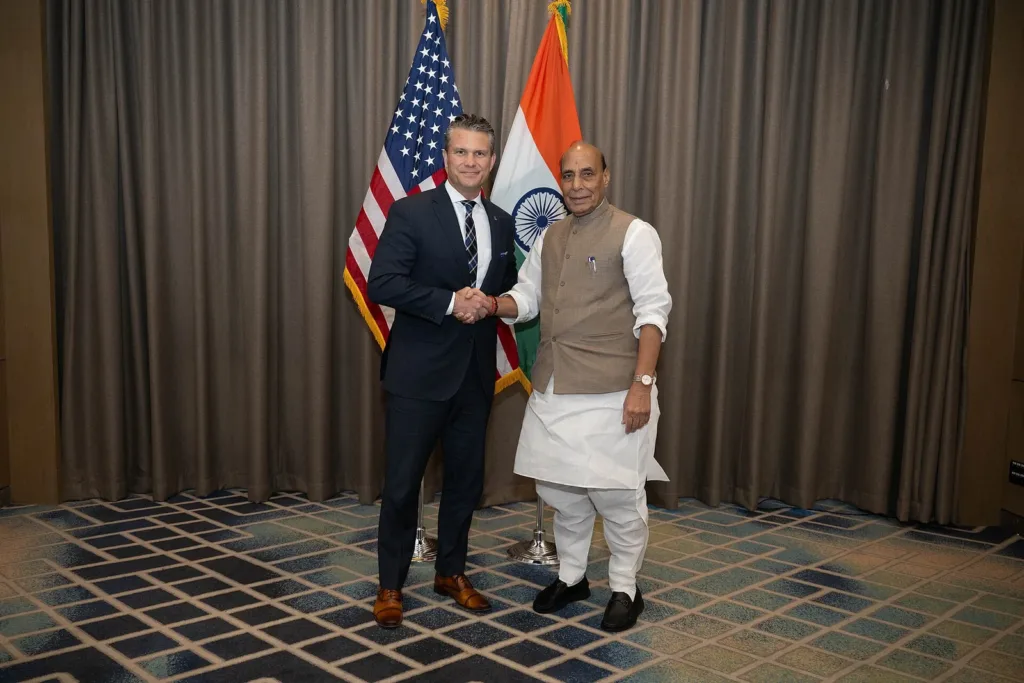
Representative image. Master Sgt. Brycen Guerrero, Public domain, Wikimedia Commons

Why it matters
The 2025 framework sets the direction for India-US defence cooperation for 10 years, but each purchase or joint production plan still needs its own agreement. The 28 October review shows both governments want to keep the defence track moving despite strains in wider ties. Whether talks such as Javelin co-production turn into contracts will decide how much of the work comes to India.
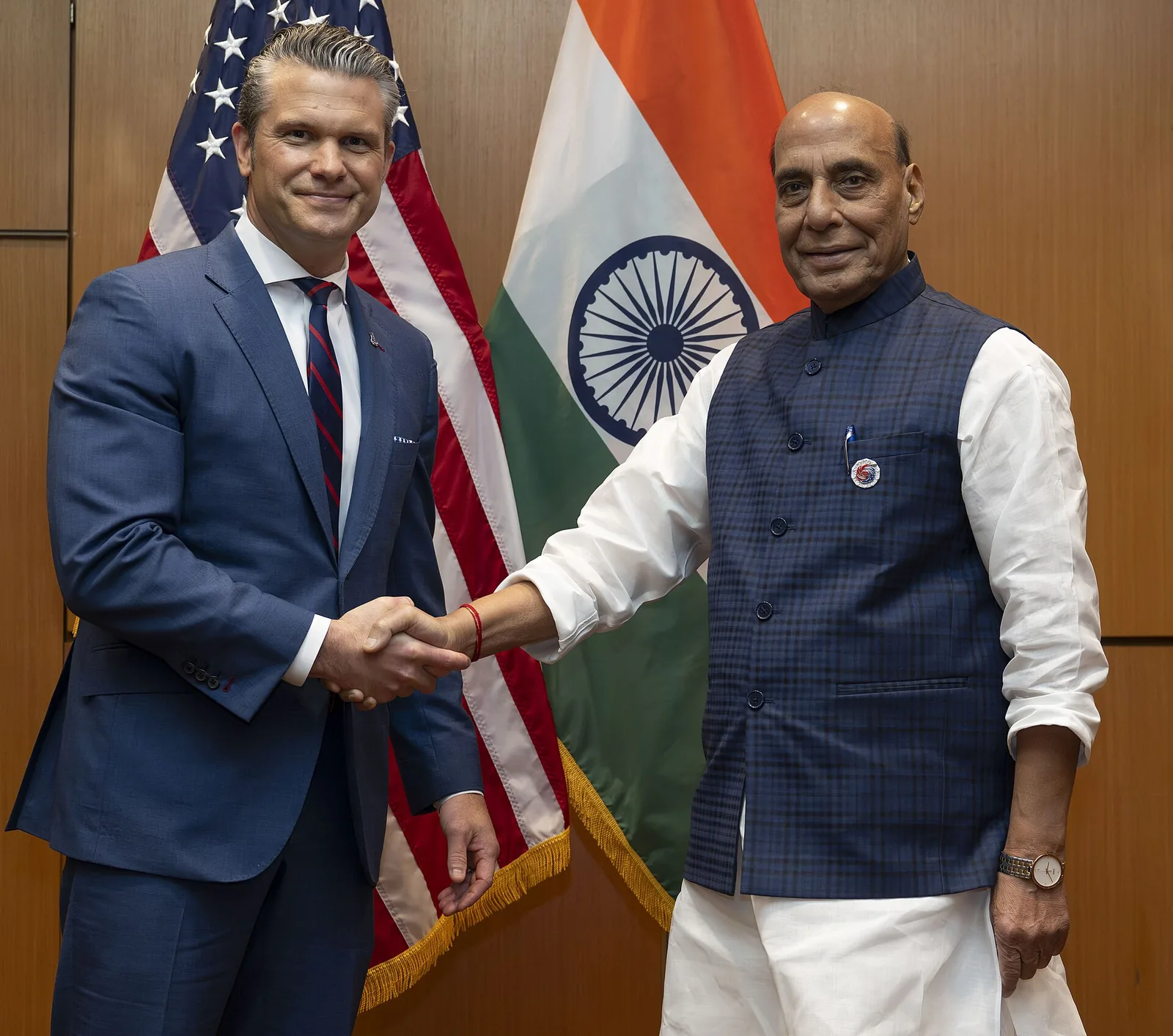
The India-US defence pact turns one year old on 31 October 2026. Three days before that, the two ministers who signed it sat down to check how it is going: Defence Minister Rajnath Singh and US Secretary of War Pete Hegseth met in Cebu, the Philippines, on 28 October and reviewed progress under the 10-year framework, the Ministry of Defence said in a release that day. A day later, on 29 October, Singh told the regional forum where they met that India was ready to share its counter-terrorism experience with partner countries.
Neither side announced a new agreement or a new weapons deal. What the Cebu talks produced was a list of areas both governments say they want to push next, and a public restatement on terrorism from the US side.
What Rajnath Singh and Pete Hegseth discussed on 28 October
The meeting took place on the sidelines of the 13th Defence Ministers’ Meeting-Plus of the Association of Southeast Asian Nations (ASEAN), known as ADMM-Plus, held in Cebu on 28 and 29 October. According to the ministry’s release, the two sides looked at how their earlier security agreements were working and talked about ways to speed up operational readiness, technology sharing and what the ministry called defence industrial integration, meaning closer links between the two countries’ arms makers. The talks also touched on exchanges between the two militaries, maritime security and defence supply chains.
Terrorism took a large part of the ministry’s account. Singh said the world must take a zero-tolerance approach towards countries that support, train or fund terrorist groups, the release said, and Hegseth reaffirmed US support for India against cross-border terrorism. These lines come from the Indian government’s release. Hegseth’s post on X, as the news agency Asian News International (ANI) reported it, did not mention terrorism.
In his own post on X, Singh called it “an excellent meeting” and said the partnership remained “a cornerstone for a free, open, and secure Indo-Pacific”. He listed military technology, information sharing and co-production as the areas where the framework was bringing the two sides closer. Hegseth called it a great meeting and said the two had marked the framework’s first anniversary, ANI reported.
What Singh told ADMM-Plus on 29 October
Addressing the forum on 29 October, Singh offered partner countries India’s counter-terrorism experience through intelligence sharing, joint exercises and training, The Tribune reported. He said that experience was “not theoretical classroom knowledge” and cited Operation Sindoor, which he said destroyed a large number of terrorist sites, as an example of India’s stand against terrorism and state-sponsored terrorism. He also backed ASEAN’s central role in the region and proposed an India-ASEAN Youth Bridge for exchanges and digital innovation, Open magazine reported with inputs from ANI. Neither report quoted him on the United States in the speech.
What the India-US defence pact actually is
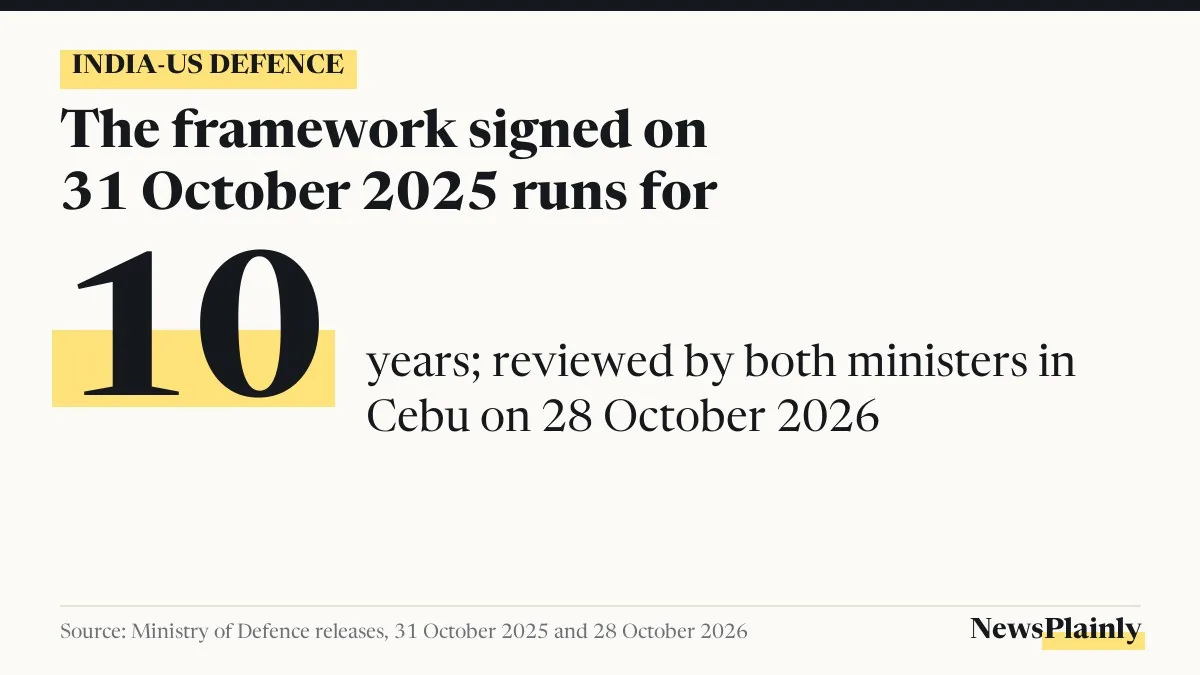
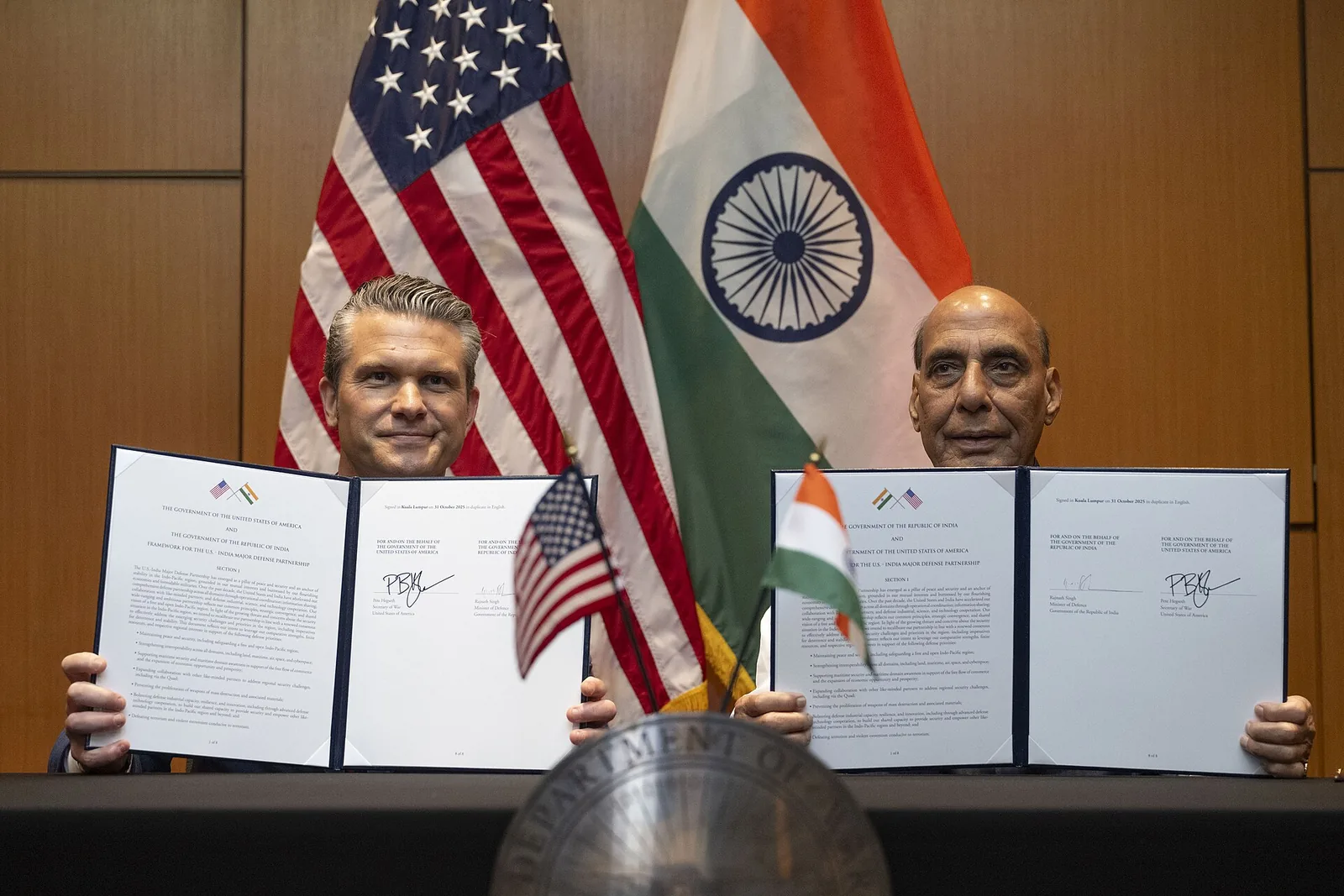
The document’s formal name is the Framework for the US-India Major Defence Partnership. Singh and Hegseth signed it in Kuala Lumpur on 31 October 2025, on the sidelines of the previous ADMM-Plus, according to a Ministry of Defence release issued that day. The ministry described it as giving a single vision and policy direction for defence cooperation over the next 10 years.
It is a framework, not a purchase contract. It sets out where both governments intend to work together. Individual deals, such as buying a missile system or making parts in India, still have to be negotiated and signed one by one. That is why a review matters: it is where ministers check whether the broad aims are turning into concrete projects.
The 2025 document replaced an older one. India and the US had renewed their “New Framework for India-US Defence Cooperation” for 10 years in 2015, ANI reported in February 2025, when Singh and Hegseth first spoke by phone. A Pentagon readout of that call said Hegseth expected to conclude the next 10-year framework during 2025, which happened in October that year.
Timeline: the India-US defence framework, 2015 to 2026
| Date | What happened |
|---|---|
| 2015 | India and the US renew the earlier defence framework for 10 years |
| 2016 | US designates India a Major Defence Partner; logistics agreement (LEMOA) signed |
| 2018 | Communications agreement (COMCASA) signed |
| October 2020 | Agreement on sharing maps and other data (BECA) signed |
| February 2025 | Singh and Hegseth agree by phone to work on a new 10-year framework |
| 31 October 2025 | Framework for the US-India Major Defence Partnership signed in Kuala Lumpur |
| 28 August 2026 | Indian Army signs a Javelin missile purchase agreement with the US |
| 28 October 2026 | Singh and Hegseth review the framework’s progress in Cebu |
| 31 October 2026 | The framework completes one year |
The three older agreements are the plumbing of the relationship. LEMOA (Logistics Exchange Memorandum of Agreement) lets each military use the other’s bases for repairs and supplies. COMCASA (Communications Compatibility and Security Agreement) allows secure communication between the two forces and the sale of high-end US equipment. BECA (Basic Exchange and Cooperation Agreement) covers sharing of maps and other sensitive data, according to the Press Trust of India (PTI) report of 28 October.
What is agreed and what is still under discussion
The clearest way to read the Cebu meeting is to separate what has been signed from what both sides only say they want.
| Item | Status | Source |
|---|---|---|
| 10-year framework | Signed, 31 October 2025 | Ministry of Defence |
| LEMOA, COMCASA, BECA | Signed in 2016, 2018 and 2020 | PTI |
| Javelin anti-tank missiles | Purchase agreement signed by the Indian Army; co-production only under discussion | US Embassy, 28 August 2026 |
| Defence industry links, supply chains, maritime security | Discussed on 28 October 2026; no new agreement announced | Ministry of Defence |
The Javelin row shows the gap well. In August 2026, the US Embassy in India welcomed the Indian Army’s signing of a Letter of Offer and Acceptance to buy the shoulder-fired Javelin anti-tank missile through the US government’s Foreign Military Sales route. The same statement said the deal “opens discussions” on producing it jointly. So the purchase is agreed, while making it in India is not.
The ministry’s 28 October release did not name specific weapons programmes or give target dates. It spoke of exploring “fresh pathways”, which describes intent rather than a decision.
Why the defence framework review matters for India-US ties
PTI noted that defence ties have kept growing even as diplomatic relations with the Trump administration have been under strain; its report did not set out the details of that strain. A ministerial review that ends with both sides restating their commitment is one sign the defence track is being kept running on its own.
For India, the practical questions are about equipment and manufacturing: whether co-production plans move from talks to contracts, and whether Indian companies get a larger share of the work. None of that was settled in Cebu. At home, the Defence Acquisition Council cleared ₹2.12 lakh crore of defence purchases on 26 October, 82% of it from Indian industry.
Singh also met Australian Deputy Prime Minister Richard Marles in Cebu, PTI reported. The Philippines chairs the ADMM-Plus in 2026; the forum brings together the ASEAN member countries and eight dialogue partners, including India and the US, according to ANI.
Frequently asked questions
What is the India-US defence pact?
The Framework for the US-India Major Defence Partnership, signed by Rajnath Singh and Pete Hegseth in Kuala Lumpur on 31 October 2025. It sets policy direction for defence cooperation over 10 years; it is not a purchase contract.
What did Rajnath Singh and Pete Hegseth discuss on 28 October 2026?
They reviewed progress under the framework and discussed operational readiness, technology sharing, defence industry links, maritime security and supply chains, the Ministry of Defence said. No new agreement was announced.
What did Rajnath Singh say at ADMM-Plus on 29 October 2026?
He offered partner countries India's counter-terrorism experience through intelligence sharing, joint exercises and training, cited Operation Sindoor, and proposed an India-ASEAN Youth Bridge, The Tribune and Open magazine reported.