
Representative image. Markus Spiske markusspiske, CC0, Wikimedia Commons

Why it matters
Developers pay separately for what a model reads and writes. The optional speed setting changes that comparison, while research access depends on verification.
Claude Fable 5.2 has been released with lower usage prices and an optional faster service that costs twice the standard rate, Anthropic announced on 9 November 2026. The company also introduced Claude Mythos 5.2, which uses the same underlying artificial intelligence model but has different safeguards and access conditions.
For developers and organisations in India, the practical distinction is between the version they can use, the speed they choose and the amount of text processed. A faster response does not come at the standard price, and Mythos access is subject to verification.
Claude Fable 5.2 prices separate input from output
In its launch announcement, Anthropic lists standard prices of $8 for each million input tokens and $40 for each million output tokens. Tokens are the units of text a model processes or generates. The two rates apply to different parts of a request.
The optional fast mode costs $16 per million input tokens and $80 per million output tokens. Anthropic says it can increase token-generation speed by up to 2.5 times. That is the company’s stated upper limit, rather than a promise that every complete task finishes 2.5 times sooner.
| Service | Input, per million tokens | Output, per million tokens |
|---|---|---|
| Standard | $8 | $40 |
| Fast mode | $16 | $80 |
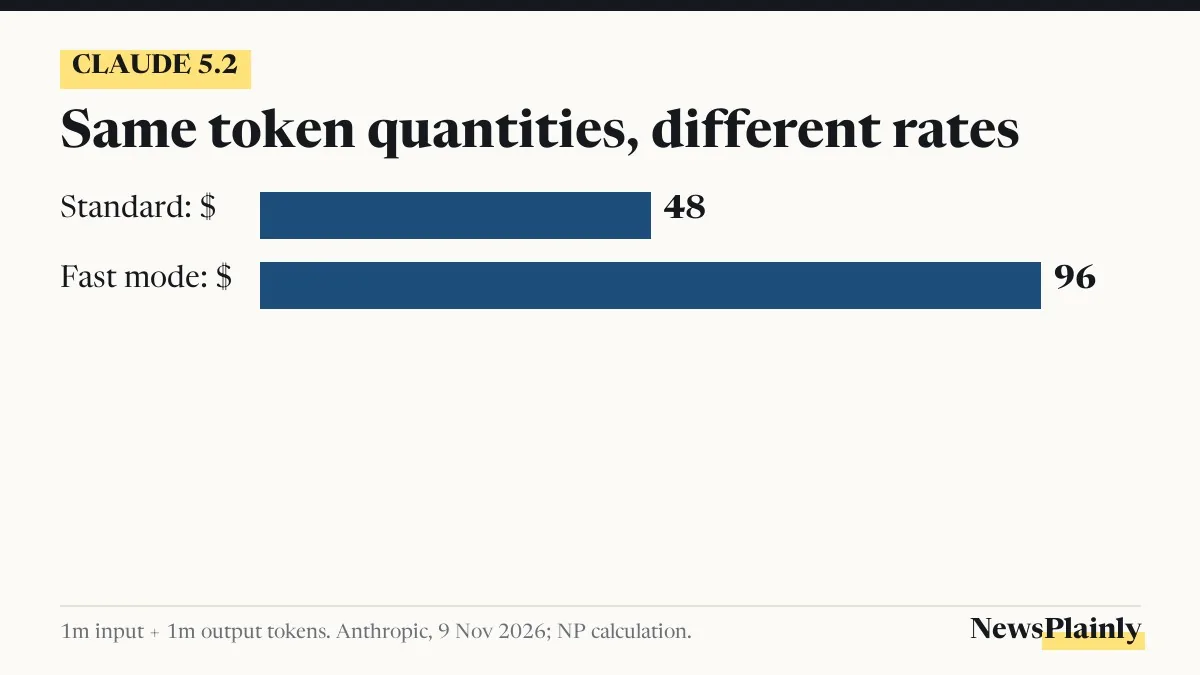
A simple comparison makes the difference clearer. For a hypothetical workload of one million input tokens and one million output tokens, NewsPlainly calculates a standard usage charge of $48: $8 plus $40. At the listed fast-mode rates, the same token quantities total $96: $16 plus $80. This compares the published token rates only, rather than estimating a user’s final bill.
Why Mythos has a different access route
Anthropic says Claude Fable and Claude Mythos are versions of the same underlying model. Fable includes safeguards that block high-risk cybersecurity and biology work. Organisations pursuing research in those areas can apply for Mythos through the company’s Cyber Verification Program or Life Sciences Verification Program.
That means the launch is not an unrestricted release of both versions to every user. The company says cybersecurity professionals can apply for Mythos access, while enterprise customers can also use its Claude Security product, powered by the wider model family.
According to the announcement, Fable’s classifiers can redirect blocked cybersecurity requests to Opus 4.8 and biology requests to Opus 5. Those are alternative models. The company reports fewer unnecessary blocks than with Fable 5.1, but the safeguards still affect which work the new version accepts.

Company tests are different from guaranteed results
Anthropic reports improvements in coding, reasoning, vision and scientific work. Its examples include software migrations, electronic-device design and mathematical formalisation, which translates a proof into steps that a computer can check.
These are claims from the developer’s launch material. They describe particular tests, tools and working conditions. They do not establish that an organisation will obtain the same result on its own documents, software or research problem.
The announcement itself notes limits in evaluating advanced models. It says no single test fully establishes how a model will behave after deployment and describes a mixture of internal evaluations, external testing and monitoring. Its assessment that high-stakes misalignment risk remains low is the company’s assessment.
Where the models are available
Anthropic says Claude Fable 5.2 is available across its platforms, including Amazon Web Services, Google Cloud and Microsoft Azure. Developers can select the identifier claude-fable-5-2 on the Claude Platform.
Fast mode is offered through Claude Code, the Claude Platform, supported Google Cloud services and Microsoft Foundry. Access to Mythos fast mode remains limited to organisations in the verification programmes, the company says.
A launch promotion also gives eligible paid subscribers extra Fable usage. The number of resets depends on how long they have subscribed, and the announcement distinguishes plan and seat types. It should therefore not be read as an identical allowance for every account.
The next practical step for an existing user is to check the model and allowance shown for their own plan. Readers can follow related developments in NewsPlainly’s technology coverage. The release changes the available tools and published rates; actual cost still depends on the input and output used.
Frequently asked questions
Is fast mode included at the standard price?
No. Its listed input and output rates are twice the standard rates.
Can everyone use Claude Mythos 5.2?
Anthropic limits it to verified organisations working in the relevant specialist areas.