Representative image. Ramesh NG, CC BY-SA 2.0, Wikimedia Commons

Why it matters
Foreign tourists, business specialists, students, and patients face significantly shorter application forms and clearer entry categories. Companies also gain predictable entry routes for foreign technical personnel.
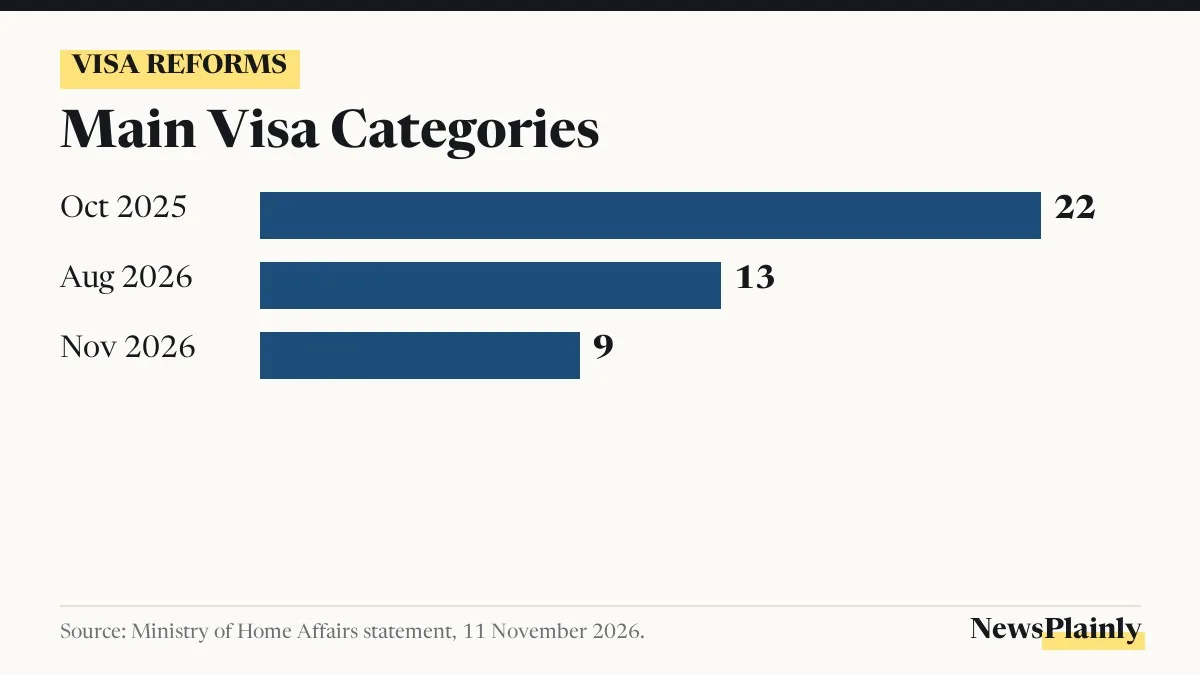
The Central Government has simplified India visa rules by consolidating its entry categories from 13 to 9 and trimming application form fields by up to 70%, the Ministry of Home Affairs (MHA) announced on Wednesday, 11 November 2026. The comprehensive overhaul replaces the conventional Tourist Visa with a broader Visitor Visa and introduces targeted permits for industrial technical specialists.
Under the revised framework, the government reduced the number of main visa categories from 13 to 9 and pruned secondary sub-categories from 49 down to 23. The Ministry of Home Affairs stated that the changes aim to make immigration procedures more compact, coherent, and responsive to the practical needs of international travellers, students, and businesses visiting India.
How India visa rules streamline entry categories
The latest reform represents the second major simplification of the Indian entry system in recent years. In October 2025, the Centre had lowered main visa heads from 22 to 13 and trimmed sub-categories from 63 to 49. The current round further cleans up overlapping definitions, drawing on a comparative review of visa systems in developed economies.
Most notably, the familiar Tourist Visa is now designated as the Visitor Visa, divided into two distinct groups. The V-1 sub-category provides a 30-day multiple-entry permit designed for short visits. Travellers can use it for tourism, business meetings, medical consultations, wellness retreats, or short training courses in Indian languages, music, and crafts. The V-2 sub-category provides longer validity of 1 year, 5 years, or 10 years for repeat visitors, and also accommodates six-month mountaineering expeditions.
By bringing a wide range of short visits under a single category, the new system simplifies selection for travellers who frequently combine personal leisure with professional meetings, wellness treatments, or cultural learning programmes during their stays in India.
| Metric | October 2025 | August 2026 | November 2026 Rules |
|---|---|---|---|
| Main Categories | 22 | 13 | 9 |
| Sub-categories | 63 | 49 | 23 |
| Form Fields | Standard bulky layout | Intermediate review | Cut by 65% to 70% |
| Tourist Category | Tourist Visa | Tourist Visa | Visitor Visa (V-1 & V-2) |
| Technical Work | General Business | e-B4 nomenclature | Production Investment Business |
New framework for business, students and medical care
The revised regulations create specific classifications for commercial and academic travel. The business visa category is now split into B-1 and B-2. The B-1 permit covers long-term, licence-based commercial activities, including establishing manufacturing plants or corporate entities. The B-2 permit handles short-term, contract-based assignments, conferences, sports events, and film productions.
Within the B-2 structure, the ministry established the Production Investment Business Visa. This dedicated provision allows Indian enterprises to bring in foreign engineers, technical specialists, and senior managers for machinery installation, plant commissioning, quality inspections, and technology transfers without navigating prolonged work permit hurdles.
Student visa India options have also been consolidated into two branches. The S-1 visa covers primary, secondary, undergraduate, and postgraduate degree studies. International students admitted through the government Study in India portal can obtain an e-S1 visa valid for up to 5 years or their full course duration. The S-2 category accommodates doctoral scholars, visiting university faculty, academic interns, and research expeditions.
Healthcare travel retains separate pathways for conventional medical care and traditional wellness under the AYUSH framework (Ayurveda, Yoga and Naturopathy, Unani, Siddha, and Homoeopathy). The M-1 visa applies to allopathic treatment, while M-3 covers AYUSH institutions. Both categories come with a default one-year validity and multiple entries, supported by M-2 and M-4 visas for accompanying medical attendants.
What travellers must know before applying
Applicants will notice the biggest change in the digital application form itself. Officials reviewed every question on the existing portal and eliminated repetitive background queries, slashing the required data fields by 65% to 70% across all 23 sub-categories. The ministry expects this reduction to accelerate online processing and reduce submission errors for applicants worldwide.
The Ministry of Home Affairs is currently upgrading the underlying software architecture across immigration servers and diplomatic missions via the official visa portal. The new rationalised system will be completely operational before the end of December 2026, when all overseas consulates and the central electronic visa portal will issue permits exclusively under the 9 revised categories.
Currently, the electronic visa facility operates across 172 countries and territories, processing Electronic Travel Authorisations through dedicated digital windows. Under the reformed MHA visa framework, travellers applying for an electronic Visitor Visa or an e-business visa will experience faster approval turnarounds because automated security filters will no longer have to parse redundant historical disclosures.
To support growing international arrivals, the central government has also notified 11 entry points equipped with modern electronic clearance gates. These checkpoints include airports in Bhopal and Tirupati, alongside land ports at Agartala, Darranga, Gede, Ghojadanga, Haridaspur, Jaigaon, Dawki, Moreh, and the Attari road border. Travellers crossing through these border routes will benefit from identical streamlined scrutiny rules.
Foreign applicants facing urgent travel needs can track their submissions through automated SMS and email notifications integrated into the refreshed digital dashboard. The Ministry of Home Affairs noted that biometric verification standards remain intact, preserving national security protocols while eliminating bureaucratic bottlenecks that previously complicated entry into India.
These procedural enhancements complement ongoing domestic connectivity projects, such as the Noida Metro Aqua Line expansion approved today, reflecting broader infrastructure investments aimed at facilitating smooth domestic and international travel across India.
Travel industry bodies and corporate chambers have welcomed the reduction in paperwork. Business groups noted that eliminating dozens of repetitive questions regarding past itineraries and redundant personal declarations will substantially lower processing delays for international delegates attending conferences and trade fairs in Indian metropolitan centres.
Immigration authorities confirmed that existing valid visas will remain fully functional until their stated expiry dates. Foreign nationals already residing in India under student, employment, or medical permits do not need to convert their documents immediately, as the new India visa rules apply to fresh applications and extensions submitted after the portal cutover in December.
Frequently asked questions
What happened to the Indian Tourist Visa?
It has been renamed the Visitor Visa. The category is now split into V-1 for visits up to 30 days and V-2 for longer stays of 1, 5, or 10 years.
How much smaller are the new visa application forms?
The Ministry of Home Affairs eliminated redundant questions, reducing required form fields by 65% to 70% across all categories.
When do the new visa rules take effect?
The ministry is updating its digital systems and expects the new forms and categories to be fully operational by the end of 2026.