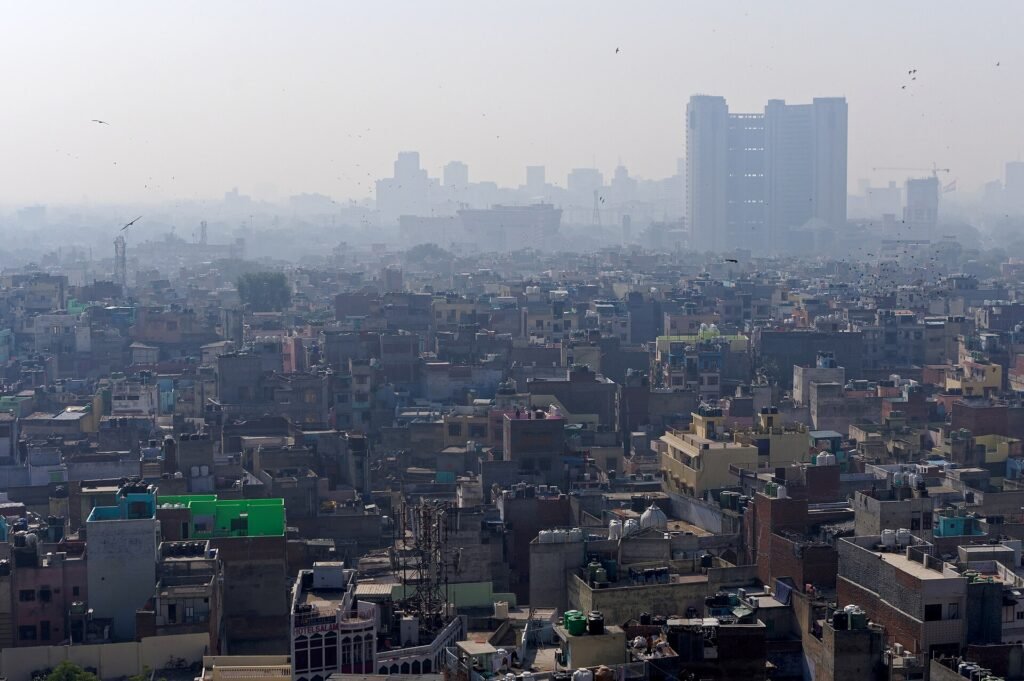
Representative image. Jakub Hałun, CC BY-SA 4.0, Wikimedia Commons

Why it matters
Anyone who drives, runs an eatery or builds in Delhi-NCR now has new rules to follow, and more arrive on 1 November. A car without a valid PUC certificate will not get fuel, parking will cost twice as much, and many office workers will work from home. If the AQI keeps rising, stricter GRAP stages will add further curbs.
GRAP 1, the first stage of Delhi-NCR’s emergency plan against air pollution, came into force on 21 October 2026 after the capital’s air turned “poor”. The Commission for Air Quality Management (CAQM) invoked it with immediate effect once Delhi’s Air Quality Index (AQI) reached 244 at 2 pm, up from 179 a day earlier.
That is a jump of 65 points, or about 36%, in roughly 24 hours. Forecasts from the India Meteorological Department and the Indian Institute of Tropical Meteorology suggest the air will stay in the poor range for the next few days, PTI reported.
What GRAP 1 bans and restricts in Delhi-NCR
The Graded Response Action Plan works in four steps that get stricter as the AQI climbs. GRAP 1 applies when the index is between 201 and 300. Most of its measures target pollution at the source:
- Hotels, restaurants and open eateries can no longer use coal or firewood in tandoors. They must cook on electricity, gas or other clean fuels.
- Diesel generator sets may run only for emergency or essential needs.
- Open burning of garbage, leaves and other waste is banned.
- Construction and demolition sites must control dust by covering material, spraying water and using anti-smog guns where needed. Projects on plots of 500 square metres or more that are not registered on the monitoring portal cannot carry on.
- Trucks not bound for Delhi are to be sent around the city on the Eastern and Western Peripheral Expressways.
Under GRAP 1, police and transport officials have been told to check Pollution Under Control (PUC) certificates strictly and to fine or impound vehicles that give off visible smoke, according to the CAQM order as reported by Mint. The existing ban on diesel vehicles older than 10 years and petrol vehicles older than 15 years stays. Inter-city and interstate buses running in the region must be electric, CNG or BS-VI diesel.
What GRAP 1 does not change
GRAP 1 is not a blanket ban. It does not stop vehicles, construction or everyday movement across the board, The Times of India noted, as long as the rules above are followed. Its core orders are about tandoors, generators, waste burning and dust.
Residents can report burning, dust or smoking vehicles on the Green Delhi app, the SAMEER app or the 311 helpline. Agencies have been told to step up action if the AQI keeps rising. Stage 2 begins at 301, Stage 3 at 401 and Stage 4, the strictest, above 450.
Delhi’s winter plan from 1 November
Separate from GRAP 1, the Delhi government has announced a winter action plan that runs from 1 November 2026 to 28 February 2027. Chief Minister Rekha Gupta presented it on 20 October. Its main rules, as listed by The Times of India and PTI:
- No PUC, no fuel: from 1 November, petrol pumps will refuse fuel to vehicles without a valid PUC certificate.
- Outside vehicles: vehicles registered outside Delhi that do not meet BS-VI standards cannot enter from 1 November to 31 January. CNG and electric vehicles are exempt.
- Parking: charges at authorised parking sites will double from 1 November. Metro parking is exempt.
- Offices: government and private offices are to cut in-office staff by 50% through work from home. MCD offices will work from 8.30 am to 5 pm and Delhi government offices from 10 am to 6.30 pm.
- Construction: dust-raising demolition and outdoor work will face limits from 1 November, with a complete ban from 10 December to 20 January.
The higher parking fee is meant to get more people onto public transport, The Times of India reported.
Where Delhi’s pollution comes from
Environment Minister Manjinder Singh Sirsa said about 30% of the city’s pollution is generated inside Delhi, while 60 to 65% comes from or is shaped by surrounding areas, citing a government assessment. He said nearly 30 agencies are working under an 11-point plan, with the number of air monitoring stations set to rise from 47 to 60 and 334 enforcement teams on the ground.
Hindustan Times reported that polluting industries and thermal power plants within 300 km of Delhi also face enforcement under the plan. Coal plants are already under strain this month, as our report on power plants running low on coal explains. The full schedule of GRAP stages is on the CAQM website.
Frequently asked questions
When does GRAP 1 apply?
GRAP Stage 1 applies when Delhi's AQI is between 201 and 300, the poor range. CAQM invoked it on 21 October 2026 when the AQI reached 244.
Is construction banned under GRAP 1?
No. Construction can continue with dust control. Projects on plots of 500 square metres or more that are not registered on the monitoring portal cannot proceed.
When does the no PUC, no fuel rule start?
From 1 November 2026, under the Delhi government's winter action plan.
Will parking charges double at Metro stations?
No. Charges double at authorised parking sites from 1 November, but Metro parking is exempt.